SEO audit cost ranges from under $200 for an automated tool export to $5,000 or more for a comprehensive agency engagement.
That gap is not arbitrary. It reflects real differences in scope, the depth of human analysis involved, and what you actually receive at the end.
This article breaks down the pricing tiers, the variables that move a quote up or down, and how to tell whether a specific price represents real work or a templated report with your domain name swapped in.
Why SEO Audit Pricing Varies So Widely
An SEO audit is not a single, standardized product. It is a range of possible deliverables, from a five-minute automated crawl to a multi-day manual review involving competitive research and a written strategy document.
Because the term covers such different scopes of work, providers price it differently depending on how much human time and expertise actually goes into the analysis. A quote that sounds cheap relative to another might simply be quoting a narrower service.
The first step in evaluating any audit price is understanding which of three general tiers you are actually being quoted for.
The Three Common SEO Audit Tiers (and What Each Actually Covers)
Most SEO audits on the market fall into one of three pricing bands. These are market ranges based on industry observation, not fixed prices any specific provider will quote, and they price the audit itself, separately from any ongoing monthly work like Search Engine Hub SEO packages and pricing, which run independently of the one-time audit covered here.
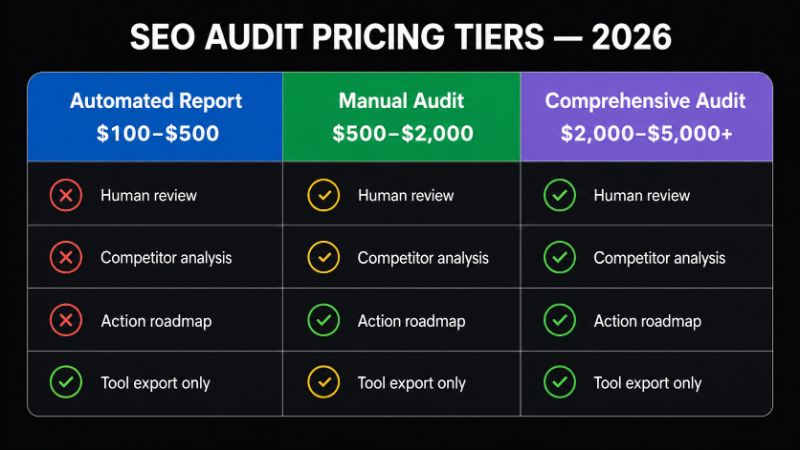
Entry-level automated reports: $100 to $500
This tier is generated primarily by a tool like Semrush or Ahrefs, with minimal human interpretation layered on top. The output is usually a list of flagged issues, an overall health score, and little context on which findings actually matter for your specific site.
These reports can be useful as a first look, but they are not a substitute for human judgment about which issues are worth fixing.
Mid-tier manual audits: $500 to $2,000
At this level, a freelancer or small agency manually reviews the technical, on-page, and backlink factors a crawl tool surfaces, rather than handing you the raw export. The price reflects the auditor's time spent interpreting findings against your specific site and market.
This is where most small and medium businesses find the right balance between cost and the depth of analysis they actually need.
Comprehensive agency audits: $2,000 to $5,000 or more
Established agencies pricing in this range typically include full competitive gap analysis, multi-person review across technical, content, and link specialties, and a detailed remediation roadmap. Pricing within this band depends heavily on site size, complexity, and how many deliverables are bundled in.
What Factors Drive the Cost of an SEO Audit Up or Down
Beyond the tier, several concrete variables determine where a specific quote lands within its range.
Site size and structure
A 20-page brochure site requires a fundamentally different scope of work than a 500-page e-commerce catalog or a multi-location service business with dozens of location pages. Crawl volume increases the time needed to review findings accurately.
The number of indexed pages and the number of backlinks an auditor needs to evaluate both scale the hours involved, and hours are what you are ultimately paying for at the mid and comprehensive tiers.
Technical complexity
Sites built on custom platforms, sites with JavaScript-heavy rendering, or sites that have been through multiple redesigns or migrations take longer to audit accurately than a straightforward CMS-built site with a clean history.
Competitive landscape
An audit that includes a genuine competitive gap analysis, comparing your site against the pages currently outranking you, takes meaningfully longer than one that only looks inward at your own site. The more competitors a thorough analysis needs to cover, the more time that section requires.
What You Should Receive at Each Price Point
Regardless of which tier you choose, certain deliverables separate a paid audit worth its price from one that is not.
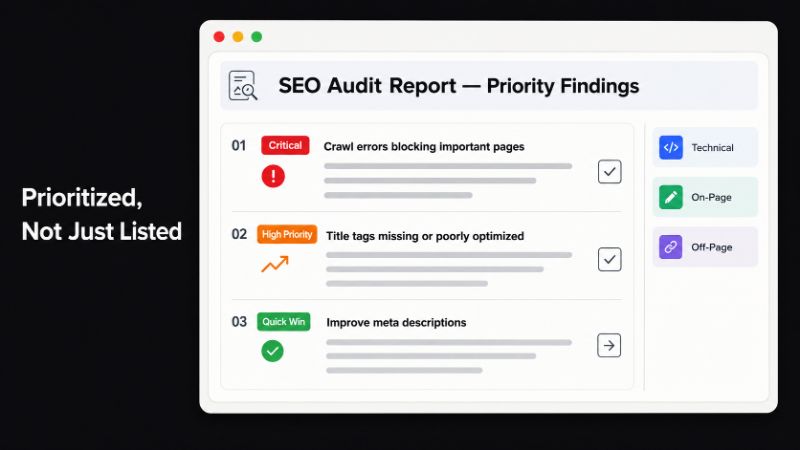
- A structured report with prioritized recommendations, not a raw tool export with no interpretation attached.
- A clear distinction between quick wins and structural problems, so your team knows what to fix first.
- A competitive gap analysis showing how your site compares to the pages currently ranking for your target queries.
- An actionable remediation roadmap your own team or your SEO provider can execute against directly.
If a quote does not include at least the first two items on this list, it is priced for a narrower service than most buyers expect when they hear the word "audit."
Automated Reports vs. Manual Audits: What the Price Difference Buys You
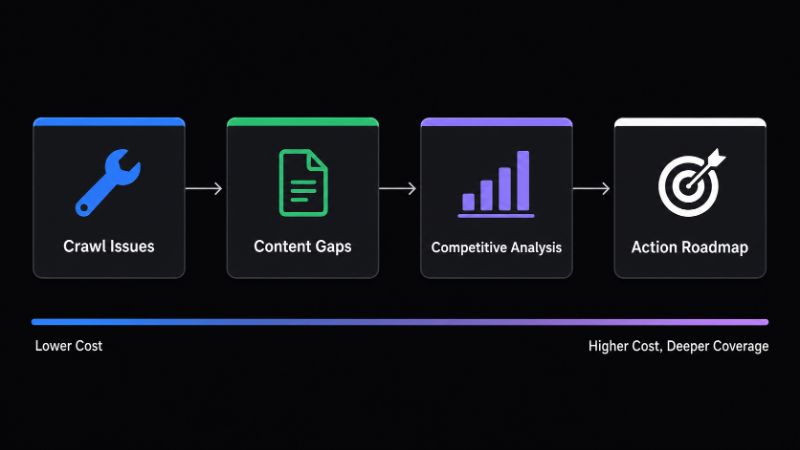
A crawl-based technical scan identifies issues like broken links, missing meta tags, duplicate content, and slow-loading pages. This is valuable, but as independent guides to audit tooling consistently point out, a tool can flag what is technically wrong without telling you which findings actually matter for your site. That judgment call is the piece a crawl alone does not cover.
A full SEO audit also evaluates content relevance against actual search intent, keyword alignment across your page set, competitive positioning relative to ranking pages, and internal linking structure. None of that comes from a crawl tool alone.
Core Web Vitals performance is a good example of where the gap shows up. A crawl tool can flag a poor Largest Contentful Paint or Cumulative Layout Shift score, but interpreting whether that score is hurting your specific pages against real Chrome user experience data rather than a lab simulation requires a person reviewing the field data, not just the automated flag.
The price difference between an automated report and a manual audit is, in practice, the price of that interpretation.
Red Flags in Low-Cost SEO Audit Offers
Three patterns show up consistently in low-cost offers that end up delivering little usable value.
- A flat fee under $200 quoted for any site regardless of size, with no questions asked about page count or complexity.
- A report delivered within 24 hours of the initial briefing, with no discovery call to understand your business or goals.
- Deliverables consisting entirely of tool-generated screenshots, with no written interpretation or strategic recommendation attached.
None of these patterns are automatically disqualifying on their own, but together they describe a service built to be sold at volume rather than tailored to your site.
How to Evaluate Whether an Audit Quote Represents Real Value
Before accepting a quote, ask the provider to walk through what specifically happens between the discovery call and the final deliverable. A provider who can describe their process step by step, including how they verify findings rather than just listing what a tool flagged, is generally pricing for real work.
Ask whether the quote includes a discovery call to understand your business and current performance, whether the report will name specific competitors and compare your site against them, and whether you will receive a prioritized action list rather than an unordered issue dump.
It is also worth asking directly whether the audit is a standalone deliverable or the first step of a larger engagement. Some providers price the audit as a loss leader expecting to sell ongoing work afterward, which is a reasonable business model as long as it is disclosed upfront rather than discovered later in a sales call.
Freelancers working with clients abroad, including those based in the Philippines, often deliver mid-tier audit quality at lower price points because their operating costs are lower, not because their expertise is lower. Independent market pricing data backs this up: agencies typically charge well over double what comparable freelancers charge for similar SEO work, a gap that lines up with overhead rather than skill.
The same dynamic shows up when comparing freelancer and agency cost and structure for ongoing SEO engagements, not just one-off audits.
What a Professional SEO Audit from Search Engine Hub Includes
A professional audit is financially rational because the issues it surfaces compound. An audit that identifies a crawlability issue blocking 40 percent of a site's pages from being indexed, or a title tag strategy misaligned with the queries people actually search, produces fixes that keep paying off for months after the report is delivered.
That includes technical health, on-page factors, backlink quality, local search signals, and Core Web Vitals performance against real user data, with every finding prioritized by impact rather than presented as an undifferentiated list.
The deliverable is a structured action plan your team or provider can work from immediately, including a competitive comparison against the sites currently outranking you for your target queries.
Frequently Asked Questions
How much does an SEO audit cost?
SEO audit pricing typically falls into three brackets. Automated reports generated by tools like Semrush or Ahrefs with minimal human interpretation run from $100 to $500. Manual audits from freelancers or small agencies, covering technical, on-page, and backlink review, run from $500 to $2,000. Comprehensive audits from established agencies, with full competitive analysis and a remediation roadmap, run from $2,000 to $5,000 or more depending on site size and complexity.
Why does SEO audit pricing vary so much?
Pricing varies because the scope of work varies. Site size, the number of pages a crawler needs to process, the volume of backlinks to evaluate, and the depth of competitive analysis all change how much time a skilled auditor needs to invest. A 20-page brochure site requires a fraction of the time a 500-page e-commerce site does, and pricing reflects that difference.
What is the difference between a technical crawl and a full SEO audit?
A technical crawl identifies issues like broken links, missing meta tags, duplicate content, and slow-loading pages, and can be generated automatically by a tool. A full SEO audit also evaluates content relevance against search intent, keyword alignment, competitive positioning, Core Web Vitals performance using real Chrome user data, and internal linking structure. The crawl is one input into the audit, not a replacement for it.
What should I receive from a paid SEO audit?
A paid audit should deliver a structured report with prioritized recommendations rather than a raw tool export, a clear split between quick wins and structural problems, a competitive gap analysis showing how the site compares to ranking competitors, and a remediation roadmap your team or provider can act on directly.
What are the red flags of a cheap SEO audit?
Three signals are worth watching for: a flat fee under $200 offered regardless of site size, a report delivered within 24 hours of the initial briefing with no discovery call, and a deliverable made up entirely of tool-generated screenshots with no written interpretation or strategic recommendation attached.
Does a cheaper SEO audit from a freelancer mean lower quality?
Not necessarily. Freelancers working with clients abroad from lower-cost markets, including the Philippines, can offer mid-tier audit quality at lower price points because their operating costs are lower, not because their expertise is lower. The price difference reflects overhead, not skill. The way to verify quality regardless of price is to check the specific deliverables being promised, not the price tag alone.
Does an SEO audit include fixing the issues it finds?
Not by default. Most audits are a standalone diagnostic deliverable. Whether implementation is included depends entirely on what was scoped and agreed before the work started. Some providers offer the audit as the first step of an ongoing engagement, while others deliver the report and leave implementation to the client's own team or a separate provider. Confirm this before purchasing so there is no ambiguity about what happens after the report is delivered.

Illan Lebumfacil
Founder of Search Engine Hub and independent SEO specialist with over 10 years of experience. Works directly with local businesses, service providers, and online brands across the Philippines, Australia, and internationally to improve their Google rankings through precise, data-driven strategies.
Read more about Illan's background and approach, or connect directly on LinkedIn.