Choosing between an SEO freelancer and an agency comes down to three practical variables: who will actually do the work, what level of coordination your project needs, and how much you can spend each month. This article breaks down both models honestly, including where each fails, so you can make the decision based on your situation rather than a sales pitch.
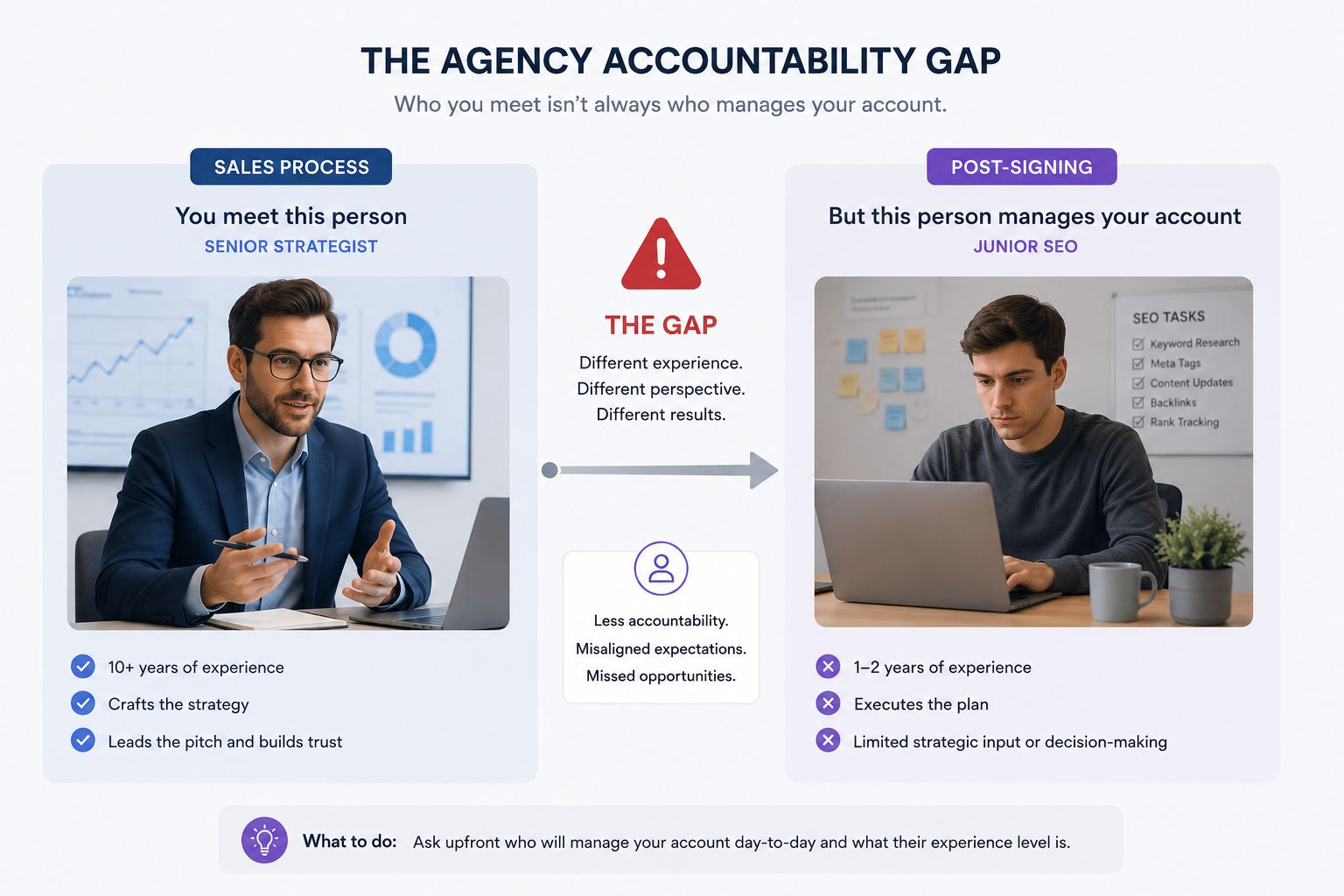
The SEO industry has a significant misalignment problem. Agencies pitch senior strategists during the sales process, then hand the account to junior staff once the contract is signed. Freelancers vary wildly in quality, with no standardized way to evaluate them. And both sides of the market use results data selectively to support whichever pitch they are making at the time.
I am an SEO freelancer with over 10 years of experience who has worked with businesses across the Philippines and internationally, so I have a clear perspective on where freelancers have a genuine edge and where they do not. I will be direct about both.

What You Actually Get from Each
The structural difference between a freelancer and an agency matters more than most businesses realize before they sign a contract.
The agency structure
When you hire an agency, you are hiring a business with multiple layers. There is typically a sales team that wins the contract, an account manager who is your day-to-day contact, and an execution team that does the actual SEO work. In larger agencies, the execution team is subdivided: one person handles technical audits, another handles content, another handles outreach.
This structure has genuine advantages at scale. A large agency can produce content at volume, run link outreach campaigns simultaneously across multiple clients, and bring in specialists for specific problems without the timeline delays a solo operator faces.
The structural risk is the distance between the person you spoke to during the pitch and the people actually working on your site. Your account manager typically does not do SEO. Their job is to manage the relationship, communicate deliverables, and keep you retained. The execution team working on your account may be experienced or may be junior staff under heavy workload pressure across 30 other accounts.
The freelancer structure
When you hire a freelancer, you are hiring one person who owns the strategy and executes the work. There is no account manager layer between you and the person doing the SEO. When you ask a question about your rankings, you are talking to the person who set up your tracking, ran your keyword research, and made the technical recommendations.
This directness is the core advantage of the freelancer model. Accountability cannot diffuse across a team because there is no team to diffuse it to. When something works, you know who built the strategy. When something does not, you are talking to the person who needs to fix it.
The structural limitation is capacity and breadth. A single SEO professional can only work on a finite number of projects simultaneously. If your needs exceed one person's bandwidth, or if you require simultaneous work across multiple specialized disciplines at high volume, the freelancer model has a practical ceiling.
The Cost Reality
The price difference between freelancers and agencies is significant and the reason for that difference is worth understanding before you decide which to hire.
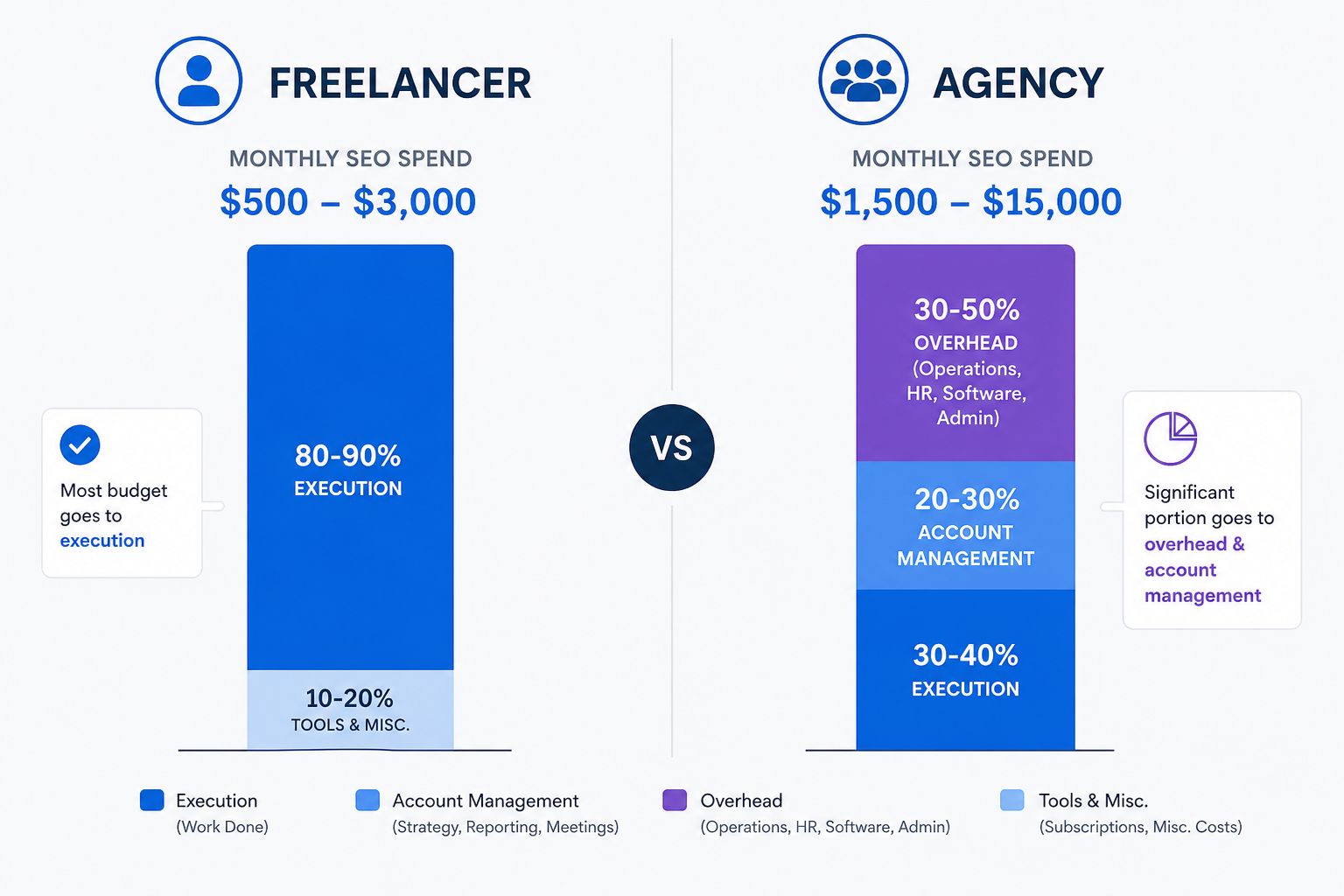
SEO agencies in the Philippines and internationally typically charge between $1,500 and $15,000 per month for ongoing retainers. Small business agency packages usually start around $1,000 to $2,500 per month. Experienced SEO freelancers typically charge between $500 and $3,000 per month for comparable scope.
That difference does not reflect a proportional difference in SEO work. It reflects the operational overhead of running an agency: account management staff, business development, office costs, project management tools, and the margin that sustains a business with many employees. None of those costs produce rankings for your business, but you are paying for them regardless.
When a small business pays $2,000 per month to a mid-sized agency, a realistic estimate is that $800 to $1,200 of that funds actual SEO execution time. The remainder funds the infrastructure around it. The same $2,000 paid to an experienced freelancer buys significantly more dedicated execution time against your specific campaign.
The SEO packages at Search Engine Hub start from $499 per month, with the scope reflecting what I can deliver directly without the overhead layer that inflates agency pricing.
SEO Freelancer vs Agency: Side-by-Side Comparison
| Factor | SEO Freelancer | SEO Agency |
|---|---|---|
| Typical monthly cost (PH market) | PHP 15,000 to PHP 45,000 | PHP 30,000 to PHP 150,000+ |
| Who does the work | The person you hire directly | A team, often including junior staff |
| Contract type | Month-to-month or project-based | 6- to 12-month retainers are standard |
| Primary contact | Direct access to the strategist | Account manager who relays to specialists |
| Turnaround speed | Faster for small-scope tasks | Slower due to internal approval layers |
| Specialist depth | Strong in one or two areas | Broader coverage across technical, content, and links |
| Best fit | SMEs, startups, single-site projects | Multi-location businesses, e-commerce, brands needing full-service SEO |
| Scalability | Limited by one person's capacity | Can scale team resources to project demands |
| Risk if key person leaves | Work stops immediately | Agency absorbs and reassigns |
This table reflects general market positioning. Individual freelancers and agencies vary significantly, which is why verifying deliverables in writing before signing is essential regardless of which model you choose.
How Much Does Each Option Actually Cost in 2026?
Pricing is the most frequently misunderstood part of this decision because both sides of the market have wide ranges that overlap in the middle.
Based on Upwork's 2024 freelancer rate data, SEO specialists in the Philippines charge between $8 and $30 USD per hour depending on experience level and specialisation, with technical SEO specialists commanding rates at the higher end of that range. At a typical engagement of 20 hours per month, that translates to roughly PHP 9,000 to PHP 33,000 per month at current exchange rates.
SEO agency retainers in the Philippine market generally start at PHP 30,000 per month for local SEO packages and rise to PHP 100,000 or more for comprehensive campaigns covering technical audits, content production, and link acquisition. A 2023 survey by Ahrefs of over 400 SEO professionals globally found that the most common agency retainer bracket fell between $501 and $1,000 USD per month for small-to-medium clients, which aligns with mid-tier Philippine agency pricing when adjusted for local rates.
The gap you are actually paying for in the agency model is not just additional hours. It is internal coordination infrastructure: project management tools, QA processes, and specialist handoffs that a solo freelancer cannot replicate at the same price point. Whether that infrastructure produces better results for your specific project is a separate question, and one this page addresses in the sections below.
What Typical SEO Agency Retainers Cover vs. What a Freelancer Includes
Agency retainers at the PHP 50,000 to PHP 80,000 per month level typically bundle technical SEO auditing, on-page optimisation for a set number of pages per month, a fixed volume of link outreach, and monthly reporting. What they often exclude, unless specified in the contract, is content production. Many agencies treat blog writing as an add-on billed separately.
Freelancer engagements are usually scoped differently. A freelancer will often quote against a deliverable list rather than a fixed monthly bundle, which gives you more flexibility to adjust scope month to month but also means the engagement requires clearer brief documentation on your side to avoid scope creep.
One structural difference worth noting: agency account managers in mid-sized Philippine agencies typically manage between 8 and 15 client accounts simultaneously, according to internal hiring benchmarks published by recruitment platform Kalibrr for digital marketing roles. This ratio directly affects how much strategic attention your account receives in any given month. A freelancer handling three to five clients at a time is structurally different from an agency AM managing twelve.
Ask any agency you evaluate what the account manager to client ratio is before signing. If they cannot answer that question, it is a meaningful signal about operational transparency.
When a Freelancer Is the Right Choice
A freelancer is usually the better fit in the following situations.
You are a small to medium business with a defined market
If your SEO goal is to rank in a specific city, region, or niche, a focused strategy from one experienced person typically outperforms a standardized agency process. Local SEO in particular benefits from someone who understands the specific market you are targeting, can build a custom strategy around your competitive landscape, and executes without the process overhead that slows agency work.
For businesses in the Philippines targeting local search visibility in Cebu, Manila, or other Philippine cities, the depth of market knowledge matters more than the breadth of an agency team.
You want direct access to the person doing the work
If you have ever tried to get a straight answer from an agency account manager about why a specific page is not ranking, you understand the communication problem. Account managers are trained to manage your expectations, not necessarily to give you the technical explanation you need to make an informed business decision.
With a freelancer, the person who can answer your question is the person you are talking to. This matters significantly when you are making decisions about budget, strategy pivots, or evaluating whether the current approach is working. You get the full picture, not a curated summary.
You need month-to-month flexibility
Most agencies require 6 to 12 month minimum contract terms. This is partly because SEO genuinely takes time, but it is also because long contracts protect agency revenue. If the results are not materializing, a 12-month contract limits your options significantly.
Experienced freelancers are more likely to work month-to-month, which means accountability is continuous rather than deferred. If results are not moving in the right direction, you have real leverage to change course, renegotiate scope, or stop and reassess without penalty. That flexibility matters when you are managing a finite marketing budget.
Your budget is under $3,000 per month
Below $3,000 per month, the agency overhead model works against you. At that budget level, most agencies will assign a junior SEO or account executive as your primary contact rather than a senior strategist. You are paying for the agency brand and its overhead without getting the senior expertise you are paying for.
At that same budget level, you can hire an experienced freelancer who will personally own your campaign from strategy through execution. The value differential is significant.
When an Agency Makes More Sense
There are genuine scenarios where an agency is the better fit, and it is worth being honest about them.
Enterprise-level multi-department coordination
If your business needs simultaneous SEO work across multiple product lines, languages, and markets, with integration into in-house development, content, and PR teams, a larger agency has the team structure to manage that complexity. A single freelancer has capacity limits that can become a bottleneck at that scale.
High-volume content production
If your strategy requires 30 or 40 optimized content pieces per month, a freelancer cannot produce that volume while also managing your technical SEO, link building, and reporting. Agencies built around content production have writer teams and editorial processes designed for that output level.
You need team redundancy
If your business requires continuous SEO activity with no single point of failure, an agency with a team structure provides continuity if one person leaves or is unavailable. A freelancer is one person, and while that creates direct accountability, it also creates dependency on a single individual's availability.
The Accountability Problem No One Talks About
The most common complaint I hear from businesses that have left agencies is a version of the same thing: "We were paying for their senior team but a junior person was doing our account."
This is structural, not individual. Agencies have incentives to allocate their most experienced staff to the highest-billing clients and their highest-billing clients to the sales team. The business paying $1,500 per month is not the agency's priority. The business paying $12,000 per month is. Junior staff who are still learning SEO get assigned to smaller accounts to build their experience.
This is not necessarily malicious. It is how agency economics work. But it means the quality of work you receive is often determined by your billing tier, not by the pitch you received.
If a business is stuck on page 2 of Google after six months with an agency, a common root cause is that the person assigned to the account lacked the experience to diagnose and fix the underlying issues. Changing the brief does not fix the problem. Changing who owns the work does.
Red Flags to Watch for When Hiring Either
Vetting an SEO provider is where most businesses lose money, not in the model they choose. These warning signs apply to both freelancers and agencies.
They cannot explain their link-building process in plain language. If a provider describes link acquisition as "outreach and partnerships" without specifying what sites they target, what editorial standards they apply, or how they vet domain quality, you have no basis for evaluating whether their links will help or create a future penalty risk. Ask for a sample of sites they have placed links on for current clients.
They guarantee a specific ranking position. No ethical SEO provider can guarantee a page-one ranking for a competitive keyword within a fixed timeframe. Google's own documentation states that no one can guarantee a number one ranking on Google. A provider making this claim is either misrepresenting what they control or planning to target keywords with near-zero search volume.
Their reporting shows rankings but not traffic or conversions. Rankings are an intermediate metric. A provider who reports only keyword positions without connecting that data to organic traffic changes in Google Search Console, or to lead and revenue outcomes, is not doing performance SEO. They are doing visibility theatre.
The contract auto-renews without a performance review clause. Standard agency contracts in the Philippine market run six to twelve months. That term is reasonable if the contract includes a defined review point, typically at month three, where deliverables and progress are assessed. A contract with no exit or review provision at a milestone is a structural mismatch of incentives.
They cannot show you work they have done for a site in your industry or of comparable complexity. A case study from an unrelated niche is weak evidence. Ask for organic traffic data, ideally pulled directly from Search Console or GA4, showing growth over the engagement period for a project similar in scope to yours.
What to Evaluate Before Hiring Either
The decision between a freelancer and an agency matters less than the quality of the specific provider you choose from either category. A highly experienced freelancer consistently outperforms an average agency. An elite agency consistently outperforms a novice freelancer.
Before committing to any SEO provider, ask these questions directly and evaluate the specificity of the answers.
Who will actually be working on my account?
This is the single most important question for agency evaluation. Ask for the name and role of the person who will be your primary strategist and executor, not your account manager. Ask about their specific experience with businesses in your industry and market. If the answer is vague or deferred to "our team," that is a signal worth taking seriously.
Can you show me examples of results for businesses like mine?
Any credible provider should be able to show you ranking improvements, traffic growth, or Local Pack placements for past or current clients in comparable markets. Results in different industries or at different scales are less useful as evidence. What you want to see is proof that this specific person or team has solved the same type of problem your business has.
What does a typical month of deliverables look like?
Ask for a specific list of what will be done in month one, month three, and month six. Vague deliverables like "ongoing optimization" or "content strategy" are not sufficient. You should know exactly what tasks are being executed, at what frequency, and how progress against each will be measured.
The first deliverable from most providers is some form of audit. How that audit report is structured and what it prioritizes tells you a great deal about the quality of the work that will follow.
What happens to my content and data if I stop working with you?
Some agencies build their reporting dashboards in proprietary tools and do not transfer the data if you leave. Some retain ownership of the content they produce. Some use link building approaches that create dependencies where removing your retainer means losing the links they placed.
You should own your Google Analytics account, Google Search Console, and any content created during the engagement. Links that are earned genuinely remain in place regardless of whether you continue paying the provider. Links placed through paid schemes or private networks often disappear when the retainer stops.
What tactics are you using to build links?
This question separates providers who follow Google's guidelines from those who do not. A credible provider will be able to describe specific, legitimate link acquisition methods. Answers that are vague about methodology, or that include phrases like "our proprietary network" or "guaranteed link placements," are warning signs that paid or manipulative link schemes may be involved.
A Direct Assessment
For most small and medium businesses, especially those with a defined local or national market and a monthly SEO budget under $3,000, an experienced freelancer provides better results at lower cost than a comparably priced agency engagement. The direct accountability, the absence of overhead layers, and the custom strategy built for your specific situation consistently produce better outcomes than a standardized process applied across a large client portfolio.
That is not a universal conclusion. Businesses with complex multi-market needs, very high content volume requirements, or in-house team integration needs will find genuine value in agency capabilities. But those scenarios describe a minority of the businesses that are currently searching for SEO help.
If you are a business in the Philippines or internationally that needs local search visibility, a direct engagement with a specialist who owns your results from strategy to execution is the most efficient path to rankings that move.
Frequently Asked Questions
Is an SEO freelancer better than an agency?
For most small and medium businesses, a freelancer delivers better value. You get direct access to the person doing the work, a custom strategy built around your specific market, and no cost markup from account managers or project coordinators who are not doing SEO. Agencies have advantages at enterprise scale or when you need simultaneous work across many channels, but for a focused local or national SEO campaign, the overhead of an agency rarely improves results.
How much does an SEO freelancer charge compared to an agency?
SEO freelancers typically charge between $500 and $3,000 per month for ongoing retainers, depending on scope and market. SEO agencies typically charge between $1,500 and $15,000 per month for similar work. The difference rarely reflects a proportional difference in SEO deliverables. Much of the agency premium pays for account management, business development staff, and operational overhead that does not directly contribute to your rankings.
What is the biggest risk of hiring an SEO agency?
The biggest risk is paying senior rates for junior execution. Most agencies pitch their most experienced strategists during the sales process, then assign the actual day-to-day work to junior staff once the contract is signed. The person you met during the proposal is not always the person managing your account. The only way to address this risk is to ask directly, before signing, who will be executing the work and what their specific experience is.
Can an SEO freelancer handle large or complex campaigns?
Yes, depending on the freelancer. Experienced SEO freelancers regularly manage campaigns for multi-location businesses, e-commerce sites with thousands of pages, and international clients across multiple markets. The relevant question is not whether they are a freelancer but what their specific track record is with projects similar to yours. A freelancer with ten years of focused experience often outperforms a large agency team on complex campaigns because the strategy is owned and executed by one accountable expert rather than distributed across a rotating team.
What questions should I ask before hiring an SEO provider?
The most important questions are: Who will actually be doing the work on my account? Can you show me examples of results for businesses similar to mine? What does a typical month of deliverables look like? What tools will you use and will I have access to the data? What happens to my content and link profile if I stop working with you? Do you use any tactics that violate Google's guidelines? How do you handle a traffic drop following a core update? The answers tell you more about what you are actually buying than any proposal document.
Is it worth hiring an SEO specialist in the Philippines?
Yes. Local SEO in the Philippines, especially for businesses in Cebu, Metro Manila, Davao, and other cities, requires specific knowledge of local search behavior, Google Business Profile management for Philippine markets, and citation sources relevant to Philippine directories. A specialist who has ranked businesses in the Philippine market brings context that a generalist agency without local market experience cannot replicate. The key is verifying that the specialist has demonstrable results for the market you are targeting.
What is the average cost of an SEO freelancer versus an SEO agency in the Philippines?
Based on current market data, Philippine-based SEO freelancers typically charge between PHP 15,000 and PHP 45,000 per month for ongoing engagements, depending on scope and experience level. SEO agency retainers in the same market generally start at PHP 30,000 per month for local SEO packages and can exceed PHP 150,000 per month for full-service campaigns covering technical SEO, content, and link acquisition. The overlap in the PHP 30,000 to PHP 45,000 range is where most businesses face a genuine choice, and at that price point, the decision should hinge on whether you need one specialist's focused attention or a team's broader coverage.
Can a freelancer handle enterprise-level SEO needs?
Most solo freelancers are not structured to manage enterprise SEO, which typically involves large-scale technical audits across thousands of URLs, coordinated content programmes across multiple site sections, and simultaneous link acquisition at volume. Enterprise SEO also requires consistent output regardless of one person's availability, which a solo operator cannot reliably guarantee. That said, some experienced freelancers work as project leads who subcontract technical or content work to other specialists, which can function as a hybrid model. If you are evaluating a freelancer for a large site, ask specifically how they handle deliverables during illness, leave, or periods of high demand from other clients.
What should I ask before signing an SEO contract with an agency or freelancer?
Ask four questions before committing: first, who specifically will be doing the work on your account and what is their experience level; second, what is the account manager to client ratio if you are hiring an agency; third, what does the reporting include and how does it connect SEO activity to business outcomes rather than just rankings; and fourth, what are the exit terms and whether there is a performance review clause at a defined milestone. Providers who answer these questions clearly and without hesitation are demonstrating the operational transparency that separates accountable SEO partners from those optimising for contract renewal rather than your results.
Working with an SEO specialist directly means you get a strategy built for your specific market, not a template applied to it.
Tell me about your business, your current rankings, and where you want to be. I will tell you honestly whether and how I can help.
Start a Conversation
Illan Lebumfacil
Founder of Search Engine Hub and independent SEO specialist with over 10 years of experience. Works directly with local businesses, service providers, and online brands across the Philippines, Australia, and internationally to improve their Google rankings through precise, data-driven strategies.
Read more about Illan's background and approach, or connect directly on LinkedIn.