A small business trying to rank for "SEO services" is competing against agencies with ten-year-old domains, thousands of backlinks, and content teams. That is not a winnable battle in the short term. A small business targeting "SEO specialist for small restaurants in Cebu" is competing against almost nobody.
That is the core logic of long-tail keywords. Specificity trades volume for intent. And intent is what produces customers, not traffic.
Research from Whitehat SEO shows that 91.8% of all searches are long-tail keywords, and they convert at 2.5 times the rate of broad head terms. The HOTH puts average long-tail conversion rates at 36%, compared to 11.45% for the highest-performing generic landing pages. For a small business with limited SEO resources, this trade-off is one of the clearest strategic advantages available.
This article explains what long-tail keywords are, why they matter more in 2026 than before, how to find them using free tools, and exactly where to use them once you have identified them.
What Long-Tail Keywords Are (and What They Are Not)
A long-tail keyword is a specific search phrase, typically three or more words, that targets a narrower topic or intent than a broad "head" term.
Here is how the difference looks in practice:
- Head term: "dentist" — Long-tail version: "emergency dentist open Saturday Cebu"
- Head term: "SEO" — Long-tail version: "affordable SEO freelancer for e-commerce Philippines"
- Head term: "accounting software" — Long-tail version: "best accounting software for freelancers in the Philippines"
- Head term: "restaurant" — Long-tail version: "family-friendly Japanese restaurant open Sunday Talisay"
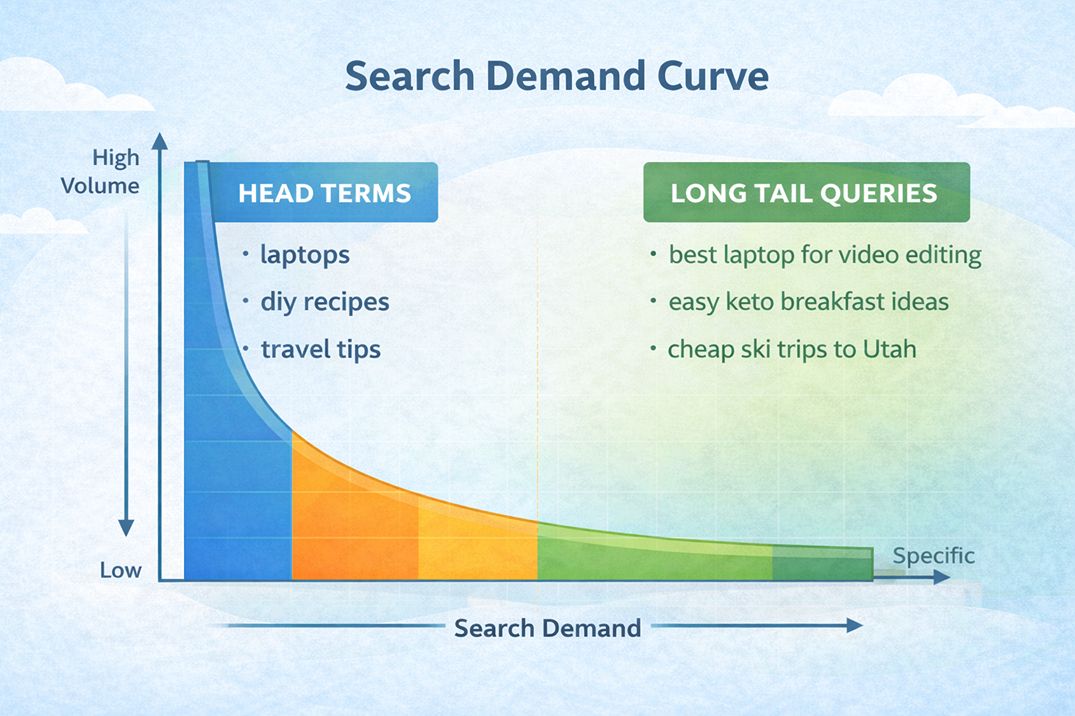
The name comes from the shape of the search demand curve. A small cluster of high-volume terms sits at the "head" of the curve. The "tail" extends far to the right, representing millions of low-volume but highly specific queries. Individually, each tail query gets few monthly searches. Collectively, they represent the majority of all search traffic.
What long-tail keywords are not: any keyword that is simply longer. The defining characteristic is specificity and intent clarity, not word count alone. "SEO services in the Philippines for businesses" is long but still fairly broad. "SEO specialist for dental clinics in Cebu City" is genuinely long-tail because it narrows the audience, service type, industry, and location simultaneously.
Why Long-Tail Keywords Matter More in 2026
Two shifts in the search landscape have increased the value of long-tail targeting for small businesses specifically.
Google AI Overviews are absorbing broad queries
Google AI Overviews now appear on a meaningful portion of searches, particularly informational queries where the answer can be summarized in a short paragraph. When someone searches "what is local SEO," Google increasingly answers that question directly in the results page without requiring a click.
Long-tail queries with specific local or situational context are much harder for AI to fully satisfy. A search like "SEO specialist Cebu available for contract project" or "local SEO for physiotherapy clinic Philippines" requires specific, current, and contextually relevant information that a generic AI summary cannot reliably provide. Optimized pages targeting these queries still consistently earn clicks in a way that broad informational queries do not.
Voice and conversational search use natural long-tail phrasing
Voice search queries are naturally conversational and specific. Nobody speaks "best coffee shop Talisay" into a voice assistant. They ask "what is the best coffee shop near me in Talisay that opens early?" That is a long-tail query. As voice search continues to grow and AI-powered assistants handle more search behavior, the specificity of long-tail keywords maps directly onto how people actually speak their searches.
The Conversion Advantage: Why Specific Means Ready to Buy
The reason long-tail keywords convert at significantly higher rates than broad terms is not coincidental. It reflects where the searcher is in their decision process.
Someone searching "SEO" is in the earliest possible stage. They might be curious, a student doing research, or a competitor analyzing the landscape. Almost none of them are ready to hire someone today.
Someone searching "hire SEO specialist for local business Cebu" has already decided they need SEO help, decided they want someone local, and decided they want a specialist rather than an agency. The decision is practically made. They are looking for the right person, not deciding whether they need the service at all.
This is why long-tail traffic, despite lower volume, produces a higher proportion of actual customers. The searcher arrives with context, intent, and specificity that broad traffic cannot match.
For small businesses with limited budgets and no ability to compete for head terms in the short term, this conversion advantage is the entire argument for long-tail strategy. Less traffic, more buyers.
How to Find Long-Tail Keywords Using Free Tools
You do not need a paid SEO platform to find strong long-tail keywords. The three methods below use tools that are either free or already available to any business with a website.
Method 1: Google Autocomplete
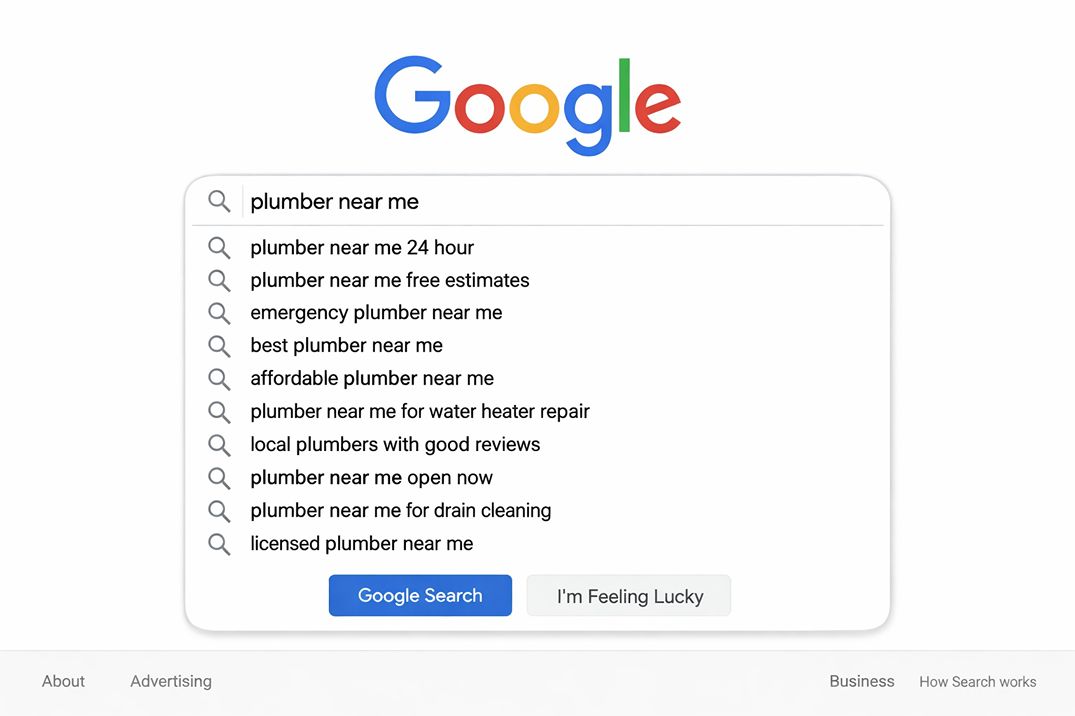
Open an incognito browser window, go to Google, and start typing your main service or product followed by a space. Google will immediately suggest completions based on what real users are searching.
Try variations:
- Your service + a location: "physiotherapy Cebu City..."
- Your service + a modifier: "affordable dentist..." or "emergency plumber..."
- Your service + a question word: "how to find SEO specialist..." or "what does an SEO audit include..."
- Your service + "for": "SEO for restaurants..." or "accounting for freelancers..."
Each suggestion is a real query that real people are typing into Google. Write them all down. The most specific and relevant ones are your long-tail targets.
After hitting search on any query, scroll to the bottom of the results page. The "Related searches" section at the bottom gives you additional long-tail variations that Google associates with the same intent cluster.
Method 2: People Also Ask
On most search results pages, Google displays a "People Also Ask" section. Each question shown is a real query that searchers use in connection with the main topic. These questions are almost always long-tail by nature.
When you expand one question, Google adds more related questions below it. You can keep expanding to uncover an entire cluster of related long-tail queries around a single topic.
For a small business, each of these questions is a potential blog post, FAQ section, or service page subheading. Covering them systematically builds topical authority for your main service area without competing directly on the head term.
Method 3: Google Search Console
If your site has been live for more than a few months, Google Search Console is the most valuable free keyword research tool available to you. It shows the actual queries real users typed before clicking through to your site.
To find long-tail opportunities:
- Open Search Console and go to Performance, then Search Results
- Click on Queries to see what searches are bringing users to your site
- Filter by queries with four or more words — these are your existing long-tail appearances
- Look for queries with decent impressions but low click-through rate — these are pages where better title tags or content alignment could capture more traffic without any new content
- Look for queries where your average position is between 8 and 20 — these are keywords where you are close to page one and targeted optimization could push you over
This method surfaces real, verified demand that your site is already partially meeting. Acting on this data produces results faster than targeting brand-new keywords because Google has already started associating your site with those queries.
How to Use Long-Tail Keywords Once You Have Found Them
Finding long-tail keywords is only half the work. Placing them correctly determines whether the pages you build actually rank and convert.
One primary intent per page
Each long-tail keyword should have its own dedicated page or dedicated section if the keyword is a question that fits naturally within a broader guide. Do not try to target three or four long-tail variations on a single page by squeezing them all into the same content. This confuses both the reader and Google about what the page is primarily for.
The exception is when multiple long-tail keywords share the same intent. "Affordable SEO freelancer Cebu" and "budget SEO specialist Cebu" are close enough in meaning that one page can satisfy both without diluting focus.
Where to place long-tail keywords
- Title tag: Include the full long-tail phrase or a close variation at the start of the title
- H1 heading: Match the title tag closely, with the keyword appearing naturally in the heading
- First paragraph: Use the keyword naturally within the first 100 words
- At least one H2 subheading: Where it fits naturally in the page structure
- Meta description: Include the keyword and a clear reason to click
- Image alt text: Describe the relevant image using language that reflects the keyword
The goal is natural language that reads well for a human visitor. If you are forcing the keyword into a sentence where it sounds awkward, rewrite the sentence rather than forcing the fit. Google's language models in 2026 understand semantic context well enough that variations and synonyms count toward relevance. You do not need exact-match repetition.
For local businesses: add geography to long-tail targets
Local service businesses have a natural long-tail modifier available to them that purely online businesses do not: location. Adding your city, district, or region to a service keyword instantly narrows competition and increases intent specificity.
"Keyword research service" has broad national competition. "Keyword research service for small businesses Cebu" has almost none. Both serve different audiences, but for a local business, the second query produces far more qualified leads.
Location-based long-tail keywords also feed directly into your Google Local Pack visibility. When your service pages, Google Business Profile, and citations all reinforce the same location-specific terms consistently, Google becomes more confident about matching your business to those local queries.
Organizing Long-Tail Keywords Into Topic Clusters
The most effective approach to long-tail keyword strategy is not to create isolated pages for each keyword. It is to organize related long-tail keywords into topic clusters — groups of pages that collectively cover a subject from multiple angles.
A topic cluster has two components:
- A pillar page covering the broad topic, such as "Local SEO for Small Businesses in Cebu"
- Cluster pages targeting specific long-tail variations around that topic, such as "how to get your business on Google Maps in Cebu," "best local citation sources for Philippine businesses," and "how many Google reviews do you need to rank locally"
Each cluster page links back to the pillar page, and the pillar page links out to each cluster page. This internal linking structure tells Google that your site covers the topic with depth and authority, not just surface-level information on a single page.
Topic clusters also prevent keyword cannibalization — the problem where multiple pages on your own site compete against each other for the same query, splitting ranking potential instead of concentrating it. Each page in a well-structured cluster serves a distinct long-tail intent, so they support rather than compete with each other.
Understanding the intent behind each long-tail keyword you target determines what kind of content each cluster page needs. The full explanation of how intent shapes content format and structure is covered in the article on search intent and on-page SEO.
What to Do With Long-Tail Keywords That Have Zero Reported Search Volume
Keyword tools often report zero monthly searches for highly specific long-tail queries. This does not mean nobody is searching for them.
Keyword tools aggregate search data and display volume only when a threshold of searches is met over a given period. A query with 15 monthly searches in a small market will show as zero in most tools. But 15 people a month searching for "SEO specialist for dental clinics in Cebu City" and finding your page is worth far more than 1,500 people landing on a page about "SEO" and immediately leaving.
The test for whether a zero-volume long-tail keyword is worth targeting is not the tool's number. It is whether the query represents a real question that your ideal customer would plausibly search. If yes, the content is worth creating. The traffic will be small but highly qualified, and the page builds topical authority regardless of its standalone traffic volume.
If you want to verify whether there is any search signal before investing in a full page, type the query directly into Google in incognito mode. If Google returns results rather than suggesting you try different search terms, the query has real search traffic even if the tools do not report it.
Tracking Whether Your Long-Tail Pages Are Working
Long-tail keyword pages do not generate dramatic traffic spikes. They accumulate steadily. The right metrics to watch are:
- Impressions in Google Search Console for the target query — confirms the page is being shown for the right searches
- Average position for the target query — shows whether the page is moving toward page one
- Click-through rate — low CTR at a good position often means the title or meta description needs adjustment
- Conversions or contact form submissions from that page — the ultimate measure of whether the traffic is qualified
Give long-tail pages three to four months before drawing conclusions. New pages need time for Google to discover, crawl, index, and evaluate them against competing pages. Pages targeting very low competition long-tail queries can rank within weeks. Pages in slightly more competitive spaces take longer.
If a page has been live for four months, is ranking between positions 8 and 15, but not clicking through, the usual culprit is a title tag that does not match the searcher's expectation well enough. This connects directly to the on-page elements covered in a keyword research service, where every target is mapped to the right page type, title structure, and content format before anything is written.
Frequently Asked Questions
What are long-tail keywords?
Long-tail keywords are specific search phrases, typically three or more words, that target a narrow topic or intent. Instead of "dentist," a long-tail version would be "emergency dentist open Saturday Cebu." They have lower individual search volume than broad head terms but convert at significantly higher rates because the searcher's intent is much clearer and more specific.
Why do long-tail keywords convert better than short keywords?
People who use specific, multi-word searches have usually already done their initial research. They know what they want, where they want it, and sometimes when they need it. That specificity signals purchase or action intent. Research shows long-tail keywords convert at around 36% on average, compared with approximately 11% for the highest-performing generic landing pages.
How do I find long-tail keywords for my business without paying for tools?
Three free methods cover most of what small businesses need. First, type your main service into Google and read the autocomplete suggestions that appear. Second, look at the People Also Ask section on the results page for that query. Third, open Google Search Console, go to the Performance report, and filter for queries with four or more words — these are long-tail keywords you are already appearing for, even if you are not yet optimizing for them.
How many long-tail keywords should a small business target?
There is no fixed number. The goal is to cover the specific questions and variations your ideal customers are actually searching, organized into topic clusters rather than isolated pages. A small local service business might start with five to ten well-chosen long-tail targets and expand from there as those pages gain traction. Relevance and intent match matter more than volume.
Do long-tail keywords still work when Google AI Overviews answer questions directly?
Yes, and in some ways they work better. Google AI Overviews most often appear for broad informational queries where the answer can be summarized quickly. Long-tail queries with specific local or situational context are much harder for AI to fully satisfy with a generic summary. These are the queries where optimized pages still consistently earn clicks.
Where should I use long-tail keywords on my pages?
The title tag and H1 heading are the highest-priority placements. From there, use the keyword naturally in the first paragraph, in at least one subheading if it fits, and in the meta description. For local long-tail keywords, also include them in your Google Business Profile service descriptions and Google Posts. Write for the reader first and the keyword will appear in context naturally.
What is the difference between a long-tail keyword and a local keyword?
Local keywords include a location modifier, such as a city, neighborhood, or "near me." Long-tail keywords are simply more specific than broad head terms. Many local keywords are also long-tail, for example "affordable SEO freelancer Talisay Cebu." But not all long-tail keywords are local. A long-tail keyword like "how to fix a slow WordPress site without a developer" has no location component but is still highly specific.
Need help finding the right keywords for your business?
Keyword research at Search Engine Hub maps every target to the right intent, the right page format, and the right content structure — so the traffic you attract is the traffic that converts.
Learn MoreWritten by
Illan Lebumfacil
SEO Freelancer at Search Engine Hub, based in Talisay, Cebu. Helping businesses in the Philippines and internationally improve their search visibility through precise, data-driven strategies.
About me →