Most campaigns need 3 to 12 months to produce results that affect leads or sales. The starting point, market, technical condition, content, and links decide where a site falls within that range.
About the author: Illan Lebumfacil is an SEO specialist with more than a decade of experience across local, technical, and content work. He helps businesses use search data to plan fixes and measure progress.
Business owners often ask how long does SEO take before it starts producing leads. A fair planning range is 3 to 12 months, but the first signs usually appear before the main business result. Google may crawl and index new pages first, then test them for more searches, and later move them into positions that bring clicks.
Google explains that Search works through three stages: crawling, indexing, and serving results. Crawling means finding and downloading a page. Indexing means understanding and storing it. Ranking happens when Google selects results for a search. This process is different from paid search, where an approved ad can appear soon after a campaign goes live.
The Honest Answer: 3 to 12 Months, and Why the Range Exists
The 3 to 12 month range is not a way to avoid giving an answer. It covers different starting conditions. An established local company may already have indexed service pages, customer reviews, local citations, and links from other sites. A new business may have none of those signals and may also be competing with companies that have published useful content for years.
A 2024 Ahrefs poll of 3,680 marketers found that the most common answer was three to six months for visible progress. Ahrefs also notes that competition, resources, goals, strategy, and execution affect the pace. For a new site, the wait can be longer. In a Google office hours discussion reported in 2020, John Mueller said rankings for a new site may fluctuate for up to a year while Google works out where the site belongs.
This does not mean no value is created during the first months. Technical fixes, new pages, internal links, and better search coverage can be measured before traffic rises. The mistake is judging the work only by whether a main keyword has reached page one.
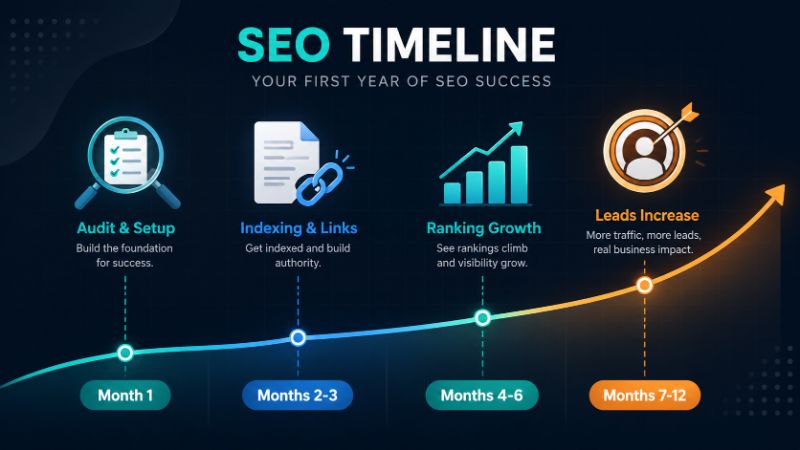
Month-by-Month: What SEO Looks Like in the First Year
A campaign should have planned work and a record of what changed. The table below shows a normal sequence. It is a guide, not a guarantee.
| Period | Work taking place | Signals to watch |
|---|---|---|
| Month 1 | Audit the site, set tracking, fix access and indexing problems, review search demand, and plan pages. | Clean tracking, valid sitemap, blocked pages found, priority list agreed. |
| Months 2 to 3 | Publish or improve priority pages, repair internal links, fix duplicate or thin sections, and start local or industry outreach. | More valid pages indexed, first impressions for new searches, movement on lower-competition terms. |
| Months 4 to 6 | Continue content work, earn relevant links and mentions, update pages using Search Console data, and improve weak conversion paths. | More non-branded impressions and clicks, more terms in the top 50 and top 20, leads from search may begin to rise. |
| Months 7 to 12 | Build on pages that show demand, update content that has stalled, strengthen topic coverage, and address gaps against competitors. | Growth in qualified traffic, stronger positions for commercial searches, more assisted leads and sales. |
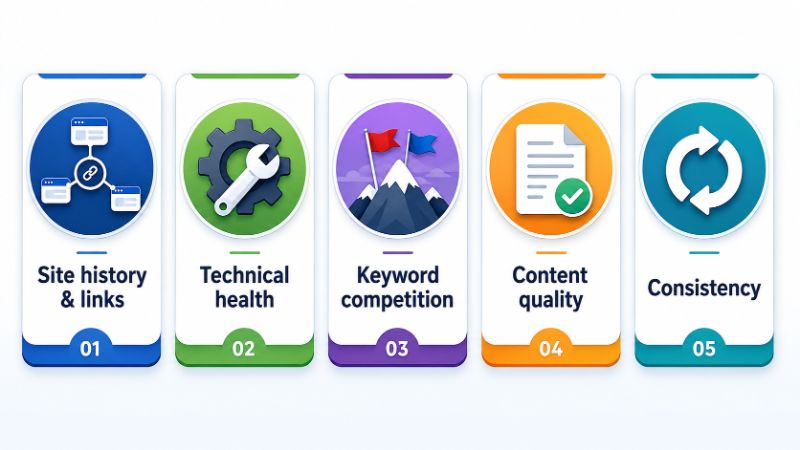
Five Factors That Affect How Quickly a Site Ranks
- Site history and link profile. An older domain does not rank just because it is old. It often has an advantage because other sites have linked to it, people search for the brand, and Google has seen its pages over time. Referring domains are separate websites that link to a site. Relevant links can help Google find pages and understand which sources are trusted within a topic.
- Technical health. Pages cannot compete if Google cannot access, render, or index them. Common delays include blocked pages, wrong canonical tags, redirect chains, slow servers, duplicate URLs, and important content loaded in a way that search crawlers cannot process well.
- Keyword competition. A local plumber targeting “water heater repair in Austin” is competing within one service area. A software company targeting “project management software” is competing with large brands, review sites, and products with years of links and coverage. The second target may need 18 to 24 months or longer, while the local term may move within 60 to 90 days when the market is less crowded.
- Content output and quality. Publishing more pages does not help when they repeat the same points or miss the reason behind a search. Each page needs a clear job, useful information, a match to the search intent, and links to related pages. Updating pages with real sales questions, service details, prices, examples, and proof can be more useful than adding weak articles each week.
- Consistency of the work. Search growth often stalls when fixes are approved but never released, content waits for months, or link work stops after a short burst. A steady plan gives Google more useful pages and signals to assess. The right setup depends on budget, skills, and the amount of work required. When deciding who will manage the work, compare the scope, reporting, and support needed before choosing whether to hire an SEO freelancer or an agency.
New Website vs Established Website: Why the Starting Point Matters
Research on page age shows why new pages face a hard start. Ahrefs studied ranking pages in 2025 and found that 72.9% of pages in Google’s top 10 were more than three years old. Only 13.7% were under one year old. This is a correlation, not proof that age itself causes rankings. Older pages often have more links, updates, user history, and brand demand.
| Starting point | Likely early work | Typical pace |
|---|---|---|
| New website | Help Google find and index the site, create core service pages, prove the business is real, and start earning relevant mentions. | Early impressions may appear in weeks, but stable commercial rankings often need 6 to 12 months. |
| Established website | Fix technical waste, update pages already close to page one, improve internal links, and use existing authority. | Measurable gains may appear in 3 to 6 months, sometimes sooner for pages already ranking. |
What You Can Expect at the 90-Day Mark
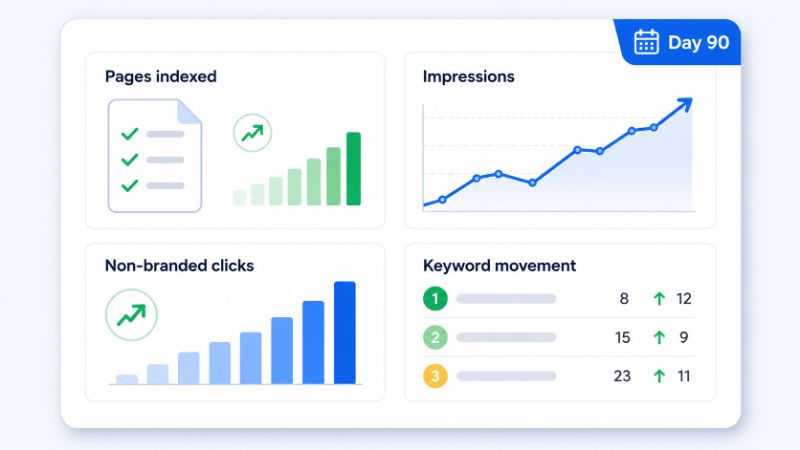
At 90 days, a well-run campaign should produce evidence that the site is moving through the right steps. It may not produce a large traffic gain yet. A useful review should look for:
- New or updated pages appearing as indexed in Google Search Console.
- Growth in impressions, which means pages are being shown for more searches.
- Ranking movement for lower-competition and longer search terms.
- More non-branded clicks, rather than clicks from people already searching for the company name.
- Completed technical fixes and a record of pages published or improved.
Be careful with vanity metrics. Ranking for a phrase that no one searches does not support revenue. Branded clicks may reflect demand created by referrals, advertising, or repeat customers rather than new reach from organic search. Early progress is better measured through index coverage, impressions, non-branded clicks, and movement on terms linked to services or products.
Warning Signs That Work Is Moving Too Slowly
Slow progress does not always mean the campaign has failed, but the following signs call for a review:
- Indexable pages were published, but none are indexed after 60 days.
- Search Console shows no impression growth after 90 days, even though work has gone live.
- No relevant referring domains or local mentions have been gained after six months of active outreach.
- Target terms remain outside the top 50 after six months, with no movement on related lower-competition searches.
- Reports list tasks and rankings but do not connect the work to non-branded traffic, enquiries, calls, or sales.
Each sign needs context. A seasonal business may have flat demand outside its selling period. A new national brand in finance, legal services, or software may need more time. The concern is not one weak month. It is a lack of completed work, search visibility, and a clear reason for the delay.
How to Compress the Timeline Without Cutting Corners
The fastest route is not publishing at high speed or buying large batches of links. It is removing blockers, choosing targets that match the current strength of the site, and completing the work in the right order.
Start by getting an SEO audit to identify what is slowing rankings. An audit should check crawl access, indexation, page duplication, redirects, site structure, internal links, page quality, search demand, and measurement. Google also advises businesses to ask for realistic estimates and warns against anyone who guarantees first place.
- Fix access and indexing first. There is little value in building links to pages that are blocked, duplicated, redirected, or marked not to be indexed.
- Work from current data. Pages ranking between positions 8 and 30 often give faster gains than starting every topic from zero.
- Choose a mix of targets. Use lower-competition commercial terms for early movement while building the pages and links needed for larger terms.
- Publish useful pages, not filler. Answer sales questions, show the service process, explain costs and limits, add examples, and make the next action clear.
- Keep releases moving. A plan only works when technical changes, content, and outreach are completed and checked.
- Measure business outcomes. Track non-branded clicks, calls, forms, booked appointments, qualified leads, and sales, not rankings alone.
Set a Baseline Before Judging the Timeline
So, how long does SEO take to work? Three to six months is a common window for measurable progress, while new sites and competitive markets may need 6 to 12 months or more. Local work may move sooner when the site, business profile, pages, and service area signals are in place. Results should be judged against the starting point and the type of search being targeted, not a fixed promise.
If the current position is unclear, an SEO audit gives the business a baseline and a prioritised list of fixes before content or link work begins. That makes the timeline easier to plan and gives each monthly review a clear set of outcomes.
Frequently Asked Questions
Can SEO produce results in less than three months?
It can, but early gains are more common when a site already has indexed pages, some authority, and terms ranking near page one. Local businesses in less competitive areas may also move sooner. A new domain targeting broad commercial searches usually needs more time.
Does changing an SEO agency reset the timeline?
Not always. A change in provider does not remove existing rankings, links, or site history. Progress may slow when the new team needs time to review the account, fix tracking, or correct earlier work. The timeline can improve when the handover includes access to Search Console, analytics, past reports, content records, and link data.
How long should a business keep investing before reviewing the campaign?
A formal review at three months is reasonable for completed work, indexing, impressions, and early ranking movement. A wider decision about leads or sales often needs six to twelve months, depending on the market. The review should compare results with the starting baseline and agreed work, not time alone.
Can a website lose progress after rankings begin to improve?
Yes. Rankings can drop after site changes, content removal, redirect errors, lost links, stronger competition, or Google system updates. A decline does not always mean all earlier work was wasted, but it should be checked against technical changes, search demand, and competitor movement.
Is SEO still working if traffic rises but leads do not?
Traffic growth alone is not enough. The site may be attracting informational searches, visitors from the wrong location, or people with no buying intent. Review landing pages, search queries, calls, forms, and sales data to see whether the campaign is reaching potential customers.
Sources
- Google Search Central: How Google Search Works. Official guide to crawling, indexing, and serving search results.
- Google Search Central: Do You Need an SEO?. Official guidance on audits, realistic estimates, and ranking guarantees.
- Ahrefs: How Long Does SEO Take to Show Results?. Poll data and factors that affect the time needed to see progress.
- Ahrefs: How Long Does It Take to Rank in Google?. 2025 study on the age of pages in the top 10 and the share of new pages that rank within a year.
- Search Engine Journal: Rankings for New Sites Could Fluctuate for Up to a Year. Report of John Mueller’s comments from a Google office hours discussion.
Not sure where your site stands or how long the work should take?
An SEO audit from Search Engine Hub gives you a baseline and a prioritised list of fixes, so you can plan a realistic timeline before content or link work begins.
See the SEO Audit Service
Illan Lebumfacil
Founder of Search Engine Hub and independent SEO specialist with over 10 years of experience. Works directly with local businesses, service providers, and online brands across the Philippines, Australia, and internationally to improve their Google rankings through precise, data-driven strategies.
Read more about Illan's background and approach, or connect directly on LinkedIn.