The signal that matters most after a Google core update is not which ranking positions changed. It is whether your Google Search Console impressions declined.
Impressions measure visibility: how often Google chose to show your pages in search results. When impressions fall across multiple pages at the same time a core update is rolling out, you have something concrete to investigate.
When only clicks decline while impressions hold steady, the problem is different. Daily ranking fluctuations and core update impacts have different causes, different thresholds, and different responses. This article focuses specifically on the core update diagnosis.
Step One: Confirm the Drop Dates Against Known Update Windows
Before drawing any conclusions about cause, check whether a confirmed core update was active when your traffic dropped.
Google publishes all confirmed updates on the Google Search Status dashboard. The Google Search Central account on X also announces when updates begin and when they finish rolling out.
Confirmed Google core updates (2024 through May 2026):
- March 2024 Core Update: March 5 to April 19, 2024 (45 days). One of the longest rollouts on record, described by Google as affecting multiple core systems simultaneously.
- August 2024 Core Update: August 15 to September 3, 2024.
- November 2024 Core Update: November 11 to December 5, 2024.
- December 2024 Core Update: December 12 to 18, 2024.
- March 2025 Core Update: March 13 to 27, 2025.
- June 2025 Core Update: June 30 to July 17, 2025.
- December 2025 Core Update: December 11 to 29, 2025.
- March 2026 Core Update: March 27 to April 8, 2026. The Semrush Sensor peaked at 9.5 during the rollout. According to SE Ranking data cited by Search Engine Land, 79.5% of top-3 URLs changed positions during this update, up from 66.8% after the December 2025 update.
If your traffic drop does not align with any of these windows, a core update is unlikely to be the cause. Look instead at technical issues, a competitor improvement, a SERP layout change, or a site change you deployed around the same time.
If the dates do align, that is a starting point, not a conclusion.
Core updates affect the entire web simultaneously. Not every site that noticed a drop during a confirmed update window was directly impacted by it. The next steps determine which category you are in.
Step Two: Check GSC Impressions Before You Look at Anything Else
Open Google Search Console, navigate to Performance, and set the date range to cover 30 days before and 30 days after your suspected drop date. Look at impressions before you look at clicks or average position.
Rank trackers report estimated positions for a set of keywords at a fixed point in time. They are useful for spotting trends, but they cannot tell you whether a position change reflects real reduced visibility or a measurement artifact from personalization, location, or Google's testing pools.
GSC impressions are actual search data: how often Google served your pages in results across every query you rank for.
What declining impressions tell you
When GSC impressions decline over a 14 to 30 day window, your pages are appearing in fewer searches. Google is choosing to show them less often.
That is the primary signal of a genuine ranking or visibility change.
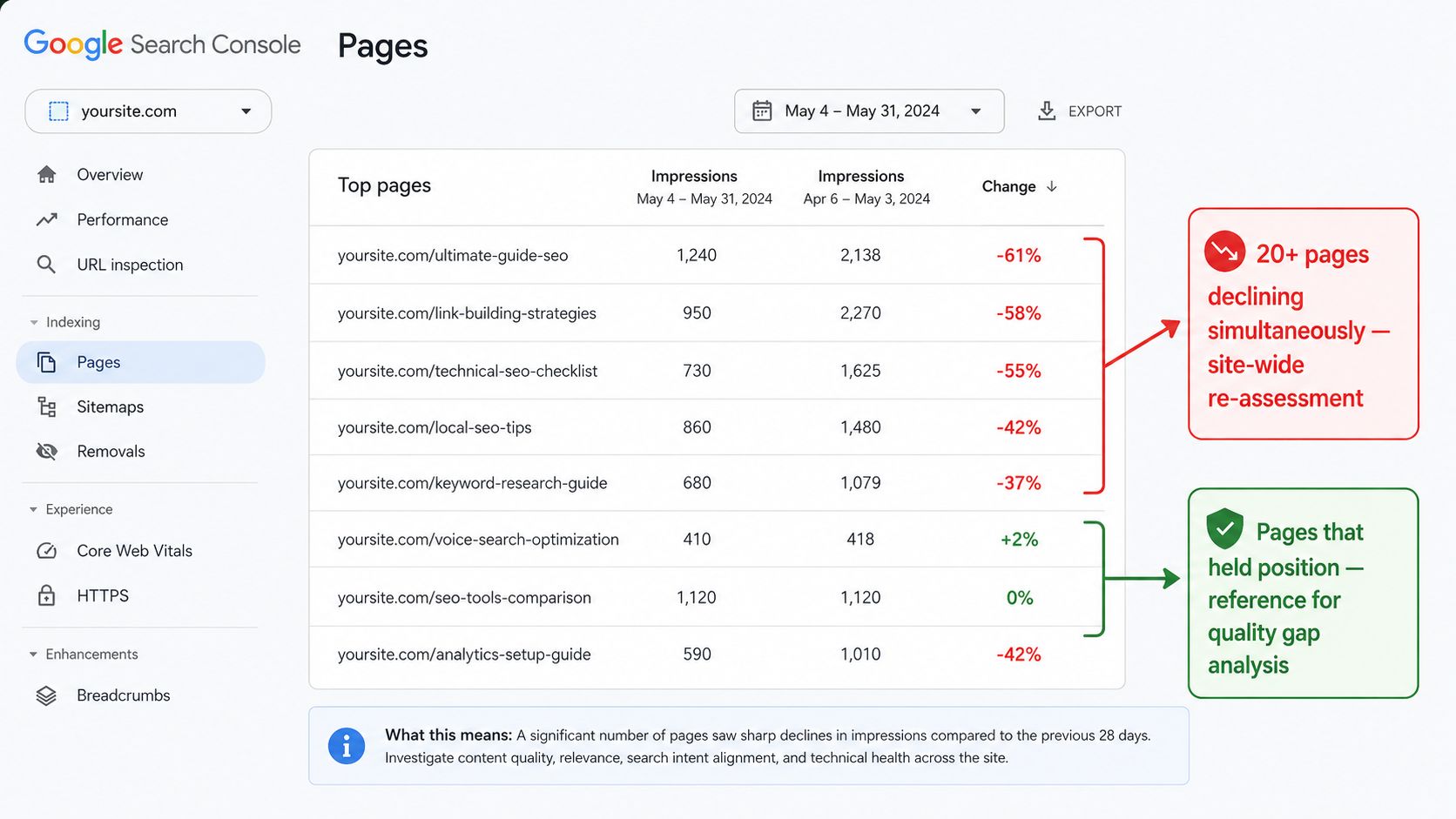
If impressions decline across 20 or more pages simultaneously during a core update window, you are looking at a site-wide re-assessment.
That is the characteristic pattern of a core update impact: broad, affecting pages across different topics, correlated with a confirmed algorithm change.
Declining clicks with stable impressions: a different problem
If your clicks declined but impressions held steady, the issue is not your ranking. It is your click-through rate. Google is still showing your pages at roughly the same frequency, but fewer people are choosing to click them.
This points to a title tag or meta description underperforming relative to what competitors show for the same queries, or to SERP features like AI Overviews, featured snippets, or local packs pushing organic results further down the page.
That is a CTR problem, not a core update impact. The cause and the correct response are different.
Step Three: Separate Site-Wide Impact from Page-Level Drops
Inside GSC Performance, go to the Pages tab. Set the same date comparison window. Sort pages by the change in impressions, largest decline first.
If 20 or more pages across different topics lost impressions at the same time, the re-assessment is site-wide.
Core updates do not usually move individual pages in isolation. They recalibrate how Google weights quality signals across the entire site portfolio, which produces broad, simultaneous movement rather than isolated page-level drops.
If only two or three pages declined while the rest held position, the issue is more likely page-level: a stronger competitor, a specific content quality gap, or a SERP layout change affecting those particular queries.
That pattern is inconsistent with a core update impact and points to a different cause.
Cross-Check with Industry Volatility Tools
Your site's data alone cannot tell you whether the movement you see is isolated to you or part of a market-wide shift. Volatility tools track ranking changes across millions of keywords simultaneously and give you that context.
- Semrush Sensor: Scores daily SERP volatility on a scale from 0 to 10 across 20-plus categories and countries. Below 5 is calm. Above 8 means significant algorithm activity. Free to use. If the Sensor was elevated on the dates your traffic dropped, the cause is more likely algorithmic and broad than site-specific.
- MozCast: Measures ranking changes as a temperature reading. Useful for cross-referencing Sensor data to confirm whether volatility was present in your specific industry category or region.
- Advanced Web Ranking Volatility Tracker: Shows a timeline of confirmed Google updates alongside daily volatility scores, which makes it easier to match your drop date precisely to a named update event.
If the Sensor was elevated and your industry peers saw similar movement during the same window, you are looking at a broad algorithmic re-calibration.
If the Sensor was calm and only your site moved, you are looking at a site-specific issue that is unrelated to a core update.
The Sites That Core Updates Hit Hardest
Core updates do not target specific sites. They recalibrate how Google's ranking system weights quality signals across the web.
But they disproportionately affect certain profiles because those profiles were ranking on signals that the update re-weighted downward.
The most consistently vulnerable pattern is pages that built ranking authority primarily through backlinks, without the content depth and demonstrated expertise to match.
When an update re-weights content quality signals more heavily, the gap between what those pages offer and what competing pages offer becomes visible in the rankings.
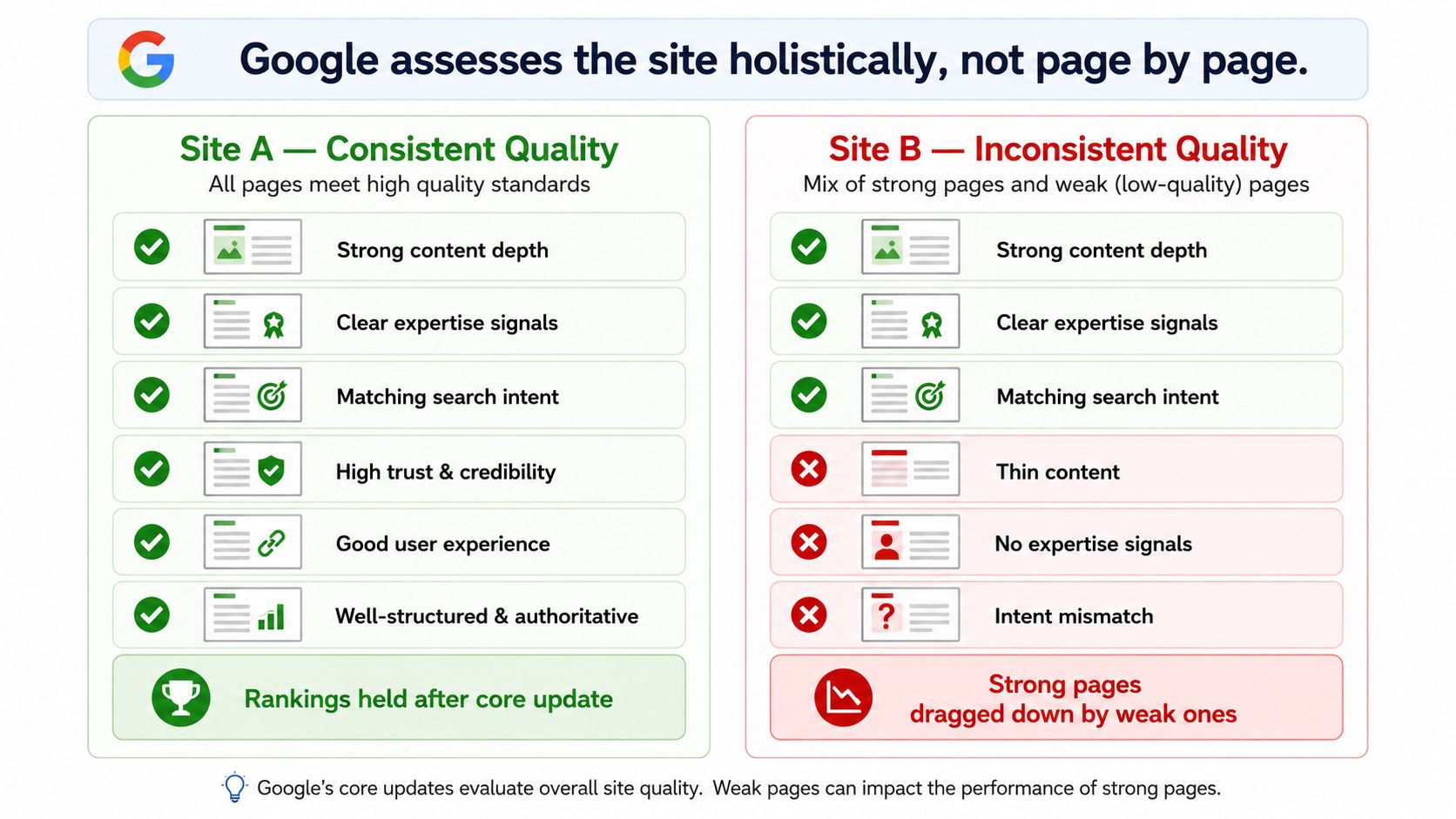
A second common pattern is sites with inconsistent quality across their page portfolio. If a domain has 20 strong pages and 80 thin ones, a core update that evaluates site-wide quality signals can pull down the strong pages because of the drag from the weak ones.
Google's systems assess a site holistically, not only page by page.
Search intent alignment is another signal that core updates frequently re-calibrate. A page can be well-written, well-linked, and genuinely useful, but if its structure, depth, or framing does not match what people actually mean when they search the target query, it will underperform when the algorithm places more weight on intent signals.
Sites with keyword cannibalization are also disproportionately affected. When two or more pages on the same domain compete for the same query, neither accumulates full ranking authority.
A core update that raises the quality threshold for a competitive query can push both pages below the new cutoff simultaneously, producing a sitewide impression drop that looks larger than the number of directly affected URLs suggests.
If multiple declining pages share similar topics, keyword cannibalization is worth examining before drawing other conclusions.
What Usually Is Not a Core Update
Misattributing the cause of a traffic drop leads to the wrong response. These patterns are inconsistent with a core update impact and point to different causes:
- Only one or two pages dropped while the rest of the site held position. Core updates produce broad, simultaneous movement across many pages, not isolated page-level changes.
- The drop occurred on a date when the Semrush Sensor was calm and no confirmed update was active. A site-specific issue or competitor improvement is more likely.
- The drop happened within days of a site change: a CMS migration, URL restructure, hosting change, or major redesign. Technical issues introduced by the change are the more probable cause. A technical SEO review after any significant site change catches these problems before they compound.
- A manual action is listed in Google Search Console under Security and Manual Actions. Manual actions are penalties applied by Google's spam review team, not algorithmic changes. They require a reconsideration request, not a content quality response.
Checking GSC for manual actions takes under a minute and should always be the first step when a sharp, sudden drop occurs.
Navigate to Security and Manual Actions, then Manual Actions. If the result shows "No issues detected," your site does not have a manual penalty.
How Long Before Rankings Settle After a Core Update
Google core updates typically take one to three weeks to fully complete. Rankings continue moving throughout the rollout period before settling.
Google announces when a rollout finishes on the Search Status dashboard.
The March 2026 core update ran for 12 days. During that window, positions shifted multiple times for many sites before reaching their post-update state.
The final position after the update completes is the one that reflects the new signal weighting. Positions mid-rollout are not a reliable indicator of the final outcome.
This is why making significant changes to your site during an active core update rollout is counterproductive. Any changes you make will be assessed under the new weighting, but the data you use to make those decisions reflects rankings that are still moving.
The right time to make decisions is after Google confirms the rollout is complete and rankings have had at least two weeks to stabilize.
What the Data Is Telling You and What Comes Next
Once you have confirmed that a core update caused a site-wide impression decline, the next step is not to fix pages immediately. It is to understand the specific gap the update revealed.
Pull the full list of pages that lost impressions from GSC. Sort by the percentage decline rather than the absolute number.
A small page that lost 60 percent of its impressions is a stronger signal than a large page that lost 5 percent.
Look for patterns across the declining pages: topic cluster, content format, page age, how specific the expertise demonstrated on those pages is relative to what the queries require.
Then compare those pages against the pages that held position or gained impressions during the same window. The difference between the two groups is where the quality gap exists.
That comparison is the foundation of any effective recovery strategy. Sites that make changes without doing it tend to apply general improvements that do not address the specific signal gap the update identified.
Reading an SEO audit report after a core update impact is different from a routine audit review. The data points to specific quality gaps, not just technical issues.
If Your Traffic Dropped Significantly, This Is When to Bring In a Specialist
Confirm two things first: that impressions declined across 20 or more pages in GSC, and that the decline persisted for more than two weeks after the update rollout was confirmed complete.
If both are true, this is the point in the process where bringing in a specialist has the highest leverage.
Recovering from a core update impact is not a content checklist. It requires comparing your declining pages against the pages that displaced them in the rankings, mapping where the quality signals differ, and building a recovery path that addresses the actual gap.
Identifying whether that gap is in content depth, expertise demonstration, topical consistency, authority signals, or intent alignment requires looking at data across multiple pages, not just the ones that declined.
That analysis is more accurate and faster when it is structured by someone who has done it across multiple sites and multiple update cycles. The patterns that produce a clear signal in the comparison are not always obvious without reference data to put them in context.
An SEO audit covers exactly this: mapping which pages lost what signals, comparing them against the pages that gained during the same update, identifying the specific quality gap, and outlining a recovery path that addresses it directly rather than generally.
Frequently Asked Questions
How do I know if a Google core update affected my site?
Check three things in order. First, confirm your traffic drop dates align with a known core update window on the Google Search Status dashboard. Second, open Google Search Console and check whether impressions declined, not just clicks. Third, check the Semrush Sensor for the same dates.
If all three confirm movement, you are looking at a core update impact. If the Sensor was calm and only your site moved, the cause is site-specific rather than algorithmic.
How long does it take for a Google core update to fully roll out?
Typically one to three weeks. Google announces when rollouts begin and when they finish on the Search Status dashboard.
Rankings can continue moving throughout the rollout window before settling. The post-completion position is the one that reflects the update's actual re-weighting, not the mid-rollout position.
Can you recover from a Google core update?
Yes. Recovery requires identifying what quality gap the update revealed and addressing it specifically. Google has confirmed that sites can recover between updates, though full recovery is most commonly seen after subsequent core updates validate the improvements.
Recovery is not a general content checklist. The pages that gained during the update and displaced yours are the reference point. Mapping what they offer that your pages do not is the foundation of an effective strategy.
What is the difference between a core update and a Google penalty?
A core update is an algorithmic recalibration that affects how quality signals are weighted across the entire web. It is not targeted at individual sites. A penalty is a manual action applied by Google's spam review team to a specific site that violated spam policies.
Penalties are visible in GSC under Security and Manual Actions. Core update impacts are not listed there. If no manual action is listed but traffic dropped, you are not under a penalty.
The distinction matters because the response is different: penalties require a reconsideration request, core update impacts require a quality improvement strategy.
Should I make changes to my site immediately after a core update?
No. Wait until Google confirms the update has fully completed and rankings have had at least two weeks to stabilize.
Making changes during an active rollout obscures what the update's actual assessment was, which makes accurate diagnosis harder afterward. Once rankings have settled, that is the data set to work from.
Which pages does a Google core update affect the most?
Pages that were ranking on signals the update re-weighted downward. The most common patterns: pages with strong link profiles but thin content depth, service pages that claim expertise without demonstrating it through specific detail, pages on sites with inconsistent quality across their portfolio, and pages competing against other pages on the same domain for the same query.

Illan Lebumfacil
Founder of Search Engine Hub and independent SEO specialist with over 10 years of experience. Works directly with local businesses, service providers, and online brands across the Philippines, Australia, and internationally to improve their Google rankings through precise, data-driven strategies.
Read more about Illan's background and approach, or connect directly on LinkedIn.