If your business is not appearing consistently in local search, mismatched citation data may be the cause. Your business name, address, and phone number need to match precisely across every directory Google checks, and even minor formatting differences can suppress Local Pack visibility that other signals cannot recover.
What NAP Stands For and What Counts as an Inconsistency
NAP stands for Name, Address, and Phone number. These three data points are how search engines verify that a local business is who it claims to be across hundreds of online directories.
Each component has a precise meaning in citation data. Name refers to the legal or trading name the business uses publicly, not a keyword-modified version created for SEO purposes. Address means the full physical street address, including suite numbers and zip codes. Phone means the primary local phone number the business uses.
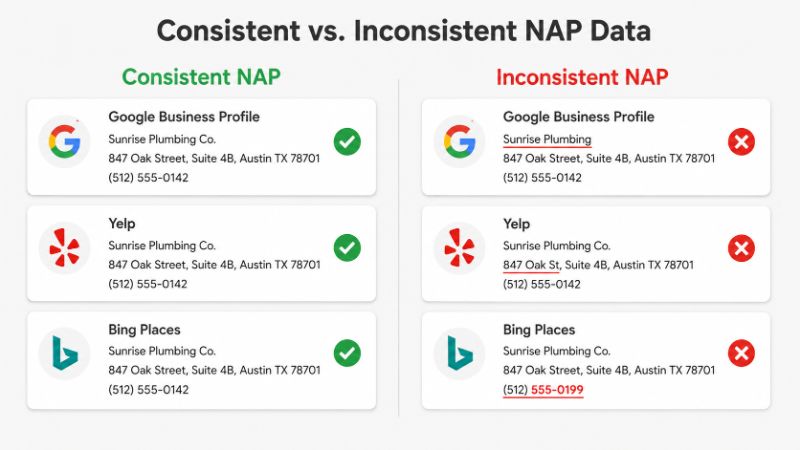
The part that catches most businesses off guard is how precisely "consistent" is defined. A crawler is a pattern-matching system, not a human reader. It does not infer that "123 Main St." and "123 Main Street" refer to the same location. It does not recognize "Suite 4B" and "#4B" as equivalent. A tracking number on one directory and the main office line on another creates a conflict in the data record, regardless of whether both numbers ring the same desk.
Minor formatting differences that a person would read right past look like contradictory data to a search engine. That is the core reason NAP consistency matters for local rankings.
Why Google Uses Citation Data to Evaluate Local Business Legitimacy
Google does not have an independent way to verify that every business claiming a local presence actually exists at the address it lists. It relies on signals: the volume of references to that business, the consistency of those references, and the authority of the sources providing them.
When NAP data matches across your Google Business Profile, your website, and dozens of third-party directories, that alignment tells Google the business is real, stable, and operating where it claims. When records conflict, Google's entity resolution process, the mechanism it uses to confirm that multiple references describe the same physical business, produces uncertainty.
That uncertainty can suppress Local Pack visibility even when a business has a well-optimized profile and strong reviews. How the Google Local Pack determines which businesses rank involves several layered signals, and citation consistency is one of the most foundational.
The Most Common Sources of NAP Inconsistency (and How They Start)
Most NAP inconsistencies accumulate gradually through ordinary business events, not neglect.
Business relocation is the single most common cause. When a company moves, the GBP address gets updated, but dozens of directory listings do not. The old address keeps circulating through data aggregators for months or years.
Phone number changes after switching providers create the same problem. The old number stays on listings that were never manually updated, producing a split record that shows different phone numbers depending on which directory a crawler hits.
Rebranding and name changes introduce mismatches at the name level. Even small differences, like dropping "LLC" from the trading name or shortening "& Associates" to "& Assoc," register as inconsistencies in citation data.
Duplicate listings are another persistent source. Data aggregators sometimes create new listings from business data they acquire, rather than updating existing ones. A business owner manually creating a listing on a platform where one already exists creates the same duplication problem.
Finally, user-suggested edits on platforms like Google Maps can introduce incorrect data. Google sometimes accepts these suggestions without notifying the business owner, which can change the GBP address or phone number without any action on the business's part.
Which Citation Sources Carry the Most Weight in Local Search
Not all citation sources carry equal weight. At the top of the hierarchy are four major US data aggregators: Neustar Localeze, Data Axle (formerly Infogroup), Foursquare, and Factual (now integrated into Foursquare).
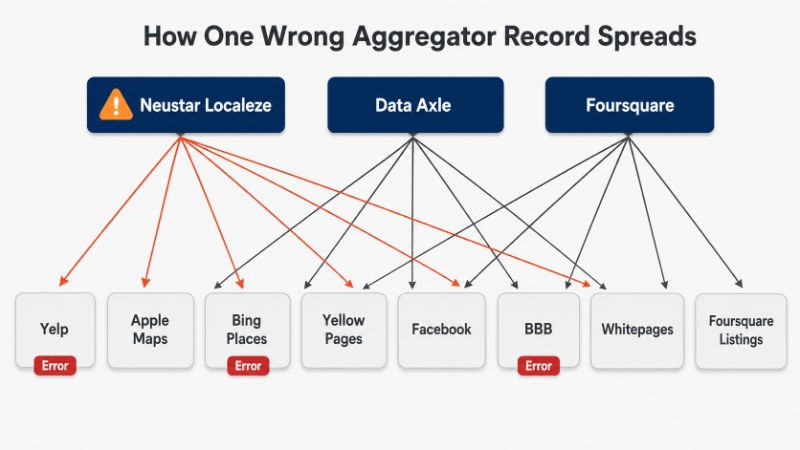
These aggregators feed NAP data to hundreds of downstream directories automatically. A single incorrect record at the aggregator level propagates to platforms like Yelp, Apple Maps, Yellow Pages, and dozens of niche directories without human involvement. That is why correcting the aggregator record takes priority over correcting individual directory listings.
Below the aggregators, the high-authority individual citation sources that carry the most weight include Google Business Profile, Yelp, Bing Places for Business, Apple Maps, Facebook and Meta business listings, and the Better Business Bureau.
Industry-specific directories matter as well. Healthgrades and Zocdoc carry significant authority for medical practices. Avvo is a critical citation source for law firms. TripAdvisor and Booking.com are important for hospitality businesses. The relevant directories for a given business category should be treated as tier-two priorities after the aggregators and the major universal platforms.
According to Moz's Local Search Ranking Factors research, citation signals remain a meaningful component of local pack rankings, contributing to the entity authority signal Google uses to evaluate local business legitimacy. The relative weighting of citation signals has shifted over time alongside the growth of review and behavioral signals, but citation consistency remains a core foundational factor.
How to Audit Your NAP Data Across the Web
A NAP audit has a clear structure. The goal is to compile a complete picture of what each major data source says about your business and identify every discrepancy against the official NAP.
Start by defining the official NAP: the exact name, address format, and phone number as it appears on your website's contact page and in your Google Business Profile. Write this down as the reference standard before you look at anything else.
Next, search Google for your business name plus city plus the name of each major directory. "[Business Name] [City] Yelp," "[Business Name] [City] Bing Places," and so on. This surfaces existing listings that may contain outdated or incorrect data.
Then use a tool to scale the search. Moz Local's listing checker and BrightLocal's citation tracker both scan major directories and flag discrepancies against the NAP you provide. BrightLocal's consumer research has documented that a significant share of users lose confidence in a business when they encounter conflicting contact information across listings, which adds a direct trust dimension beyond the ranking impact.
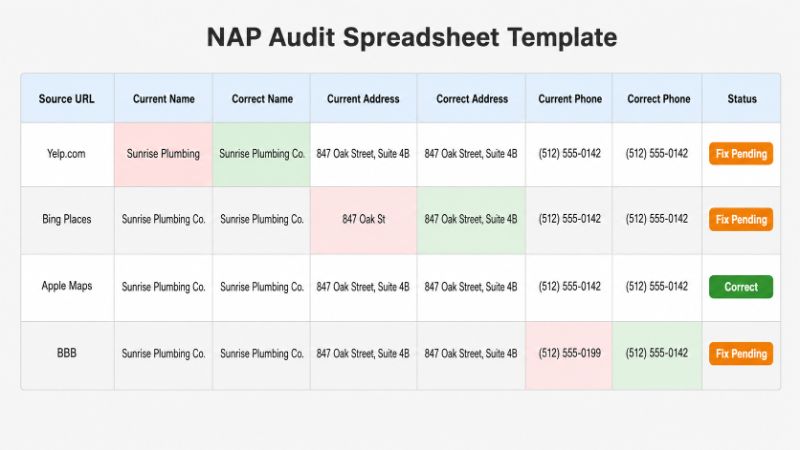
Log everything in a spreadsheet. Columns should cover Source URL, Current Name, Correct Name, Current Address, Correct Address, Current Phone, Correct Phone, and Status (Fixed or Pending).
One inconsistency that gets missed more than expected: businesses that use a P.O. Box on some listings and a physical street address on others. Google's guidelines for representing your business explicitly require a physical address for Local Pack eligibility. A P.O. Box used as the primary address on any listing creates a conflict that can directly affect Local Pack inclusion.
How to Fix Inconsistent Citations: A Prioritized Approach
Work through corrections in a specific order. Random fixes waste time and slow overall recovery.
Fix the Google Business Profile first. This is the canonical source Google uses directly to populate Local Pack results and Maps. Every other correction you make will be evaluated against what the GBP currently says.
After the GBP, correct the four major data aggregators. Neustar Localeze and Data Axle have business owner portals for submitting corrections. Foursquare accepts updates through its business tools. Prioritize aggregators before individual directories because a corrected aggregator record will eventually push accurate data to downstream directories automatically.
Next, work through the top 10 to 15 high-authority directories individually: Yelp, Bing Places, Apple Maps, Facebook, BBB, and the industry-specific platforms relevant to your business category.
After corrections are submitted, monitor for aggregator re-propagation over the following 6 to 8 weeks. Some downstream directories refresh from aggregator data on a monthly or quarterly schedule. A directory that shows corrected data two weeks after your fix may revert to the old data if the aggregator record was not corrected first.
NAP Consistency and Your Google Business Profile: How They Interact
The GBP and the business website need to agree at the field level, not just in general terms. If the GBP lists "Suite 400" and the website contact page says "Ste. 400," that is a conflict in citation data.
Three places on the website must match the GBP exactly: the footer, the contact page, and the page's structured data markup.
Implementing LocalBusiness schema on the contact page using schema.org markup is a specific technical step that many businesses skip. The relevant fields are streetAddress, addressLocality, addressRegion, postalCode, and telephone. Every value in those fields should be character-for-character identical to what appears in the GBP. This consistency between on-page structured data and the GBP reinforces the entity signal Google uses for Local Pack inclusion.
If you have resolved citation inconsistencies and are still seeing GBP performance issues, why your Google Business Profile may not be ranking often involves separate factors like category selection, service area configuration, and review signals, which operate independently of citation data.
How Long Does It Take for Citation Fixes to Affect Local Rankings
Expect 6 to 12 weeks from the time corrections are submitted before those fixes begin influencing local ranking signals. The variability depends on how quickly data aggregators process your updates and how often downstream directories refresh their records from aggregator data.
Some platforms update within days of a direct correction. Others refresh on a monthly or quarterly cycle, which means you may see partial improvement early and continued improvement over several weeks as corrected data propagates.
Citation consistency is also one of several inputs that affect why your local pack position changes depending on the searcher's location. Location-based ranking variance involves proximity signals that operate independently, and citation fixes do not produce uniform improvements across all areas simultaneously.
Do not expect a specific ranking position gain tied to citation corrections. What consistent citations do is remove a suppressive signal. The outcome depends on the competitive landscape and the strength of the remaining ranking factors working in your favor.
Frequently Asked Questions
What does NAP stand for in local SEO?
NAP stands for Name, Address, and Phone number. These are the three data points search engines use to identify and verify a local business across directories, data aggregators, and social platforms. Consistency across all sources is required for Google to confidently match listing references to the same physical business.
What counts as a NAP inconsistency?
Any formatting difference that causes two data records to not match exactly. This includes abbreviations like "St." versus "Street," suite number formats like "Suite 4B" versus "#4B," different phone number formats, old phone numbers from before a provider change, or slight name variations such as dropping "LLC" or shortening "& Associates."
How do I audit my NAP data across the web?
Define your official NAP as it appears on your website and Google Business Profile. Then search Google for your business name plus city plus each major directory to find existing listings. Use Moz Local's listing checker or BrightLocal's citation tracker to surface inconsistencies at scale. Log every discrepancy in a spreadsheet with the source URL, the current value, and the correct value.
How long does it take for NAP corrections to affect local rankings?
Expect 6 to 12 weeks from when corrections are submitted before they begin influencing local ranking signals. Some platforms update within days. Others operate on a monthly or quarterly refresh schedule depending on how they pull data from aggregators.
Does my Google Business Profile NAP need to match my website exactly?
Yes. The name, address, and phone number on your Google Business Profile should match your website footer, contact page, and LocalBusiness schema markup character for character. Even minor differences like "Suite 400" versus "Ste. 400" create a trust signal conflict between two of the sources Google evaluates together when assessing entity legitimacy.
Citation corrections across dozens of directories take time and precision.
If auditing and correcting citations across dozens of directories is outside your current capacity, Search Engine Hub manages the full citation correction process as part of a structured engagement. You can review the scope of those local SEO services for businesses in the Philippines and US markets.
See Local SEO Service
Illan Lebumfacil
Founder of Search Engine Hub and independent SEO specialist with over 10 years of experience. Works directly with local businesses, service providers, and online brands across the Philippines, Australia, and internationally to improve their Google rankings through precise, data-driven strategies.
Read more about Illan's background and approach, or connect directly on LinkedIn.