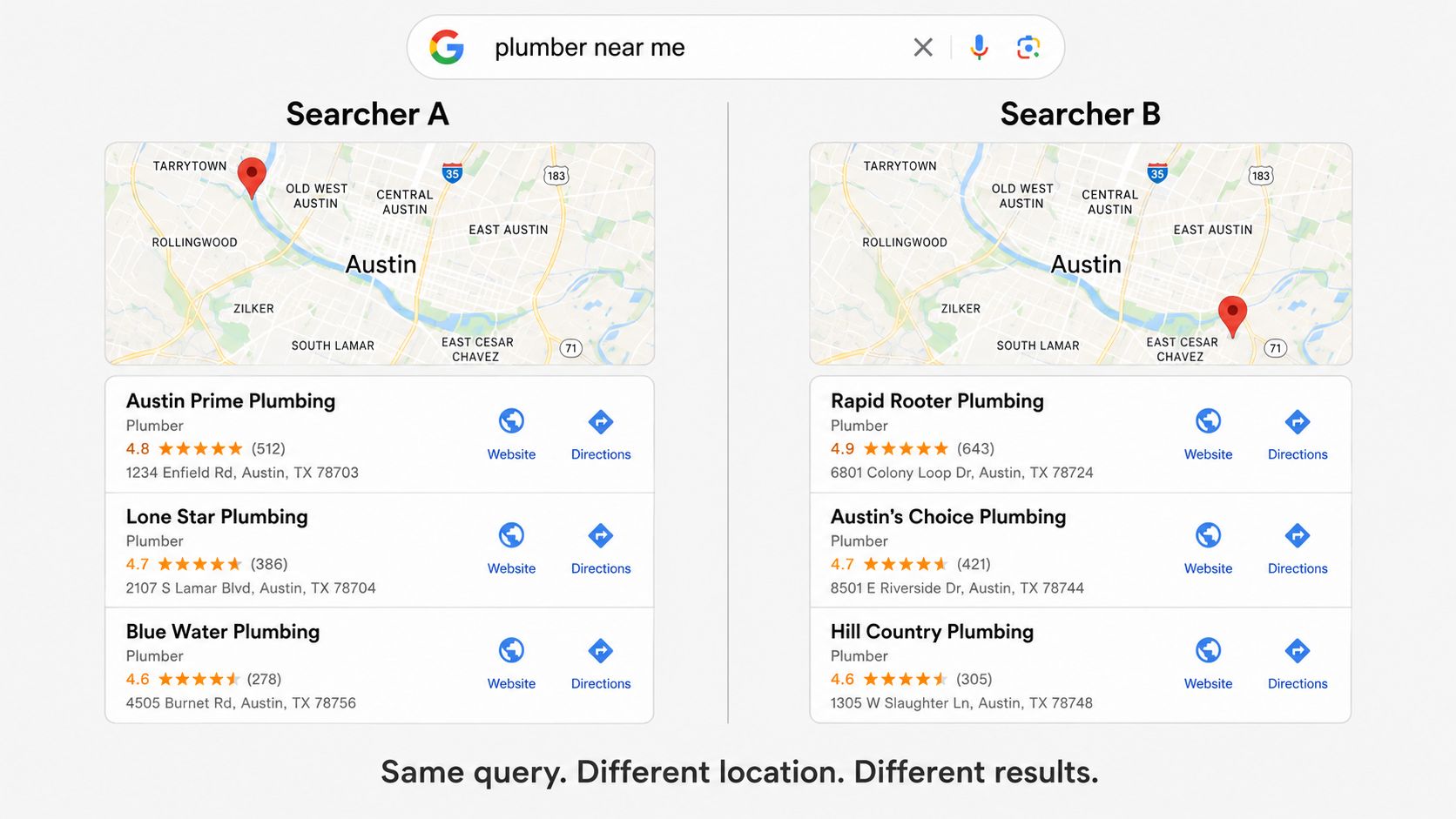
Running a search for your own business from your office and seeing yourself in the top three on Google Maps does not mean every potential customer sees the same result. The Local Pack Google shows to any individual searcher depends on where that person is physically located when they search.
This is one of the most common misreadings in local SEO. The business owner sees a favorable result. A customer on the other side of the city does not.
Neither is wrong. They are simply searching from different locations, and Google is giving each of them results calibrated to their specific position.
Your Google Maps Ranking Is Not a Fixed Position
Google does not assign permanent Local Pack positions the way a static directory would.
Every local search triggers a real-time calculation. Google evaluates which businesses are most relevant, closest, and most trusted for that specific searcher at that specific moment.
Two people searching the same query from opposite ends of the same city will often see entirely different businesses in those three spots.
How Proximity Shapes Every Local Search Result
Distance is one of the three signals Google weighs for every Local Pack result, alongside relevance and prominence.
When someone searches on a mobile device, Google uses their GPS location. When they include a location in their query, Google infers proximity from that phrasing.
A business 200 meters from the searcher starts with a natural advantage over one 4 kilometers away, all else being equal.
That advantage holds even when the closer business has a thinner profile. Distance creates a floor that other signals have to work harder to overcome.
Why Checking Your Own Ranking Gives You the Wrong Picture
When a business owner searches for their own category from their business address, they are as close as possible to their own listing.
The Local Pack result they see is the most favorable version of their ranking, reflecting proximity from a position very few of their actual customers are searching from.
Customers in neighboring suburbs, or on the other side of the city, are searching from locations where the distance factor looks entirely different.
For an accurate picture of how you appear across your service area, you need data from multiple search locations, not a single check from one spot.
Why Service-Area Businesses See Greater Variability
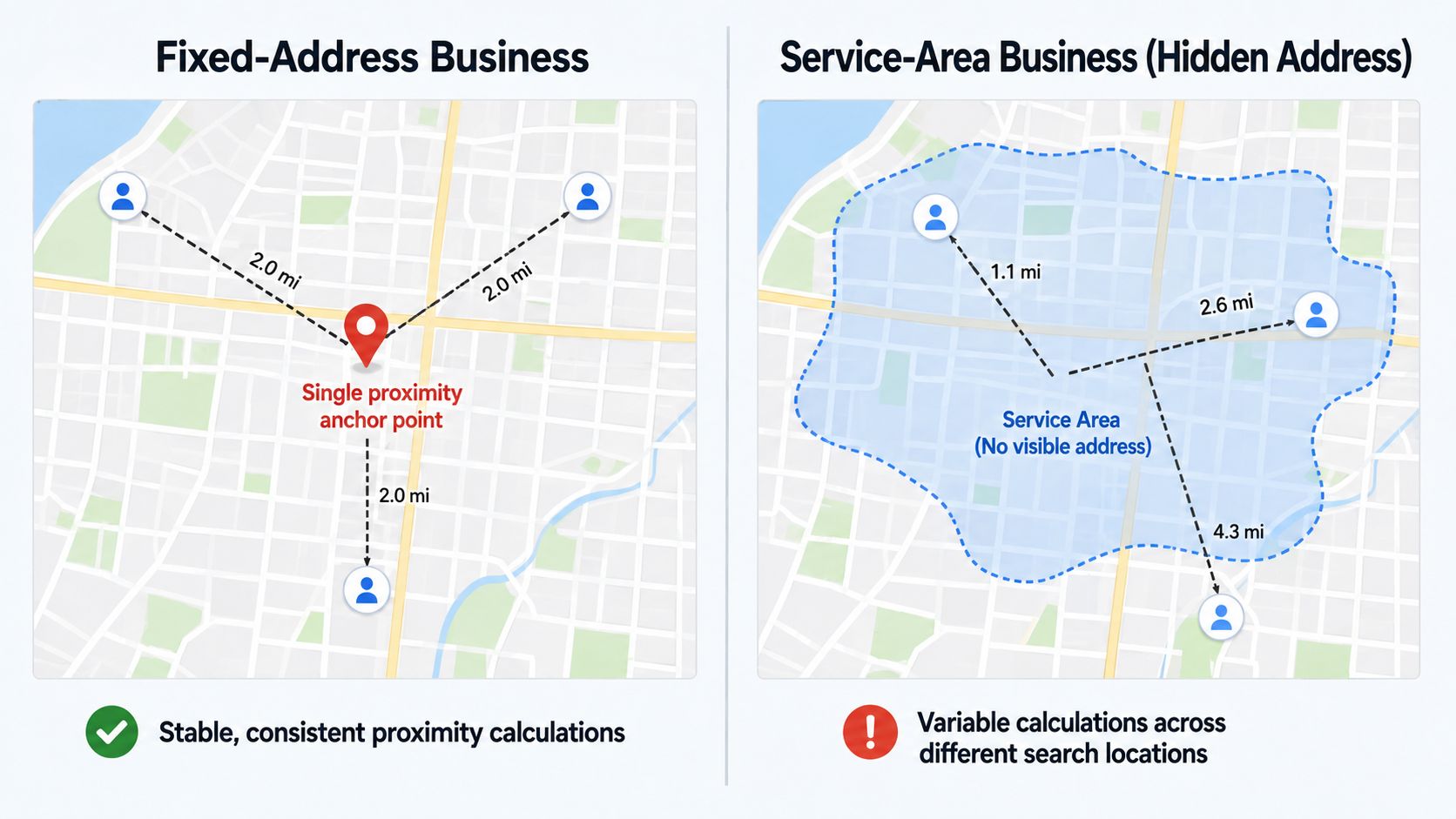
A business with a verified physical address gives Google a fixed point. Every proximity calculation flows from that precise location, consistently.
Service-area businesses that hide their address and define a territory instead give Google a broader region to estimate from. Without a specific address pin, the distance calculation is less precise.
The result is wider variation in Local Pack positions across the service territory. A plumbing business covering three districts may rank near the top for searches from the center of that area and not appear at all for searches from the edges.
What Compensates for Distance
You cannot move closer to every customer. But distance is not the only signal Google weighs.
Relevance and prominence can offset a distance disadvantage when they are significantly stronger than a nearby competitor's.
A business with a precise primary business category, consistent review velocity, and complete profile sections competes more effectively against closer competitors whose profiles are weaker on those signals.
Service area settings in Google Business Profile should accurately reflect the areas you actually serve. Overly broad areas dilute proximity signals for specific locations. Overly narrow ones exclude customers you can reach.
Location-specific keywords used consistently in GBP service descriptions and website content reinforce geographic relevance signals, helping Google match your profile to searches from across your territory rather than just from the center of it.
For businesses where these variability gaps are producing real lost visibility, a local SEO service addresses the full set of proximity, relevance, and prominence signals systematically.
Frequently Asked Questions
Why does my Google Maps ranking change depending on where I search?
Google recalculates Local Pack results for each individual search using the searcher's real-time location. The three businesses that appear are the best match for that specific searcher at that specific position. A business that appears first for someone nearby may not appear at all for someone searching from across the city.
Can I accurately check my own Local Pack ranking?
Searching from your business address or your own phone gives you a biased result. You are closer to your own listing than most of your customers are, which makes your ranking appear stronger than it actually is for most searchers. For accurate data, use a rank tracking tool that measures from fixed coordinates across your service area.
Does proximity always determine who appears in the Local Pack?
Proximity is one of three factors Google weighs, alongside relevance and prominence. A business further from the searcher can still outrank a closer competitor if it has a stronger primary category match, higher review velocity, and more complete profile signals. Distance creates an advantage but does not override significantly stronger signals elsewhere.
Why do service-area businesses see more ranking variability?
Fixed-address businesses give Google a precise location point for every proximity calculation. Service-area businesses with hidden addresses give Google a broader region to estimate from, which makes proximity calculations less consistent. The result is wider variation in Local Pack positions across the territory.
My competitor has fewer reviews but outranks me in some areas. Why?
Reviews are one signal within the prominence factor, but proximity and category relevance play separate roles. If your competitor is physically closer to searchers in that area, the distance factor gives them an advantage that review count alone cannot override.
Not sure how your business actually appears across your service area?
The Local SEO service at Search Engine Hub covers a full audit of your Google Business Profile, service area settings, proximity signals, and profile completeness to identify exactly where visibility gaps exist and what is causing them.
See Local SEO Service
Illan Lebumfacil
Founder of Search Engine Hub and independent SEO specialist with over 10 years of experience. Works directly with local businesses, service providers, and online brands across the Philippines, Australia, and internationally to improve their Google rankings through precise, data-driven strategies.
Read more about Illan's background and approach, or connect directly on LinkedIn.