More people are getting their answer without clicking a single link. They ask Google, ChatGPT, or Perplexity a question, and an AI writes the answer for them.
When that happens, ranking number one in the blue links matters less than being the source the AI quotes. Getting cited in that answer is what AEO is about.
AEO stands for answer engine optimization. This article explains what it means, how it differs from SEO, why it is suddenly a topic in 2026, and whether it is worth your attention yet.
What AEO Actually Means
AEO is the practice of structuring your content, data, and authority so AI answer engines cite your business when they respond to a question.
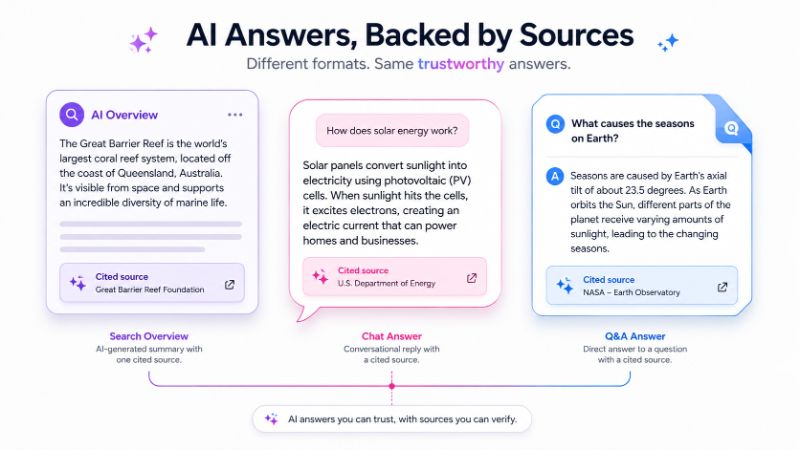
An answer engine is any system that replies with a written answer instead of a list of links. Google AI Overviews, Google AI Mode, ChatGPT, Gemini, and Perplexity are the main ones.
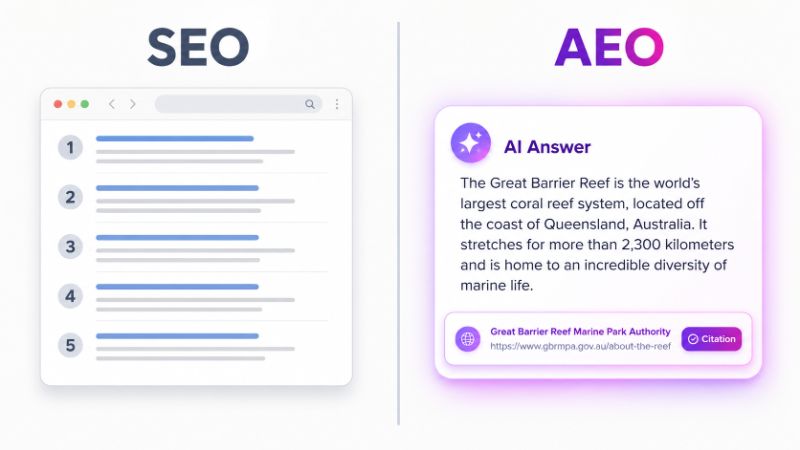
Traditional optimization tries to win a position in the list of results. AEO tries to win a mention inside the answer the engine generates.
The distinction matters because of how these answers behave. When an AI Overview answers a question directly, many users never scroll to the links below it. If your business is named and linked inside that answer, you stay visible. If it is not, you are invisible for that query no matter how well your page would have ranked.
AEO vs SEO: What Is the Difference?
SEO and AEO are closely related, and the same work often supports both. The difference is the target and how you measure success.
SEO aims to rank your page in Google's list of links so a person clicks through to your site. Success is a position and the traffic that follows.
AEO aims to get your business cited inside an AI-generated answer. Success is a citation, a mention, or a link that appears within the answer itself.
They overlap because the signals that make a page rank also make it eligible to be cited. A page that is crawlable, relevant, and trustworthy is a candidate for both. What AEO adds is structuring that page so an answer engine can lift and attribute it cleanly.
This is also why matching search intent matters even more in AI search. Answer engines are trying to satisfy the exact question, so content built around the real intent behind a query is easier to cite than content padded with keywords.
Is AEO the Same as GEO?
You will see both terms used, often for the same thing.
AEO, answer engine optimization, frames the goal as being the source an answer engine cites. GEO, generative engine optimization, frames it as being referenced by generative AI systems.
In practice the tactics are nearly identical. Both are about structure, clarity, entities, and authority. Treat the two terms as interchangeable and do not get caught up in the labels.
Why AEO Is a Topic Now
AI answers moved from novelty to default fast. AI Overviews now appear for a large share of informational searches, and tools like ChatGPT and Perplexity have become research habits for many people.
That changes where visibility lives. A question that once sent ten people to ten different websites may now be answered once, citing only two or three sources.
Freshness and structure carry unusual weight here. One industry analysis found that 83% of AI citations for commercial queries came from pages updated within the previous twelve months, with more than 60% refreshed within the last six.
The engines also reward content they can extract cleanly. Direct answers near the top of a section, clear formatting, original data, and credible sourcing all make a page easier to quote.
None of this is a separate discipline from good SEO. It is the same foundation, structured and maintained so an answer engine can use it.
Does AEO Matter for Your Business?
The honest answer is that it depends on your customers, not on the hype.
AEO matters to you if the people you want to reach already ask AI tools the kinds of questions your business answers. If buyers research your service through AI Overviews or ChatGPT, being cited there protects your visibility as their habits shift.
It matters less, for now, if your audience rarely uses AI search for your topic. In that case AEO is something to prepare for rather than rush into, while you keep your core rankings strong.
There is also a clear limit worth stating plainly. No one can guarantee that your page will appear in an AI Overview, the same way no honest provider guarantees a number one ranking. The engines decide. What you can do is optimize the factors that genuinely influence whether you are eligible to be cited.
One thing has not changed. Google judges content on quality and usefulness, not on who or what produced it, and it actively suppresses thin, mass-produced pages. Trying to win AI citations with low-effort content tends to fail in both AI answers and normal search.
What AEO Work Involves
At a high level, AEO comes down to four things.
- Structure: answer the question directly and early, with clear headings and scannable formatting an engine can extract.
- Entities and schema: make your business machine-readable so engines understand who you are and what you are an authority on.
- Authority: original data, credible sources, and a real author behind the content.
- Freshness: keep cited pages current, since recency strongly influences AI citations.
Each of those becomes a concrete set of page changes when you sit down to get cited in Google AI Overviews and ChatGPT.
If you would rather have this handled end to end, the AI search optimization service at Search Engine Hub audits where you are cited today, then structures your content, entities, and authority to improve it.
Frequently Asked Questions
What is AEO?
AEO stands for answer engine optimization. It is the practice of structuring your content, data, and authority so AI answer engines such as Google AI Overviews, ChatGPT, and Perplexity cite your business when they respond to a question.
Traditional SEO aims to rank a page in the list of links. AEO aims to get your page named inside the answer itself.
What is the difference between AEO and SEO?
SEO works to rank your page in Google's list of links so a person clicks through to your site. AEO works to get your business cited inside an AI-generated answer, where the user may never see a list of links at all.
They overlap, because the same signals that make a page rank also make it eligible to be cited, but the goal and the way you measure success are different.
Is AEO the same as GEO?
They describe the same goal with slightly different framing. AEO focuses on being the source an answer engine cites, and GEO, generative engine optimization, focuses on being referenced by generative AI systems.
In practice the tactics are nearly identical, and the two terms are often used interchangeably.
Does AEO replace SEO?
No. AEO is a layer on top of solid SEO, not a replacement for it.
A page generally has to be crawlable, relevant, and trustworthy before an AI engine will consider citing it. Strong SEO is what makes a page eligible, and AEO then structures it so an engine can extract and reference it.
Does AEO matter for a small business?
It depends on whether your customers ask AI tools the kinds of questions your business answers.
If people research your service through AI Overviews, ChatGPT, or Perplexity, being cited there protects your visibility. If your customers rarely use AI search for your topic yet, AEO is something to prepare for while keeping your core SEO strong.
Want to know if AI is already citing your competitors and not you?
AI search optimization at Search Engine Hub starts with a visibility audit across AI Overviews, ChatGPT, and Perplexity, then structures your content to improve where you are cited.
See AI Search Optimization
Illan Lebumfacil
Founder of Search Engine Hub and independent SEO specialist with over 10 years of experience. Works directly with local businesses, service providers, and online brands across the Philippines, Australia, and internationally to improve their Google rankings through precise, data-driven strategies.
Read more about Illan's background and approach, or connect directly on LinkedIn.