Getting cited in an AI answer is not luck. The pages that AI engines quote tend to share a clear set of traits, and most of them are within your control.
This guide covers the practical changes that make a page easier for Google AI Overviews, ChatGPT, and Perplexity to extract and attribute.
This is the practical side of answer engine optimization, focused on how to do it rather than what it is.
How AI Engines Choose What to Cite
An answer engine reads a question, pulls passages from pages it trusts, and assembles a response. To be cited, your content has to be easy to find, easy to extract, and credible enough to use.
That means clarity beats cleverness. Content structure, clear entities, and verifiable authority matter far more here than keyword density or a polished meta description.
The steps below map directly to those three needs: be extractable, be understood, and be trusted.
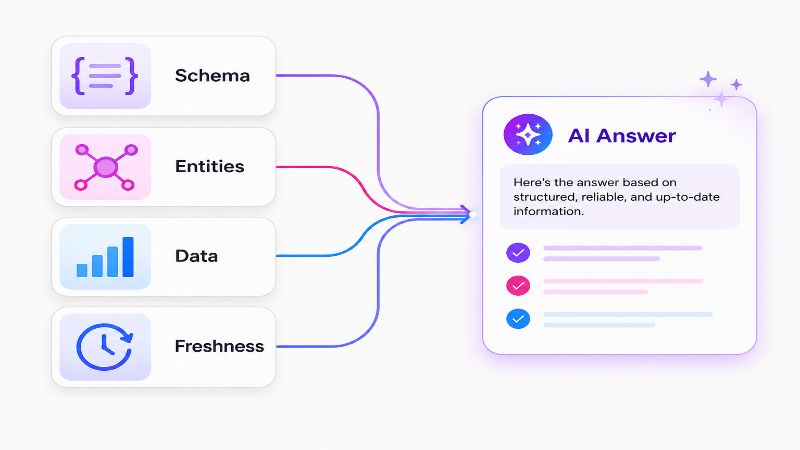
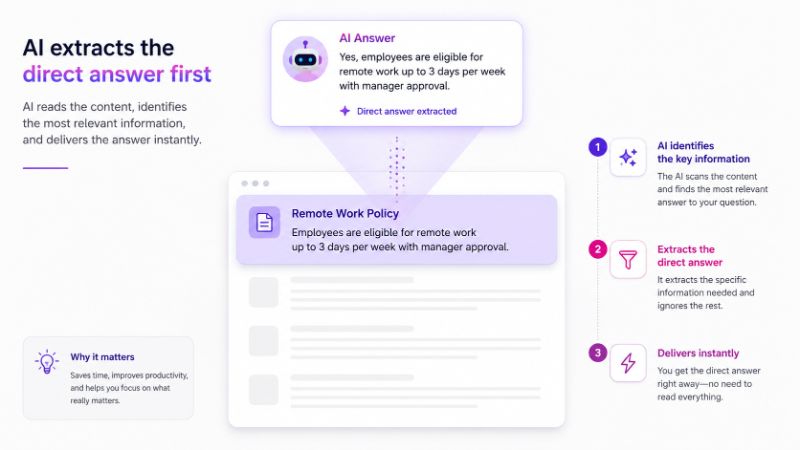
Answer the Question First
Lead each section with a direct answer to the question it addresses, usually in the first 40 to 60 words.
Engines lift self-contained passages. A paragraph that states the answer plainly before the context is far easier to quote than one that builds up to the answer over several sentences.
Then support that answer with specifics. Aim for real fact density: numbers, named examples, and concrete steps rather than vague claims.
This is the same discipline that makes content rank, applied harder. It rewards pages built around the genuine intent behind a query rather than pages padded to hit a word count.
Use Formats AI Engines Lift
Some structures get quoted more than others.
- Short, direct definitions for "what is" questions.
- Numbered steps for "how to" questions.
- Bullet lists for criteria, options, or comparisons.
- A clear FAQ section for the specific questions people ask.
ChatGPT in particular tends to lift bullet points and FAQs almost word for word. A well-built FAQ is one of the highest-value formats for AI visibility.
Add Schema That Engines Read
Structured data tells engines what your content is, not just what it says.
FAQ and HowTo schema reinforce the formats above. Organization and author schema tell engines who is behind the page.
Google AI Overviews in particular tend to favour content with clear FAQ and HowTo structure and short definitions, and schema makes that structure explicit.
Schema sits within your wider technical setup, so it is best handled alongside the rest of your technical SEO rather than bolted on in isolation.
Make Your Business a Clear Entity
AI engines reason about entities: people, organizations, and the relationships between them. The clearer your business is as an entity, the more confidently an engine can cite you.
Use consistent organization details, a real and identifiable author, and accurate descriptions of what you do and where. Connect your site, profiles, and citations so they reinforce the same identity.
This is the same trust foundation that supports normal search. It just carries more weight when an engine has to decide whether to put your name in an answer.
Bring Original Data and Real Authority
Original information creates citation opportunities that recycled content cannot.
If you quote someone else's statistic, the engine tends to cite them, not you. If you publish your own data, your own examples, or a genuinely first-hand perspective, you become the source worth naming.
Back claims with credible references, and make sure a real expert stands behind the content. Verifiable authority is one of the strongest signals an engine uses when choosing what to trust.
This also protects you from the opposite failure. Google judges content on quality and usefulness regardless of how it was produced, and it suppresses thin, mass-produced pages, which rarely earn AI citations either.
Keep Cited Pages Fresh
Recency carries unusual weight in AI search.
One analysis found that 83% of AI citations for commercial queries came from pages updated within the previous twelve months, with more than 60% refreshed within the last six.
Treat your best pages as living documents. Revisit them on a schedule, update the data, and keep the answer current as the topic evolves.
The Engines Are Not Identical
The principles are shared, but each engine has tendencies worth knowing.
Google AI Overviews favour FAQ and HowTo structure, short definitions, and clean formatting. ChatGPT lifts structured formats like bullets and FAQs, often verbatim.
Perplexity always shows its sources and leans toward authoritative pages and original data. Optimizing for clarity, structure, and authority is what helps you across all three at once.
Set a Realistic Expectation
None of this comes with a guarantee, and you should be cautious of anyone who offers one.
AI citation cannot be promised any more than a top ranking can. The engine decides. What you can do is optimize the factors that genuinely influence eligibility, then track which queries cite you and improve from there. For measurement, AIORadar tracks Google AI Overview citations by query and market, helping you establish a baseline and monitor observed changes over time.
If you would rather have the audit, schema, structure, and monitoring handled for you, the AI search optimization service at Search Engine Hub does exactly that.
Frequently Asked Questions
How do I get my website cited in Google AI Overviews?
Answer the question directly near the top of the relevant section, usually in the first 40 to 60 words, then support it with specifics.
Add FAQ and HowTo schema, make your business a clear entity with organization and author markup, back claims with original data and credible sources, and keep the page recently updated. No provider can guarantee inclusion, but these factors make a page far easier to extract and attribute.
Can you guarantee inclusion in an AI Overview?
No. AI citation cannot be guaranteed, in the same way a number one ranking cannot.
The engine decides what to cite. You optimize the factors that influence eligibility, then measure which queries cite you over time and improve from there.
Does schema markup help with AI citations?
Yes. Structured data such as FAQ, HowTo, and Organization schema helps AI engines understand what your content is and who is behind it.
Google AI Overviews in particular tend to favour content with clear FAQ and HowTo structure and short definitions, which schema reinforces.
Why does freshness matter for AI search?
AI engines lean heavily on recently updated content. One analysis found that 83% of AI citations for commercial queries came from pages updated within the previous twelve months, and more than 60% within the last six.
Keeping a cited page current is one of the most reliable ways to protect and grow its AI visibility.
Do ChatGPT and Perplexity work the same way as Google AI Overviews?
They share principles but weigh things differently. ChatGPT often lifts structured formats like bullet points and FAQs almost verbatim, and Google AI Overviews favour FAQ and HowTo structure, short definitions, and clear formatting.
Perplexity always cites its sources and leans toward authoritative pages and original data. Optimizing for clarity, structure, and authority helps across all of them.
Want your pages structured to be cited, not just to rank?
AI search optimization at Search Engine Hub audits where AI engines cite you today, then structures your content, schema, and authority to improve it.
See AI Search Optimization
Illan Lebumfacil
Founder of Search Engine Hub and independent SEO specialist with over 10 years of experience. Works directly with local businesses, service providers, and online brands across the Philippines, Australia, and internationally to improve their Google rankings through precise, data-driven strategies.
Read more about Illan's background and approach, or connect directly on LinkedIn.