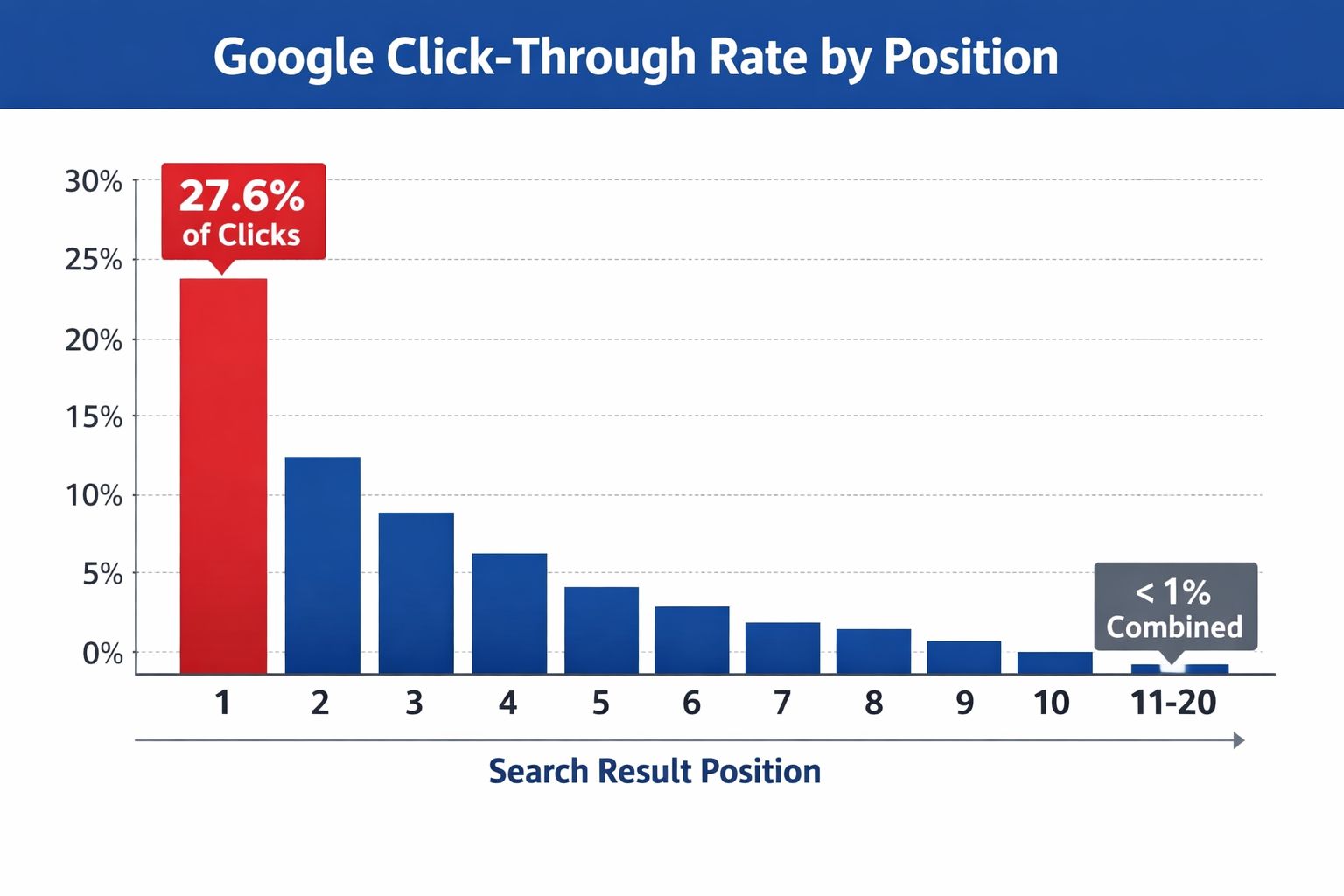
The cruelest place to be in Google is position 11. Your page exists, Google has indexed it, and it is technically ranking. But position 11 means page 2, and page 2 is where pages go to be ignored. Studies consistently show that fewer than 1% of searchers click past the first page of results.
For most businesses, having a page sit at position 12 or 15 is the same as not ranking at all. The traffic does not trickle in slowly. It simply does not come. And because the page is technically ranking, the problem is easy to overlook until you connect the dots between what Google Search Console shows and what your actual inbound traffic looks like.
There are specific, diagnosable reasons pages plateau at positions 11 to 20. Understanding which one applies to your pages is the first step toward doing something about it.
What Page 2 Really Means for Your Business
Page 1 of Google captures around 71% of all clicks for a given search. Positions 1 through 3 alone account for more than half of those. By the time you reach position 10, the click-through rate has already fallen to around 2.5%.
Position 11, the first result on page 2, averages below 1%.
For a keyword that gets 500 searches a month, the difference between ranking position 3 and position 11 is roughly 85 clicks per month versus 5. That gap represents inquiries, leads, and revenue that are going to whoever holds those top positions instead of you.
The frustrating part is that Google already considers your page relevant enough to rank it. You are not being ignored. You are being outcompeted by a small margin on signals you can actually improve. That is different from starting from zero.
Reason 1: Your Page Does Not Match What the Searcher Is Actually Looking For
Google's primary job is to return results that match what the person typing the query actually wants. Not what the words literally say, but what the intent behind them is.
A business owner searching "local SEO" might be looking for an explanation of what it is, a list of providers to evaluate, or a step-by-step guide to do it themselves. Those are three completely different intents, and Google has analyzed millions of past searches to understand which type of result most people want for any given query.
If your page is written as a service page but the dominant intent for that keyword is informational, Google will consistently rank how-to guides and explanatory articles above your page. The reverse is also true. If someone is searching for a service and your page reads like a blog post, it will lose to pages that clearly present themselves as service providers.
This is one of the most common reasons pages sit at positions 11 to 20. The page is relevant to the topic but delivers the wrong type of answer. A deeper look at what the intent mismatch problem actually looks like across different page types is covered in the article on search intent and why it outranks keyword density.
Reason 2: The Content Does Not Go Deep Enough
Thin content is one of the most consistent reasons pages fail to hold page 1 positions. The threshold for what counts as thin has shifted significantly over the past two years as Google has become better at evaluating whether a page genuinely addresses the full scope of what someone is asking.
Thin does not mean short. A 300-word page can outrank a 2,000-word page if it answers the specific question better. What Google is evaluating is whether the page covers the topic with enough substance that a real person would find it useful and not need to go back to search results to fill in the gaps.
Pages that plateau at positions 11 to 20 often have the right keyword focus but cover the topic at surface level only. The pages ranking above them go further. They address follow-up questions, cover edge cases, include specifics rather than generalities, and demonstrate a real understanding of the topic rather than just a passing familiarity.
The test is simple: read your page alongside the pages ranking in positions 1 to 3. If a visitor would learn significantly more from those pages than from yours, Google already knows it.
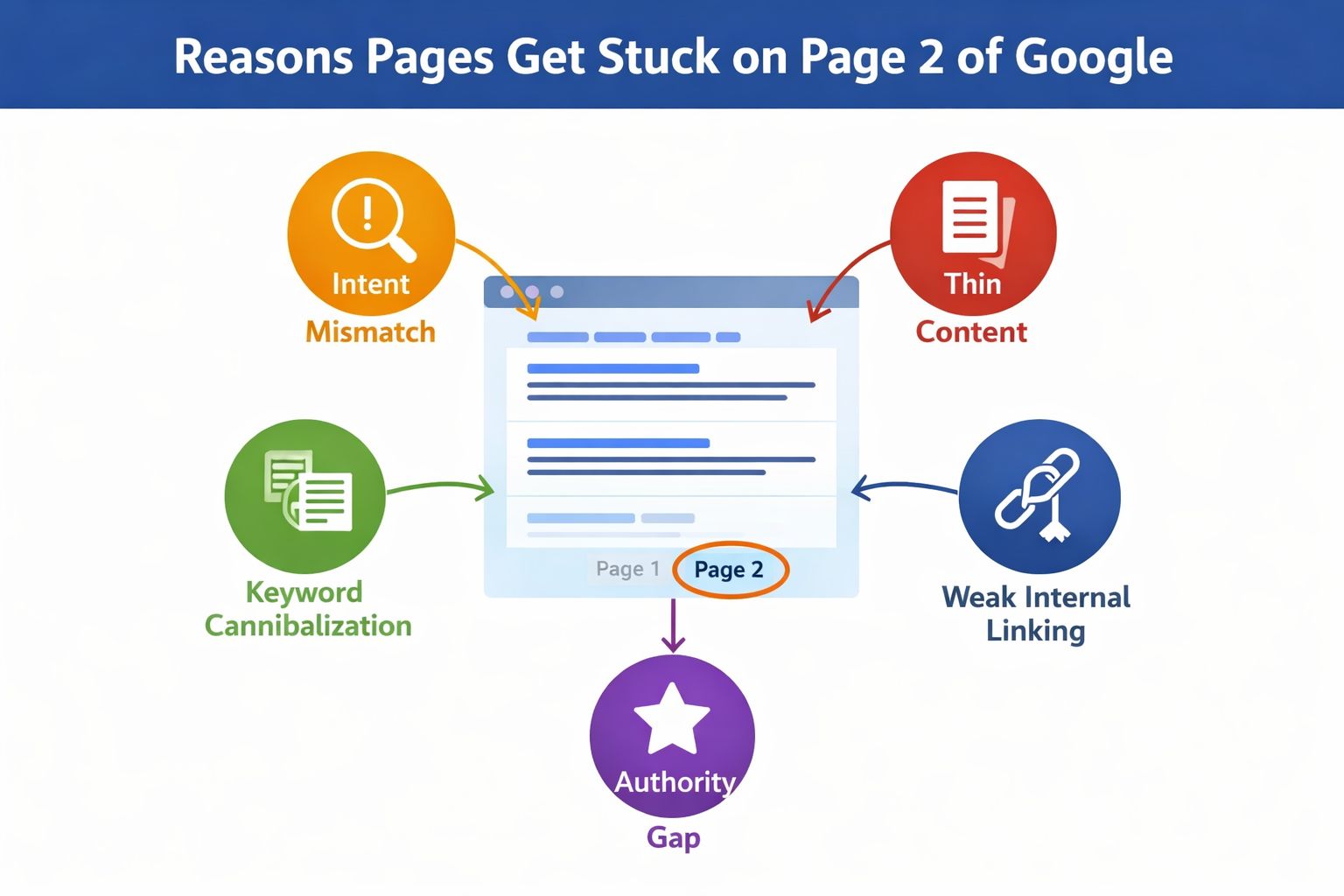
Reason 3: Another Page on Your Own Site Is Targeting the Same Keyword
This one catches a lot of business owners off guard. If two pages on your website are both trying to rank for the same keyword or closely related phrases, they compete against each other instead of reinforcing each other. Google has to pick one to show, and it often picks the wrong one from your perspective, or alternates between them unpredictably.
The result is that neither page builds the ranking strength it would have if it were the only page targeting that topic. You have split the authority that should concentrate on one page across two weaker ones.
This problem, called keyword cannibalization, is more common than most people realize. It happens when a business publishes a blog post that overlaps with a service page, creates separate pages for similar services, or builds location pages that all target the same phrase with only the city name swapped out. The full explanation of how this happens and what the symptoms look like is in the article on keyword cannibalization and why it suppresses rankings.
Reason 4: Not Enough of Your Own Pages Link to It
Google uses the links between pages on your site as signals of importance. When a page on your site has many other pages pointing to it, Google interprets that as a sign that the page matters. When a page is largely isolated, sitting without internal links pointing toward it from other relevant pages, it receives less of that internal authority signal.
Many businesses have service pages or blog posts that were published and then essentially abandoned. They exist on the site but are not referenced from anywhere else. They sit in the navigation but no article, related page, or contextual link points to them with descriptive anchor text.
This is a structural problem rather than a content problem. The page might be well written and targeting the right keyword. But if Google sees that the rest of your site rarely references it, that absence is a signal that the page may not be as important as the competing pages that have dozens of internal links pointing to them.
Fixing this does not require new content. It requires a systematic review of which pages are under-linked and deliberately adding contextual links from related pages that already have authority.
Reason 5: The Sites on Page 1 Simply Have More Authority
Sometimes the reason a page is stuck on page 2 is not something wrong with the page itself. The sites holding page 1 positions have significantly more external links from other websites, have been publishing on the topic longer, and have established a level of authority in Google's eyes that is not closed by a content update alone.
This is the hardest situation to be in, but it is also the most honest one to acknowledge. Improving content quality and internal linking will help, but if the gap is primarily an authority gap, the longer-term answer involves building the credibility of the domain through external signals over time.
Identifying whether this is the real bottleneck requires looking at the backlink profiles of the pages ranking above yours. If those pages have hundreds of referring domains from relevant sites and yours has a handful, that tells you what you are actually competing against.
How to Tell Which Problem Your Page Has
Most pages stuck on page 2 have more than one of these problems. But they are not equal in impact, and treating them all at once without understanding the priority is one of the most common ways businesses waste effort without results.
The starting point is Google Search Console. Filter for pages sitting at an average position between 11 and 30. Look at the keywords those pages are appearing for. Then ask:
- Are the pages ranking above yours structured differently from mine? If they are blog posts and yours is a service page, intent mismatch is likely the primary issue.
- Does the content on those pages cover more ground, include more specifics, or address questions mine does not? Content depth is the issue.
- Is there another page on my site covering the same topic? Check for cannibalization before investing in improvements that may not work if two pages are splitting signals.
- How many pages on my own site link to this page? If the answer is few or none, internal linking is part of the diagnosis.
- How many external sites link to the pages on page 1 compared to mine? If the gap is large, authority is a long-term factor to address alongside content work.
For a structured framework on reading the signals an audit pulls together across all these factors, the article on how to read an SEO audit report walks through how to interpret what the data is actually telling you.
What Typically Happens When These Pages Are Left Alone
Pages do not stay in place passively. Google's index is continuously updated. Competitors publish new content. Algorithm updates re-evaluate what qualifies as the best result for a given query.
A page sitting at position 13 today is not guaranteed to stay at position 13 next quarter. If nothing improves it, and competitors improve their pages, it will drift lower. Position 13 becomes position 18. Position 18 becomes position 25. At that point, moving it back requires significantly more work than addressing it early would have.
The window where a page at position 11 to 20 can realistically be improved into a page 1 position is not permanent. It exists because the page is close enough that Google already sees it as relevant. That gap closes when something better replaces it in Google's assessment.
Have pages sitting on page 2 that should be ranking higher?
The content optimization service at Search Engine Hub identifies which pages are closest to breaking through, diagnoses the specific reason each one is stuck, and implements the changes needed to move them. Businesses typically see position movement within 4 to 8 weeks.
See Content Optimization ServiceFrequently Asked Questions
What is the difference between page 1 and page 2 in Google search results?
Page 1 of Google captures roughly 71% of all clicks for a given search. Page 2 captures less than 1%. The drop-off is not gradual. It is a cliff edge at the bottom of page 1. For most queries, being on page 2 produces so little traffic that it is functionally the same as not ranking at all.
Can a page jump from position 15 to page 1?
Yes, but not without understanding what is holding it back first. Pages sitting at positions 11 to 20 are close enough that Google already considers them relevant. The gap is usually quality-related. Identifying the specific cause, whether content depth, intent mismatch, weak internal linking, or a competing page on the same site, determines what improvement is actually needed.
My page was on page 1 and dropped to page 2. What happened?
A drop from page 1 to page 2 usually follows a Google algorithm update, a competitor publishing something stronger, or a change on your own site that weakened the page. If the drop coincides with a known update date, that is the most likely cause. Algorithm updates re-evaluate content quality and intent signals across categories, and pages that previously ranked on signals the update re-weighted are common casualties.
Does fixing one underperforming page help other pages on my site?
Indirectly, yes. Improving a page's content and internal link coverage raises its authority, which benefits pages it links to. Fixing a cannibalization issue by consolidating two competing pages concentrates signals into one stronger page. Improving internal linking from strong pages to weak ones transfers some authority. These effects compound over time rather than appearing immediately.
How long does it take to move from page 2 to page 1?
Pages already at positions 11 to 15 can see meaningful movement within 4 to 8 weeks of a substantive improvement. Pages at positions 16 to 20 typically take longer, often 2 to 4 months, because they usually need a combination of content improvement, internal link coverage, and in competitive markets, some external authority. The speed depends heavily on how competitive the keyword is and how significant the improvement is.
Should I update an old page or create a new one to rank better?
If the existing page is indexed and sitting at positions 11 to 30, updating it is almost always the better choice. Creating a new page targeting the same keyword creates a second competing page on your own site. The existing page already has some history with Google. Building on it is faster and safer than starting from zero with a new URL.
Why does my page rank differently depending on where I search from?
Google personalizes results by location, device, search history, and the data center serving the query. A page ranking at position 8 in Manila may rank at position 12 in Sydney for the same query. For an accurate read of where your page actually stands, use Google Search Console, which shows average position across all searches, or a rank tracking tool set to a fixed location without personalization.
Written by
Illan Lebumfacil
SEO Freelancer at Search Engine Hub, based in Talisay, Cebu. Helping businesses in the Philippines and internationally improve their search visibility through precise, data-driven strategies.
About me →