There is a particular kind of SEO problem that is almost invisible from the inside. You have a service page you spent time on. You also published a blog post on the same topic to drive traffic. Both look fine individually. Neither ranks particularly well. You assume the market is just competitive.
The real problem might be that your two pages are competing against each other. Google sees both, has to pick one to show for a given search, and often picks the one you did not intend, or rotates between them in a way that prevents either from building consistent authority. This is called keyword cannibalization, and it is one of the quieter reasons sites plateau without an obvious cause.
What Keyword Cannibalization Actually Is
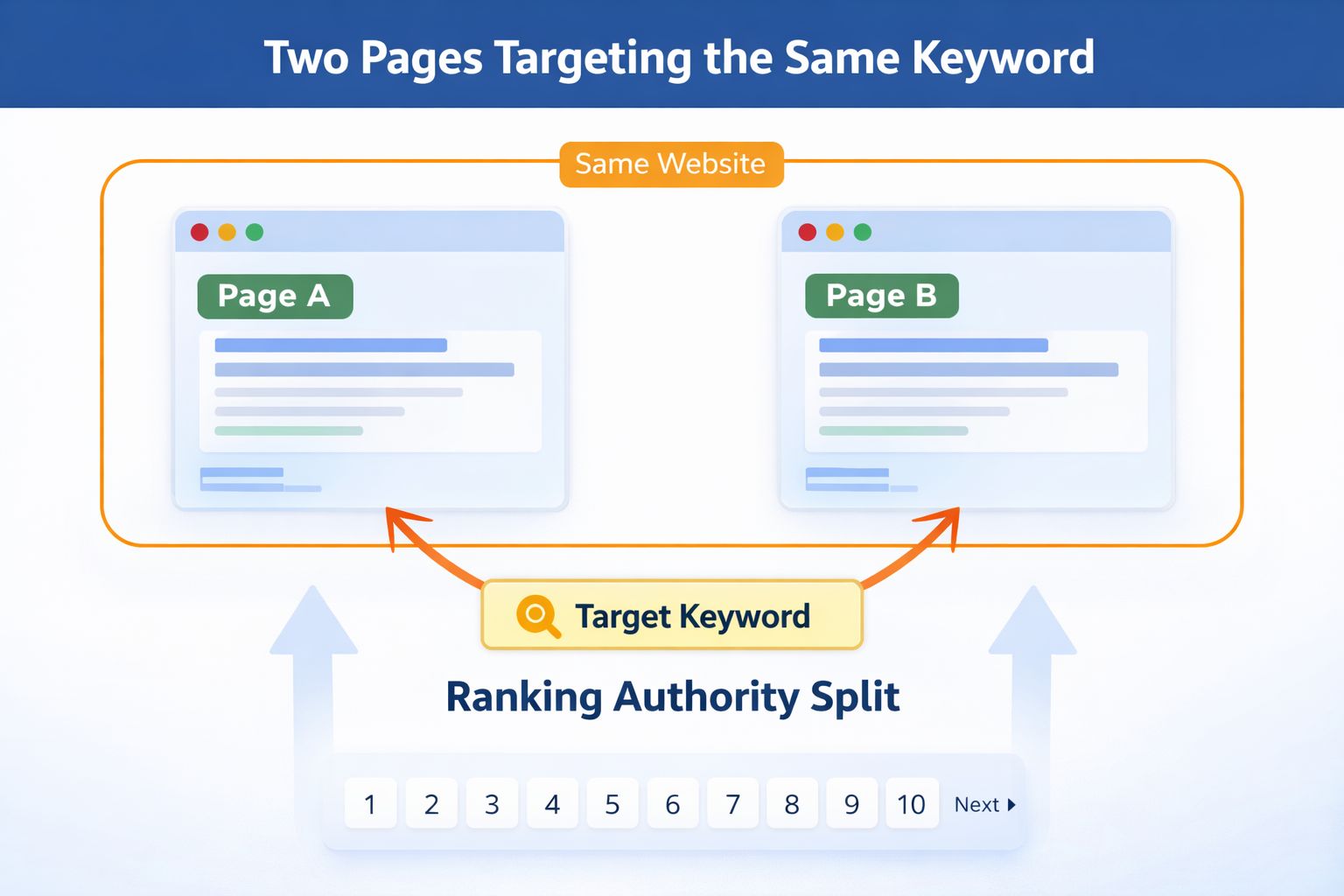
Every page on your website sends signals to Google about what topic it covers and what searches it should appear for. When two pages send similar signals for the same search query, Google faces a conflict. It needs to return one result per site for most queries, but it has two candidates that both appear relevant.
In this situation, Google does one of three things. It picks the page it considers stronger and ranks that one consistently, often the wrong one from your perspective. It alternates between the two pages, which creates ranking instability where your position for a keyword shifts without explanation week to week. Or it ranks both at lower positions than either would achieve alone, because the authority that should concentrate on one page is split across two.
None of these outcomes is good. The underlying issue is that two pages are drawing from the same pool of ranking signals instead of one page accumulating all of them.
How It Happens on Real Business Websites
Keyword cannibalization is rarely intentional. It builds up over time as a site grows, and it is easy to miss because each individual page decision looks reasonable in isolation.
A service page and a blog post on the same topic
This is the most common scenario. A business has a service page for, say, on-page SEO. Later, someone decides to publish a blog post explaining what on-page SEO is to attract informational traffic. Both pages now target phrases like "on-page SEO" or "what is on-page SEO." The service page is meant to convert. The blog post is meant to educate. But to Google, they look like two competing answers to the same question.
The blog post often wins the ranking battle because Google interprets the query as informational and ranks educational content above service pages. The service page, the one you actually want people to find when they are ready to hire someone, gets pushed down or disappears from results for that query.
Multiple service pages covering overlapping territory
A business offering both content optimization and on-page SEO might write detailed descriptions of each service that overlap significantly. Both pages end up mentioning title tags, heading structure, meta descriptions, and keyword placement. If the language is similar enough, Google cannot clearly distinguish which page should rank for a given phrase, and both underperform as a result.
Location pages that are too similar to each other
Businesses with multiple location pages sometimes build them by duplicating one page and swapping the city name. A page for local SEO in Manila and a page for local SEO in Sydney that use nearly identical content, apart from the location name, send almost identical signals to Google. Geographic signals help differentiate them, but if the content itself is largely the same, Google struggles to treat them as distinct enough to rank independently for their respective markets.
What Cannibalization Looks Like From the Outside
Because the problem is structural rather than visible on any single page, keyword cannibalization often presents as symptoms that look like unrelated issues.
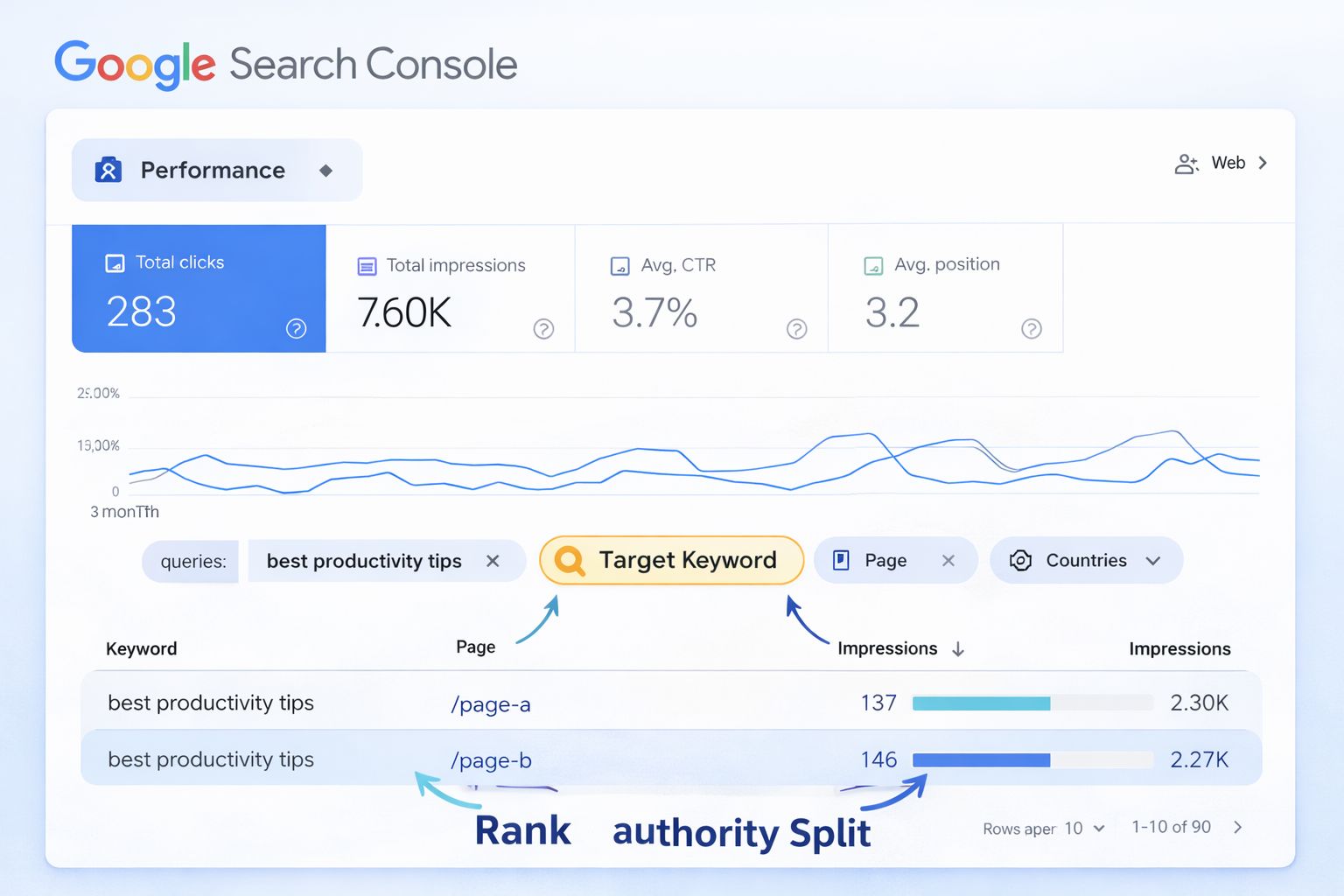
- A keyword that you rank for at position 15 to 25 with two different pages appearing in Google Search Console for the same query.
- Ranking positions that fluctuate significantly week to week for specific keywords without any changes to the pages or any external news affecting the topic.
- A page you recently updated that declined in position while a different, older page on the same topic increased slightly. Google switched its preferred candidate.
- A service page that receives almost no organic traffic despite ranking for relevant keywords, because a blog post on the same topic is absorbing the impressions instead.
The connecting thread in each of these patterns is that two pages are involved in the same ranking conversation. That is the signal to look for.
Why Google Struggles to Choose Between Competing Pages
Google's ranking systems are not designed to evaluate one page at a time in isolation. They evaluate all pages across the entire web that appear relevant to a query, and then rank them relative to each other. When two pages from the same site both appear relevant, Google has to make a judgment call about which one is the better answer.
That judgment is based on signals that can be inconsistent when the pages are similar. The page with more internal links pointing to it might win, even if it is not the page you want to rank. The page that was indexed first might rank, even if the newer page is better written. The page with a title tag that more closely matches the query might rank for that specific phrasing, while the other page ranks for a slightly different phrasing, splitting your visibility across both.
None of this is predictable from the outside without looking at the actual data. And because Google's assessment can change with each update and re-crawl, the situation does not resolve itself passively. It tends to get worse as both pages age without one clearly dominating.
Cannibalization is one of the reasons pages get stuck at positions 11 to 20 without an obvious cause. The full picture of why pages plateau there is covered in the article on why pages get stuck on page 2 of Google.
How to Check If Your Site Has This Problem
There are two checks that are straightforward enough to do without specialist tools.
The first is a site search. Type site:yourdomain.com "your target keyword" into Google. If two or more of your own pages appear in the results for the same search, you have a cannibalization signal worth investigating.
The second is Google Search Console. Open the Performance report, filter by a specific keyword you care about, and then look at which pages are receiving impressions for that query. If multiple pages are listed, those pages are competing. The one with lower clicks despite similar impressions is likely the one Google is deprioritizing.
These checks give you the signal. Understanding what to do with it requires looking at the relationship between those pages, their content, their internal link structure, and their authority relative to each other. That is where the diagnostic work becomes more involved.
An SEO audit that specifically covers on-page structure will surface cannibalization issues across the entire site, not just the keywords you happen to check manually. It also identifies which fix is appropriate for each instance, since consolidation, differentiation, and canonical tagging each solve a different variation of the problem.
What the Fix Involves and Why It Is Not Straightforward
There is no single universal fix for keyword cannibalization. The right approach depends on the relationship between the specific pages involved.
When two pages cover the same topic at a similar level and serve the same audience, consolidation is usually the strongest option. The content from both pages is merged into one page, and the weaker page is redirected to it using a 301 redirect. The combined page inherits the authority signals from both pages and can rank more cleanly for the target keyword. The content optimization service handles this kind of consolidation work as part of a broader page improvement process.
When two pages genuinely serve different audiences or different parts of the buyer journey, differentiation is the answer. This means making each page more clearly distinct: tightening the keyword focus, adjusting the content angle, and updating internal links so each page is referenced consistently for its intended topic.
When one page is the definitive version and the other exists for structural reasons, a canonical tag tells Google which page to treat as the primary one. This is common in situations involving location pages, paginated content, or pages that exist at multiple URLs due to site architecture decisions.
The risk of applying the wrong fix is real. Redirecting the wrong page, or merging content that should stay separate, can remove ranking signals that were helping individual pages hold positions. This is one of the reasons on-page structural changes carry more consequence than they might appear to from the outside.
Suspect your pages are working against each other?
The on-page SEO service at Search Engine Hub includes a cannibalization audit across your entire site, identifying which pages are competing, which fix applies to each, and implementing the changes so rankings consolidate rather than split.
See On-Page SEO ServiceFrequently Asked Questions
What is keyword cannibalization?
Keyword cannibalization is when two or more pages on the same website compete for the same search query. Google has to decide which page to rank, and it often picks the wrong one or alternates between them unpredictably. The result is that neither page builds the ranking authority it would if it were the only page targeting that keyword.
How do I know if my site has keyword cannibalization?
The simplest check is typing site:yourdomain.com followed by your target keyword into Google. If two or more of your own pages appear, that is a signal worth investigating. Google Search Console reveals it more precisely: filter the Performance report by a specific keyword and check which pages are receiving impressions. If multiple pages share impressions for the same query, those pages are competing.
Is keyword cannibalization the same as duplicate content?
They are related but different problems. Duplicate content means two pages have the same or very similar text. Keyword cannibalization means two pages target the same keyword even when the content is different. A service page and a blog post on the same topic can cannibalize each other without having identical content. Both problems weaken rankings, but they have different causes and different fixes.
Can keyword cannibalization cause a ranking drop?
Yes. When two pages compete for the same query, ranking signals split across both. Neither page builds full strength. Google also alternates between them, which creates ranking instability where your position fluctuates without any external cause. Over time, both pages drift lower as competing sites with consolidated authority outrank them.
What is the best way to fix keyword cannibalization?
The right fix depends on the specific pages. Consolidation works when two pages cover the same topic at a similar level and serve the same audience. Differentiation works when the pages genuinely serve different audiences or stages of the buyer journey. A canonical tag works when one page should be treated as primary for structural reasons. Applying the wrong fix can remove ranking signals that were helping, which is why this is one of the higher-consequence on-page changes to make.
Do location pages cause keyword cannibalization?
They can. Location pages that target the same service phrase with only the city name swapped, and the same content structure duplicated, send nearly identical signals to Google. Without genuinely differentiated content and clear geographic signals, Google struggles to rank each page independently for its intended city. This is why location pages need more than a city name substitution to perform well in competitive local markets.
Can internal links cause or worsen cannibalization?
Internal links do not cause cannibalization directly, but they can reinforce the wrong page. If your internal links point to a blog post using anchor text you want your service page to rank for, you are sending mixed signals to Google about which page is authoritative for that keyword. When resolving cannibalization, internal links need to be reviewed and updated to consistently point to the page you want to rank, using anchor text that reflects its intended keyword focus.
Written by
Illan Lebumfacil
SEO Freelancer at Search Engine Hub, based in Talisay, Cebu. Helping businesses in the Philippines and internationally improve their search visibility through precise, data-driven strategies.
About me →