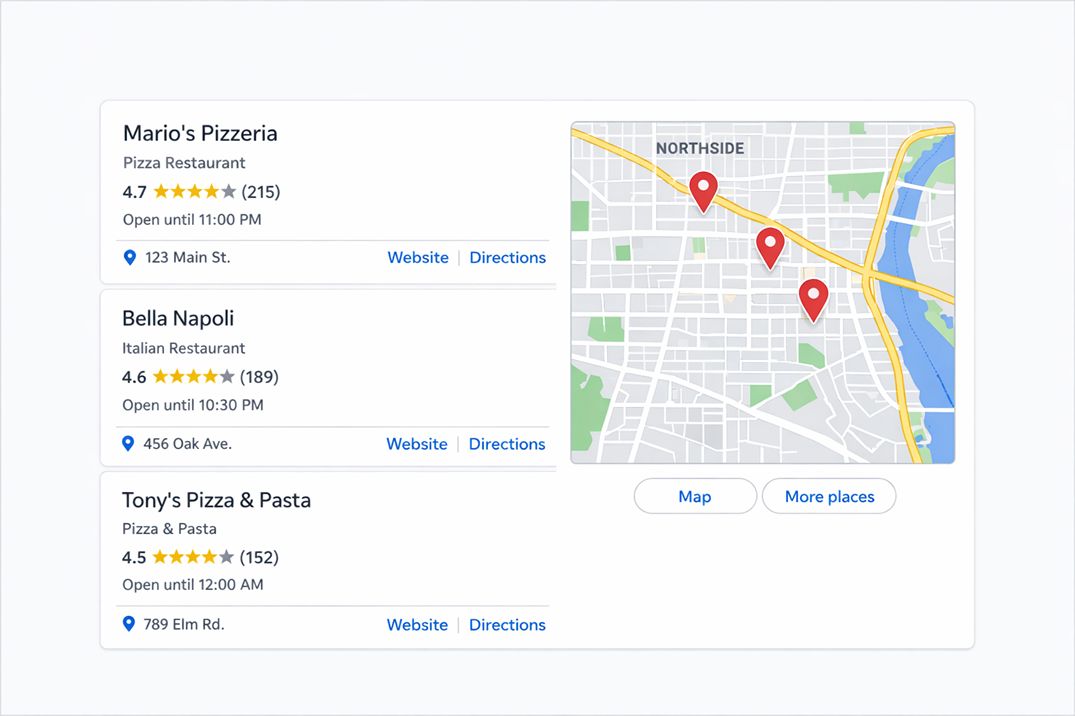
When someone searches "dentist near me" or "coffee shop in Talisay," they see a block of three business listings appear above the organic results, alongside a map. That block is the Google Local Pack, also called the Map Pack or 3-Pack.
It is the single most valuable piece of real estate in local search. Data from ALM Corp shows that businesses appearing in the Local Pack earn 126% more traffic and 93% more user actions than those ranked fourth through tenth.
With nearly half of all Google searches carrying local intent, getting into those three spots is not optional for any business that serves a local area. This article breaks down exactly how Google selects those three businesses, what has changed in 2026, and the specific actions that move the needle.
The Three Factors Google Uses to Rank the Local Pack
Google's official documentation states that three factors determine Local Pack rankings: relevance, distance, and prominence. These have not changed. What has changed is how Google measures them.
Relevance
Relevance is how closely your business profile matches what the searcher is looking for.
The single most important relevance signal, according to the Whitespark 2026 Local Search Ranking Factors survey based on responses from 47 local SEO experts, is your primary Google Business Profile category. It is the number-one ranking factor overall.
Specificity matters here. "Emergency Plumber" sends a stronger signal than "Plumber." "Pediatric Dentist" outperforms "Dentist" if that is your actual specialty. Your primary category is what Google uses to determine which searches your listing is even eligible for.
Secondary categories matter too. The same survey ranks selecting relevant additional categories as the eighth most important factor. The principle is the same: be precise, not broad.
Distance
Distance is straightforward. Google looks at how close a business is to the searcher, whether that is their GPS location or the area they implied in the search query.
You cannot move your business. But you can strengthen distance signals by keeping your verified address accurate, targeting service area keywords, and generating reviews from across the areas you serve.
For service-area businesses without a physical storefront, getting reviews from clients across your service territory is one of the few levers available.
Prominence
Prominence is how well-known and trusted Google considers your business to be. This is the most layered of the three factors and the one you have the most control over.
Prominence signals include:
- Review volume and average star rating
- Consistency of your business name, address, and phone number (NAP) across directories and the web
- Quality and authority of websites linking to yours
- How users behave when they interact with your listing
All three of these factors are shaped by what you do actively. Prominence is not something Google assigns once and leaves alone.
What the 2026 Whitespark Report Actually Says
The Whitespark Local Search Ranking Factors survey, released in late 2025 and covering 2026 conditions, is the most comprehensive available data on what influences Local Pack rankings. A few findings stand out.
GBP signals dominate. Eight of the top ten ranking factors in the Local Pack and Maps category come directly from the Google Business Profile. No other single channel concentrates this much ranking influence.
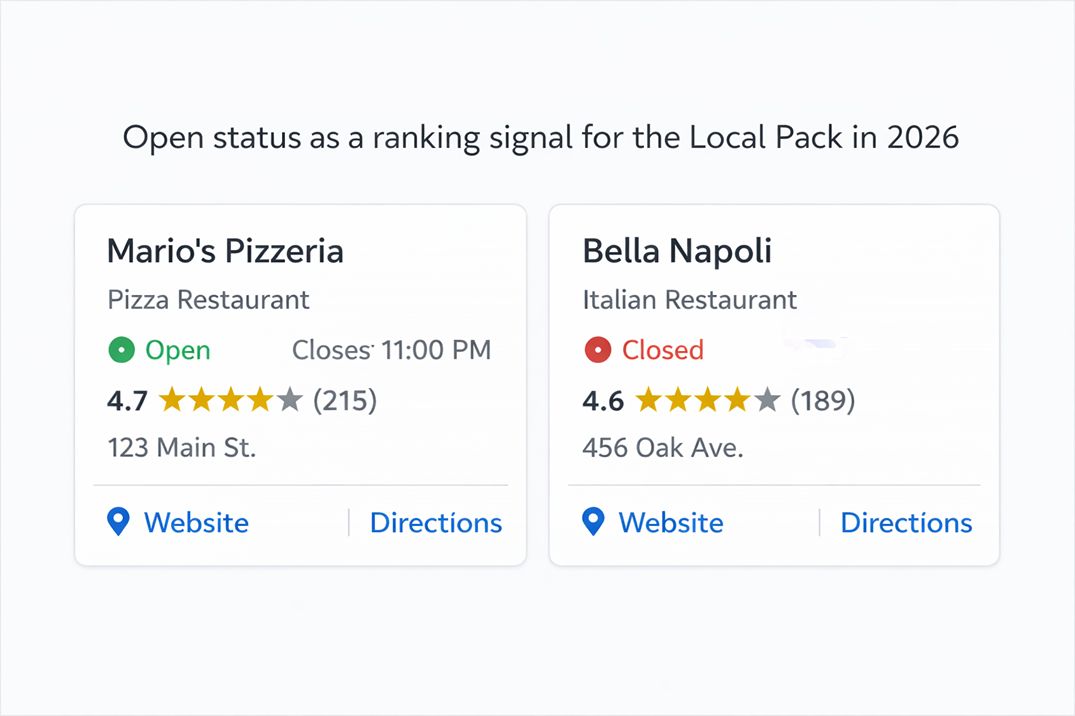
Being open matters more than it used to. Being open at the time of a user's search is now the fifth most important factor for Local Pack visibility. A BrightLocal study tracking 50 businesses across 10 categories found that rankings dropped consistently when a business was listed as closed.
If your hours are wrong, outdated, or missing special holiday closures, you are losing visibility at the exact moments when searchers have the highest intent to act.
Review velocity beats review totals. It is not enough to have a high total review count from years ago. A steady stream of new reviews over time signals to Google that your business is currently active and trusted. The review velocity signal has grown in importance as Google becomes better at reading recency.
Behavioral signals are now measurable ranking inputs. Clicks to your website, calls initiated from your listing, direction requests, and photo views are all signals Google tracks. When users interact with your profile, Google interprets that as validation that your listing was a relevant result.
How Operating Hours Became a Ranking Factor
This is one of the more practical findings from recent local SEO research and one that most business owners overlook.
If a user is searching at 7pm on a Sunday and your hours say you close at 5pm, Google may suppress your listing in favor of competitors who are open. The search engine is trying to give searchers results that are actually useful to them right now.
The fix is simple but requires discipline:
- Audit your hours and verify they are accurate across all platforms
- Add special hours for public holidays
- Update your hours whenever they change, immediately
Keeping hours current is one of the lowest-effort, highest-impact optimizations available for Local Pack rankings.
The Shift Google Made: Static Profiles No Longer Work
For years, the playbook was straightforward. Claim your Google Business Profile, fill it out, pick a category, add some photos, and it would hold its position. That era is over.
Google has transformed the GBP from a directory listing into a live engagement surface. Businesses that treat it like the former are losing local visibility to competitors who treat it like the latter.
What Google now rewards is consistent activity. The signals it looks for include:
- Regular photo uploads (not a one-time batch from years ago)
- Recent review responses, ideally within 48 hours of each review
- Active use of Google Posts to share updates, offers, or events
- An up-to-date services section that matches your actual current offering
The practical implication is that your GBP requires a weekly maintenance habit, not a one-time setup.
If you want to understand exactly where your GBP and website stand before doing any of this, a proper SEO audit will map out the gaps clearly and prioritize them by impact.
NAP Consistency: Still Foundational, Still Underestimated
NAP stands for Name, Address, and Phone number. Google cross-references this information across your website, your GBP, and every directory or platform that mentions your business.
When that information is inconsistent, it creates what local SEO practitioners call "citation noise." Google becomes less confident that the references across the web all point to the same business. That uncertainty is not rewarded with rankings.
The sources that matter most for citation consistency are:
- Your own website (header, footer, contact page)
- Google Business Profile
- Facebook and other social profiles
- Industry directories relevant to your category
- General directories: Yelp, Foursquare, Apple Maps, Bing Places
Small variations cause real problems. "St." versus "Street," a suite number listed in some places but not others, or an old phone number still appearing somewhere can all create inconsistency signals.
Choosing the right keywords to target across these citations connects directly to the topic of long-tail keywords for local businesses, which covers how to identify the exact search terms your local audience uses and where to place them effectively.
Reviews: The Signal That Has Grown Most in 2026
Reviews have always mattered. In 2026, they matter more than at any prior point, and the way Google reads them has become more sophisticated.
Google's AI reads the content of reviews, not just the star rating. This means the specific words customers use in their reviews affect your relevance for related searches.
A physiotherapy clinic where clients repeatedly mention "sports injury rehab" in their reviews will rank better for sports injury-related queries than a clinic with the same star rating but vague, generic reviews.
What this means practically:
- Respond to every review within 48 hours, both positive and negative
- Request reviews within 24 hours of completing a service or transaction
- Make the ask easy by sending a direct review link, without coaching what to write
- Never use fake reviews. The Google August 2025 spam update specifically targeted inauthentic engagement, and the penalties are significant
Whitespark's Darren Shaw recommends expanding beyond Google reviews to include industry-specific platforms where your customers actually look, whether that is Yelp, TripAdvisor, Houzz, or a sector-specific directory.
The AI Layer: How Google AI Mode Is Changing Local Search
This is the biggest structural shift in local search in 2026, and most business owners do not yet understand it.
Google's AI Overviews now appear in over 13% of all searches, with the highest concentration on question-based and comparison queries. For local searches, this means an AI-generated summary sometimes appears above the Local Pack entirely. In some cases, it appears instead of a local pack.
The businesses that appear in these AI summaries are not always the same businesses that appear in the traditional three-pack. Research from Sterling Sky's "The State of Local SEO in 2026" report found that AI local packs feature only 32% as many unique businesses as traditional packs. That is a 68% reduction in the number of businesses getting any local visibility in that AI format.
What determines who gets surfaced in AI results? The Whitespark 2026 report introduced an entirely new AI Search Visibility category for the first time, with citation-based and entity-based signals making up three of the top five AI visibility factors.
Entity signals mean that Google evaluates your business as a whole entity, not just a collection of keywords. It looks at whether your business clearly and consistently represents expertise in a specific category across all of your digital touchpoints: your GBP, your website, your mentions across the web, and your review content.
The practical takeaway is that the work you do for traditional Local Pack rankings directly supports your AI visibility. They are not separate strategies.
A Practical Checklist to Improve Your Local Pack Rankings
These are recurring actions that maintain and strengthen your signal over time, not a one-time setup.
Google Business Profile
- Primary category selected with maximum specificity
- Secondary categories added for all legitimate services
- Business hours current and complete, including special hours
- Services section filled out with accurate descriptions
- Photos added regularly, at minimum once per week
- Google Posts published at least twice per month
- Questions in the Q&A section answered promptly
Reviews
- A repeatable process for requesting reviews after each completed service
- Responses written for every review within 48 hours
- Reviews sought on industry-specific platforms, not just Google
Website
- Name, address, and phone number displayed clearly and consistently
- A dedicated contact page with embedded Google Map
- LocalBusiness schema markup implemented
- Location and service keywords included naturally in page content
Citations
- NAP consistent across all major directories
- Any outdated listings corrected or removed
If this list reveals that your current presence has meaningful gaps, the right starting point is a local SEO service that addresses all of these signals systematically rather than in isolation.
Frequently Asked Questions
How many businesses appear in the Google Local Pack?
The standard Local Pack shows three businesses. Google also displays a "More places" link that opens a longer list in Google Maps. In some AI-generated local results, the format shows fewer businesses.
Does my website affect my Local Pack ranking?
Yes. Your website is one of the factors Google uses to assess prominence and relevance. A website with local keyword relevance, accurate NAP information, and LocalBusiness schema markup supports your GBP performance. Google now evaluates your website and GBP as a unified presence.
Can a business rank in the Local Pack without a physical address?
Yes, but it requires setting up your GBP as a service-area business. You specify the areas you serve instead of a public address. Service-area businesses can rank in the Local Pack for searches within their designated areas, but proximity signals are weaker without a verified address.
How long does it take to rank in the Local Pack?
There is no fixed timeline. Businesses with few competitors in a specific category can see movement in weeks. Competitive industries in major cities can take many months of consistent effort. The factors within your control, including GBP completeness, review velocity, and citation accuracy, determine how quickly your signals accumulate.
Do Google reviews affect Local Pack rankings?
Yes. Review volume, average star rating, review recency (velocity), and the specific content of reviews all influence Local Pack rankings. Google's AI reads and interprets review content, which means detailed, specific reviews carry more relevance weight than short, generic ones.
What is the difference between the Local Pack and local organic results?
The Local Pack is the map-based block of three business listings that appears for local intent queries. Local organic results are the standard blue-link results that appear below the Local Pack, which can also include local businesses with relevant web pages. The signals that influence each overlap but are not identical.
How does AI Mode affect the Local Pack?
Google's AI Mode and AI Overviews are increasingly appearing above or in place of traditional Local Pack results for certain queries. The businesses surfaced in these AI results do not always match those in the traditional pack. Maintaining a strong, complete, and consistently updated GBP is the best defense against losing visibility in both formats.
Want someone to review your local search presence?
I check GBP accuracy, citation consistency, review signals, and local ranking factors as part of every local SEO engagement.
Start a ProjectWritten by
Illan Lebumfacil
SEO Freelancer at Search Engine Hub, based in Talisay, Cebu. Helping businesses in the Philippines and internationally improve their search visibility through precise, data-driven strategies.
About me →