Most business owners claimed their Google Business Profile years ago, filled in their name and phone number, and moved on. They assume the profile is working. What they do not realize is that claiming a profile and having a profile that actually ranks in local search are two completely different things.
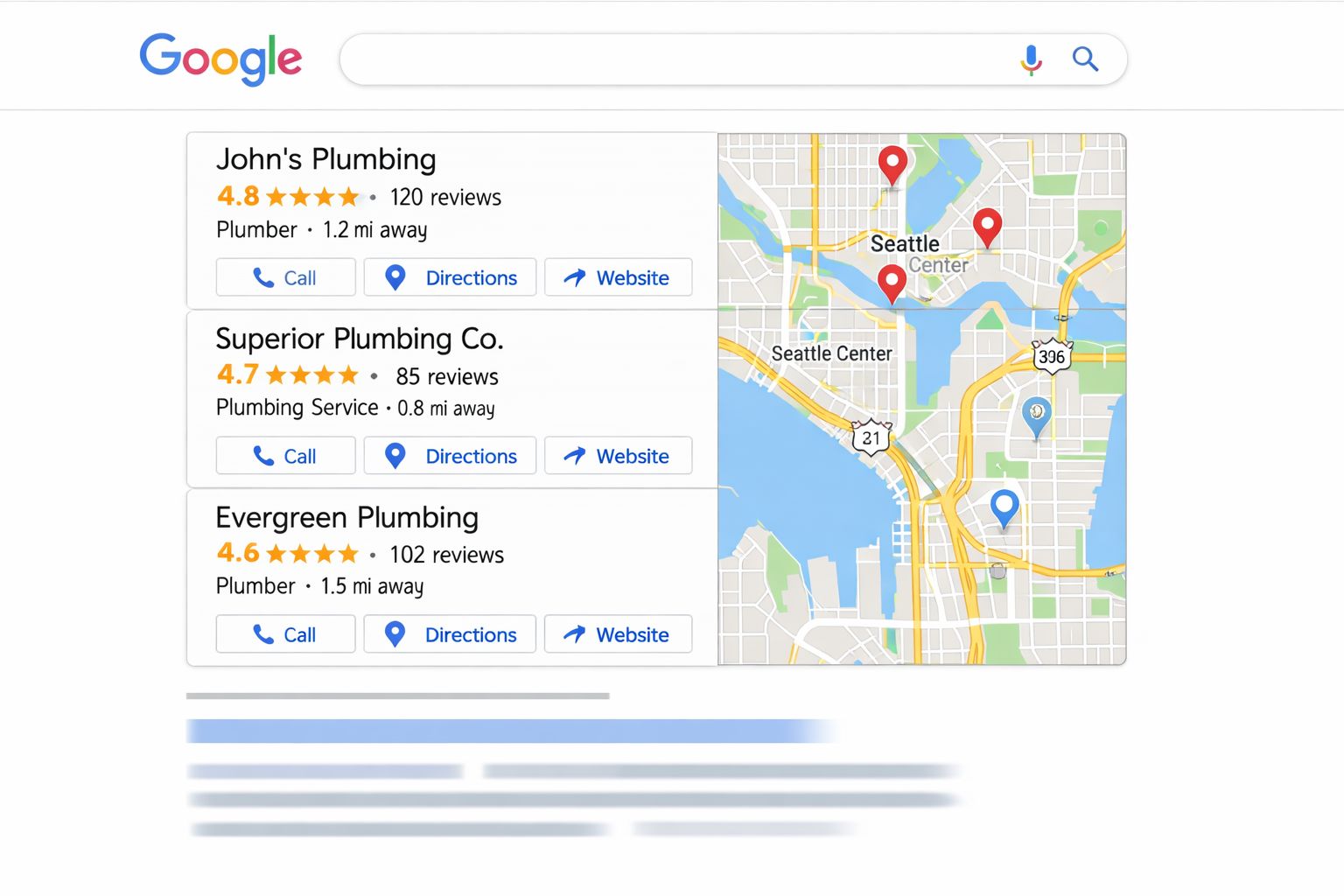
Google's Local Pack, the three-business map block that appears above organic results for local searches, is driven by a ranking algorithm that weighs dozens of signals. A profile that is claimed but incomplete, miscategorized, or inconsistent with other data Google finds about your business will consistently lose that map position to a competitor who has addressed those signals correctly.
The hard part is that most of the issues causing this are not visible to the business owner. The profile looks fine from the inside. The problem shows up in the searches you are not appearing for.
What "Claimed" Actually Means
Claiming a Google Business Profile means you have verified ownership of the listing to Google. It gives you the ability to edit the information. That is all it means. It does not guarantee you appear in search results. It does not tell Google that your profile is complete, accurate, or relevant for any particular set of searches.
Google ranks Business Profiles using three core factors: relevance (how well your profile matches what someone is searching for), distance (how close you are to the person searching), and prominence (how established and active your business appears based on information Google has from across the web).
A claimed but thin profile scores poorly on all three. Google does not have enough information to confidently match it to relevant searches, and it has no signals of activity or authority to treat as prominence. The profile exists in Google's index but competes weakly for the searches that matter to the business. The full picture of how the Local Pack ranking algorithm works is covered in the article on how Google ranks businesses in the Local Pack.
The Category Problem Is More Serious Than It Looks
Primary business category is the single most influential field on a Google Business Profile. It is the main signal Google uses to determine which searches your profile is considered relevant for in the first place.
Choose the wrong primary category and your profile may simply not appear for your most important searches. A plumbing company that selected "Home Services" instead of "Plumber" is telling Google it is a general home services business, not a plumber. A physiotherapy clinic that selected "Medical Clinic" instead of "Physical Therapist" is competing in a broader, less specific category that may not match searches for physiotherapy services in the area.
This is a common problem because the category options in Google's interface are not always obvious, and the closest match is not always the first suggestion that appears. Many businesses either pick the first option that looks reasonable or select a broad category that does not reflect what they actually do. Secondary categories matter too, but the primary category is the foundation everything else builds on. If it is wrong, the rest of the profile is fighting uphill.
Your Business Description Is Not Doing What You Think
The GBP description field is one of the most misused parts of a Business Profile. Two mistakes show up consistently: leaving it blank, or filling it with a list of keywords in a way that reads like it was written for a search engine rather than a person.
The description does not function as a direct ranking factor in the way that category does. Google does not primarily use the description to determine which searches to show your profile for. But it does affect what happens after you appear. A description that clearly communicates what the business does, who it serves, and what makes it worth contacting influences whether someone clicks or scrolls past.
The description also matters for relevance at the margins. Google parses all profile content when evaluating how well a profile matches a search. A description that naturally includes the services the business provides, written in clear language, reinforces the category signals rather than contradicting them.
A description with 50 words of generic phrases like "we are a professional team dedicated to quality service" communicates nothing. Google has nothing meaningful to work with, and neither does the searcher reading it.
Incomplete Profiles Lose to Complete Ones
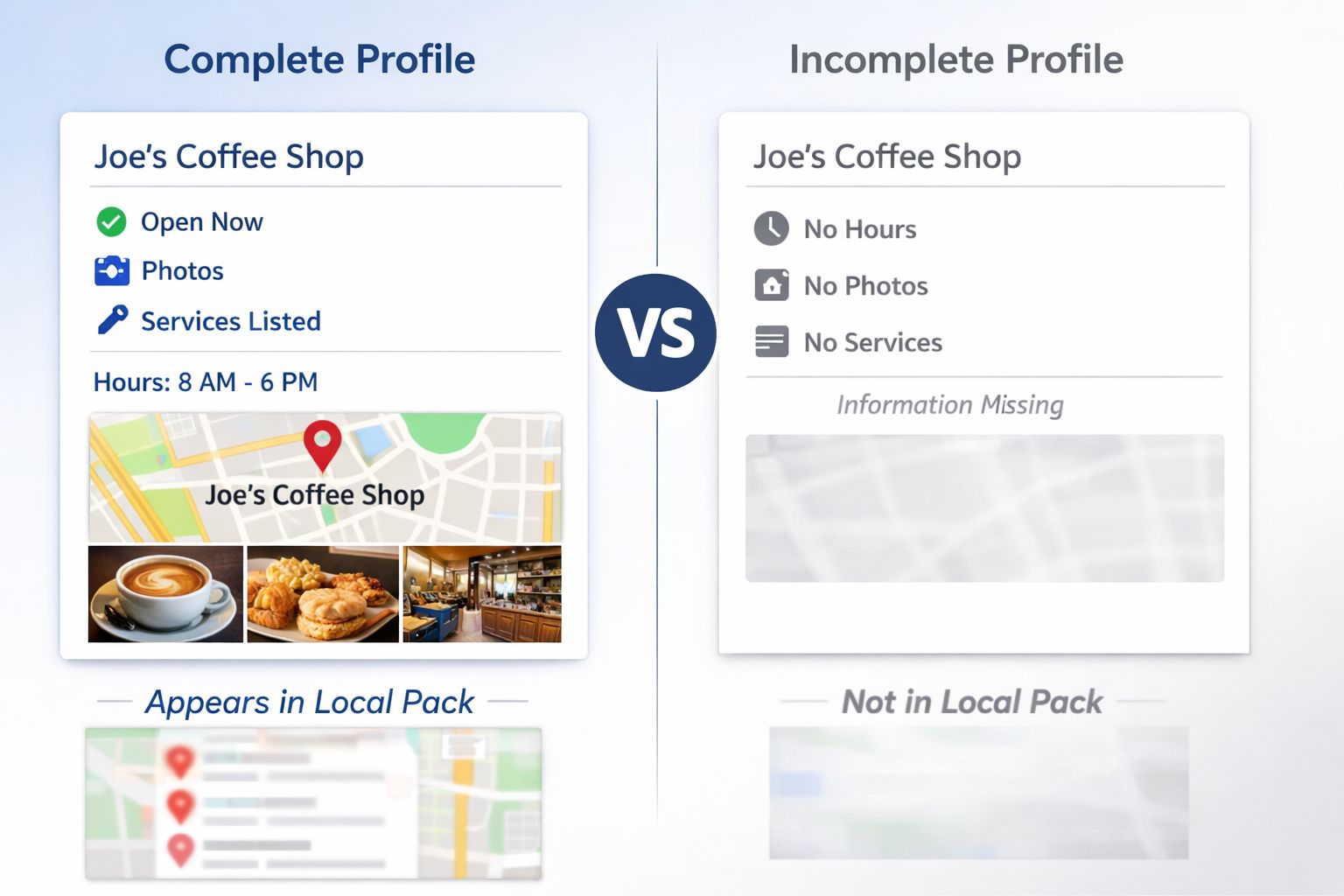
Google explicitly factors profile completeness into local rankings. A profile with all sections filled in, accurate hours, a populated services list, recent photos, and relevant attributes consistently outperforms a profile with the same category that is missing these fields.
The services section is one of the most commonly skipped. It is where you list the specific services your business offers, with optional descriptions and prices. For a business that offers multiple services, this section gives Google a detailed map of what the business does, which helps match the profile to a wider range of relevant searches. A salon that lists haircuts, coloring, keratin treatments, and balayage by name is far more likely to appear for specific service searches than one whose services section is empty.
Photos are another signal many businesses treat as optional. Google treats an active photo library as an indicator of a legitimate, engaged business. Profiles with recent photos from the business and customers typically outperform those with a single stock image or nothing at all. The completeness gap between your profile and a competitor's is often the difference between appearing in the Local Pack and not.
Reviews Are a Signal, But Not the One Most Businesses Focus On
Most business owners think about reviews in terms of the total count. The number that shows next to the star rating. That number matters, but it is not the most nuanced part of how Google uses review data.
Review velocity, the rate at which new reviews arrive over time, is a stronger signal than a high total count accumulated years ago with nothing since. A business with 40 reviews spread across the past 12 months signals to Google that it is actively serving customers and that those customers are engaged enough to leave feedback. A business with 120 reviews from three years ago and nothing recent tells a different story.
Response rate is also part of this picture. Businesses that respond to reviews, both positive and negative, signal active management of the profile. Google surfaces this behavior in profile insights and it correlates with stronger local visibility. A business that ignores reviews is not just missing a reputation management opportunity; it is missing an activity signal that competitors who do respond are accumulating.
NAP Inconsistency Is Undermining What Your Profile Sends to Google
NAP stands for name, address, and phone number. Google cross-references your Business Profile against dozens of other data sources across the web: directories, local citation sites, industry platforms, and your own website. When the information matches, it reinforces your profile's credibility. When it does not match, Google has conflicting data about who your business is and where it is located.
The inconsistency does not have to be dramatic to cause problems. A phone number formatted differently across listings. An old address still appearing on an outdated directory. A business name that appears as "Acme Plumbing" in some places and "Acme Plumbing Services" in others. Each mismatch creates a small amount of confusion in Google's model, and the cumulative effect suppresses local visibility.
Many businesses have NAP inconsistencies from old listings they set up years ago and never returned to, or from data providers that pulled inaccurate information and distributed it across multiple platforms. The cleanup process is unglamorous but necessary. Profiles with clean, consistent NAP data across all major citations consistently rank better than those with conflicting information, even when everything else is comparable.
What This Looks Like in Practice
A typical business profile with these issues looks fine from the inside. The business owner logs in, sees the profile is verified, notes a reasonable star rating, and assumes local SEO is covered. Meanwhile, searches like "plumber near me," "[service] in [city]," or "[specific service type]" are consistently producing results that do not include that business.
The competitor appearing in those results does not necessarily have a better reputation or more experience. They have a profile that communicates more clearly to Google. The right category, a complete services list, consistent NAP data across citations, recent reviews with responses, and a description that reflects what they actually do. Those are not advanced tactics. They are the foundation. But the gap between a profile that has them and one that does not shows up directly in who Google shows to a potential customer.
Not sure where your Business Profile stands?
The Local SEO service at Search Engine Hub includes a full Google Business Profile audit, category correction, NAP consistency cleanup across citations, and ongoing profile management. If your profile has gaps suppressing your Local Pack visibility, this is where to start.
See Local SEO ServiceFrequently Asked Questions
What is a Google Business Profile?
A Google Business Profile (formerly Google My Business) is a free listing that controls how your business appears in Google Search and Google Maps. It includes your business name, address, phone number, hours, category, photos, reviews, and other details. When Google shows the Local Pack, the three-business map block that appears above organic results for local searches, it draws from Business Profile data to determine which businesses appear and in what order.
Does having a Google Business Profile automatically mean I show up in the Local Pack?
No. Having a claimed profile means Google knows your business exists. Whether you appear in the Local Pack for relevant searches depends on how well your profile matches Google's three ranking factors: relevance, distance, and prominence. A profile with missing information, the wrong primary category, few reviews, and no activity will lose to a competitor whose profile addresses all of these signals correctly.
What is the most important thing to get right on a Google Business Profile?
Primary business category is the single most important field on a Google Business Profile. It determines which searches your profile is considered relevant for. A business with the wrong primary category may never appear for its most important searches, regardless of how strong everything else looks. After category, NAP consistency and review velocity are the next most impactful signals.
How often should I update my Google Business Profile?
Any change to your hours, address, phone number, or services should be updated immediately. Beyond that, active profiles that publish posts regularly, respond to reviews promptly, and add new photos consistently signal to Google that the business is active and legitimate. Profiles that go months without any changes or new reviews tend to lose ground to competitors whose profiles show ongoing engagement.
Can I rank in the Local Pack without a physical address?
Service-area businesses that do not have a customer-facing address can still rank in the Local Pack. Google allows you to hide your address and instead define the areas you serve. However, distance is still a ranking factor, and without a fixed address, Google uses your general service area to determine relevance for location-based searches. This means service-area businesses often face more difficulty competing for searches that include a specific city name or neighborhood unless their profile clearly specifies that area as a service location.
How long does it take for Google Business Profile changes to affect rankings?
Category corrections and core profile updates typically take 1 to 2 weeks to be reflected in rankings, though Google's re-evaluation of your profile can take longer depending on how much data it needs to process. Review velocity and response patterns build over time rather than producing overnight changes. Businesses that correct foundational issues like wrong category, NAP inconsistencies, and incomplete profile sections often see Local Pack visibility improve within 4 to 8 weeks, assuming competitors in their area are not significantly stronger.
Written by
Illan Lebumfacil
SEO Freelancer at Search Engine Hub, based in Talisay, Cebu. Helping businesses in the Philippines and internationally improve their search visibility through precise, data-driven strategies.
About me →