Backlinks are not equal. A single link from a trusted industry publication can do more for your rankings than two hundred links from directories nobody reads. And some links do not just fail to help — they actively create risk.
Google has confirmed backlinks are among its top three ranking signals, alongside content quality and RankBrain. A Backlinko study of 11.8 million search results found that the number one ranking page on Google has an average of 3.8 times more backlinks than pages in positions two through ten.
But the question in 2026 is not whether backlinks matter. It is which ones are worth pursuing and which ones are not.
This article breaks down the signals that make a backlink valuable, the patterns that create risk, the link types that consistently move rankings, and what local businesses should prioritize first.
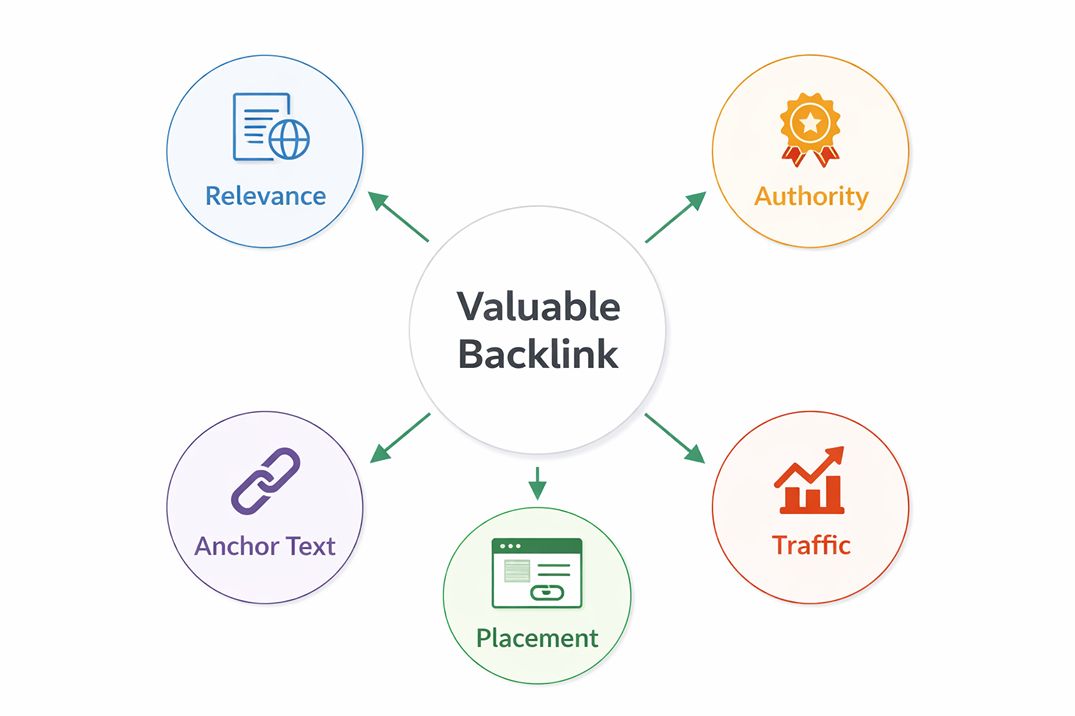
What Google Is Actually Evaluating
Google treats backlinks as votes of confidence. When one website links to another, it is telling Google that the linked content is worth referencing. But Google does not count all votes equally. It evaluates how credible, relevant, and natural each vote is.
Several signals determine how much weight a backlink carries:
Topical relevance
The most consistently important factor in 2026 is relevance. A link from a site that covers the same or closely related topic as yours carries far more weight than a link from an unrelated site with high authority metrics.
A physiotherapy clinic getting a link from a sports medicine journal is highly relevant. The same clinic getting a link from a food blogger with high domain authority is not. Google uses topical context to understand whether a link represents a genuine endorsement from someone in the same field, or an artificial signal with no logical reason to exist.
Relevance also applies at the page level, not just the domain level. A link from a deeply relevant article on a trusted site is exponentially more powerful than a link from an off-topic page on that same domain.
Authority of the linking domain
Links from established, trusted websites carry more weight than links from new or low-quality sites. This reflects the original logic of PageRank: a site that itself has many credible links pointing to it is more likely to be a credible source of endorsements.
Third-party tools use metrics like Domain Authority (Moz), Domain Rating (Ahrefs), or Authority Score (Semrush) to estimate this. These are useful as rough guides, but they are not what Google uses. Google's evaluation is more nuanced and accounts for signals that third-party tools cannot measure, including user behavior data, content quality assessments, and manual spam reports. A high DA score does not guarantee link value if the site has thin content or no real audience.
Placement on the page
Where a link sits on the page affects how much value it passes. Links placed naturally within the body text of an editorial article carry the most weight. Links placed in footers, sidebars, or in a section that contains dozens of other outbound links carry significantly less. Google reads these patterns and discounts links that look like they were placed for SEO purposes rather than editorial reasons.
Anchor text
Anchor text is the clickable words that contain the link. Descriptive, relevant anchor text helps Google understand what the linked page is about. "Local SEO services in Cebu" as anchor text points to a locally relevant page about SEO. A bare URL or "click here" provides much less contextual signal.
However, anchor text that is too heavily optimized with exact-match keywords across many links is a red flag. It looks like deliberate manipulation rather than natural editorial behavior. A healthy backlink profile has varied anchor text: some branded mentions, some descriptive phrases, some bare URLs, and only occasional keyword-matched anchors.
The real audience of the linking site
A link from a site with real readers who visit and engage with its content is more valuable than a link from a technically high-authority site that nobody actually visits. Some sites inflate their domain metrics through bulk low-quality links while having virtually no organic traffic or human readers.
The practical test for this is simple: does the linking site have actual content, real engagement, and traffic that suggests people find it useful? If the answer is yes, the link is likely to be meaningful. If the site looks like it exists primarily to sell links or publish content for SEO purposes, the link is unlikely to help.
Dofollow versus Nofollow: What Actually Matters
Every link is either dofollow or nofollow. The distinction is worth understanding because it directly determines whether a link passes ranking authority.
A dofollow link passes PageRank from the linking page to the linked page. This is the type that directly influences rankings. When you earn an editorial link from an industry blog, news article, or resource page, it is typically dofollow by default.
A nofollow link includes an HTML attribute that instructs Google not to pass ranking signals. Most links added by site owners to control their outbound link profile — including links in comments, sponsored content, and user-generated content — are nofollow.
Nofollow links are not worthless. They bring referral traffic, increase brand visibility, and contribute to a natural-looking link profile. A backlink profile made up exclusively of dofollow links from high-authority editorial sources is also slightly suspicious — real sites naturally attract a mix of both. But for ranking impact, dofollow links from relevant, credible sources are what you are building toward.
Link Patterns That Create Risk
Understanding what to avoid is as important as understanding what to pursue. Google's SpamBrain and AI-driven algorithms are significantly better at detecting manipulative link patterns in 2026 than they were even two years ago. The following patterns are the most consistently risky.
Buying links
Paying for backlinks violates Google's spam policies. The risk is not theoretical. One documented case involved a business that spent significant money on over 200 links from private blog networks in three months. Google's spam detection flagged the pattern, applied a manual penalty, and the site spent eight months recovering while rebuilding authority from scratch.
The margin for error here is slim. Google's systems are trained to distinguish between genuine editorial endorsements and manufactured ones, and the consequences of a manual action affect the entire domain, not just individual pages.
Private blog networks (PBNs)
A private blog network is a group of websites built specifically to provide backlinks to a target site. They often look legitimate on the surface — real content, real domain names — but exist solely for link manipulation. When Google identifies a PBN, every site linked from it faces penalties. The risk extends beyond the links themselves to the domain's overall trust standing.
Link velocity spikes
Acquiring a large number of links in a short period, especially from the same group of domains, looks unnatural. Natural link growth is gradual and comes from diverse sources. A sudden spike tells Google that links were purchased, manufactured, or acquired through a scheme rather than earned organically.
Irrelevant directory bulk submissions
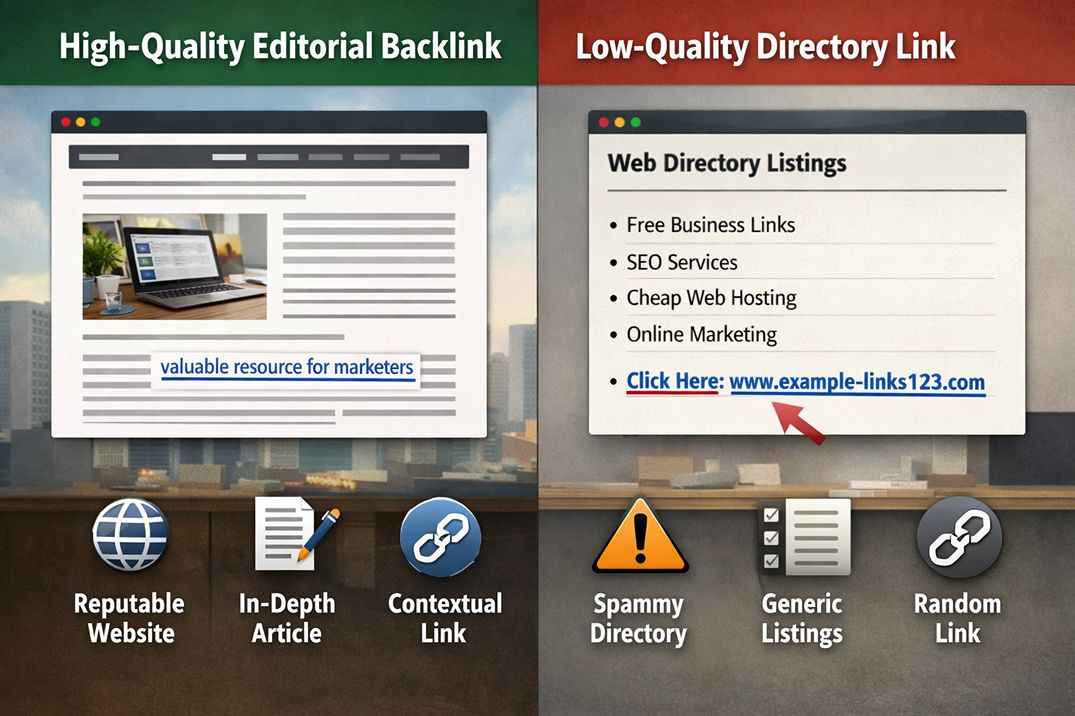
Submitting your site to hundreds of generic directories through bulk submission services generates links that are at best ignored and at worst harmful. Legitimate directories — Google Business Profile, industry-specific platforms, local business directories — are valuable. Random directories with no topical relevance and no real audience are not.
Link Types That Consistently Deliver Value
The most durable and effective links share one characteristic: they exist because the linking site considers your content worth referencing for its own readers, not because you paid or arranged for the link to exist.
Editorial links from relevant publications
The highest-value category. These are links placed naturally within content on websites that cover your industry or topic area. They come from journalists citing your data, bloggers referencing your content, or industry publications linking to your resources.
Earning them requires creating content that gives someone a genuine reason to reference you. Original research, data studies, tools, or comprehensive guides that answer questions other sites want to point their readers toward are the most reliable triggers for editorial links.
Strategic guest contributions
Writing original, expert content for relevant publications in exchange for an author link remains effective when done correctly. The key distinction is quality and selectivity. A genuine expert contributing a well-researched article to a reputable industry site that has real readers is valuable. Bulk guest posting on networks of low-quality sites that publish anything from anyone is the version that triggers algorithmic filtering.
The question to ask before any guest contribution: does this site have a real audience that would benefit from this article? If yes, the link has value. If the site appears to exist primarily for SEO link exchanges, it does not.
Broken link building
This involves finding pages on relevant, high-authority sites that link to content which no longer exists (returning a 404 error), creating content on your site that covers the same topic, and reaching out to the webmaster to suggest replacing the broken link with yours. It works because you are solving a genuine problem for the webmaster while earning a relevant contextual link in the process.
Unlinked brand mentions
When a site mentions your business name or content without linking to you, that is an unlinked mention. Reaching out to ask for the link to be added is one of the highest-conversion outreach tactics available because the site already considers your brand worth referencing — the link is a natural extension of the mention that already exists.
What Local Businesses Should Prioritize
For businesses serving a local market, the link building priorities are somewhat different from those of a national or international site. The goal is to build topical and geographic authority simultaneously.
Local citations
A local citation is any online mention of your business name, address, and phone number (NAP) — with or without a hyperlink. Citations from reputable local and industry directories reinforce geographic relevance signals that support Local Pack rankings.
The most valuable citation sources are Google Business Profile (which is the foundation), followed by industry-specific directories relevant to your category, then general local business directories for your region. Quality and consistency across sources matters more than volume.
The connection between citations and local search visibility is covered in more detail in the article on how Google's Local Pack works in 2026, which explains exactly how NAP consistency and citation signals factor into local rankings.
Local news and community publications
Links from local news sites, business association websites, and community publications are particularly valuable for local businesses because they combine geographic relevance with editorial credibility. Being featured in a local newspaper's business section or having a local chamber of commerce link to your site sends a clear signal about your physical presence and community standing.
Sponsoring local events, contributing to community initiatives, and participating in local business networks are practical paths to this type of coverage — and unlike many link building tactics, they have direct business development value independent of the SEO benefit.
Complementary business partnerships
Businesses that serve overlapping audiences without directly competing can build genuine, mutually beneficial referral relationships. A physiotherapy clinic and a sports equipment shop serve overlapping audiences. A web designer and an SEO specialist serve overlapping audiences. Linking to each other's sites in genuinely relevant contexts — a resources page, a blog post recommendation, a service FAQ — creates links that are both contextually logical and locally relevant.
Backlinks as an Amplifier, Not a Substitute
One of the most important reframes for understanding backlinks in 2026 is that they are an amplifier, not a shortcut.
Strong links can strengthen good content and push well-optimized pages from position five to position two. They rarely rescue weak content for long. If the page being linked to has a search intent mismatch, poor technical performance, or thin content, backlinks alone will not build durable rankings. The underlying page quality determines the ceiling that backlinks can push you toward.
This is why the most effective sequence for most businesses is to get the technical foundation right and the on-page factors aligned first, then pursue links to pages that already show signs of ranking traction. Building links to pages that are not yet ready tends to produce slower and less predictable results.
A proper SEO audit identifies the technical and on-page gaps that limit how much link equity your current pages can actually leverage — so that when you do invest in link building, it compounds against a solid foundation rather than compensating for problems that should have been fixed first.
How to Check Your Current Backlink Profile
Before building new links, it is worth understanding what your current profile looks like. Google Search Console shows you the domains linking to your site under the Links report. For more detail on individual link quality, Ahrefs, Semrush, or Moz provide backlink audit tools that surface referring domains, anchor text distribution, and potential risk indicators.
When reviewing your profile, look for:
- The diversity of referring domains — links from many different sites carry more weight than many links from the same domain
- The topical relevance of your linking sites — are most links coming from sites in or adjacent to your industry?
- Anchor text distribution — a healthy profile has varied anchors, not a heavy concentration of exact-match keyword anchors
- Any links from obviously spammy or unrelated sources that could be creating risk
Most sites accumulate some low-quality links over time without any deliberate action — competitors attempting negative SEO, automated bots, or historical link building campaigns from previous owners. A small number of poor-quality links is normal and does not typically require action. The concern is a high concentration of manipulative-looking links, especially if they coincide with a traffic drop following a Google core update.
When a backlink audit reveals that your site's link profile has gaps relative to competitors ranking above you, that gap is a prioritized input for a link building strategy — not a reason to acquire links indiscriminately, but a map of where targeted, quality link acquisition would produce the most ranking movement.
Frequently Asked Questions
Are backlinks still a ranking factor in 2026?
Yes. Google has consistently confirmed that backlinks are among its top three ranking signals, alongside content quality and RankBrain. A Backlinko study of 11.8 million search results found that the number one ranking page on Google has an average of 3.8 times more backlinks than pages in positions two through ten. What has changed is how critically quality and relevance are weighted compared to raw quantity.
What is the difference between a dofollow and nofollow backlink?
A dofollow backlink passes ranking authority from the linking page to your page. This is the type that directly influences Google rankings. A nofollow backlink includes an HTML attribute that tells Google not to pass ranking signals. Nofollow links still provide referral traffic and brand visibility but do not directly boost rankings. Most links in editorial articles are dofollow by default.
How do I know if a backlink is toxic?
Warning signs include links from sites with no real audience or traffic, links from sites completely unrelated to your industry, links placed in footers or sidebars alongside hundreds of other outbound links, and links acquired through bulk outreach packages or link farms. Tools like Google Search Console, Ahrefs, and Semrush can surface your current backlink profile for review. Not every imperfect link is toxic — patterns matter more than individual links.
Is buying backlinks safe in 2026?
No. Paying for links violates Google's spam policies and risks manual penalties, algorithmic filtering, and ranking losses that can take months to recover from. One documented case involved a business that received a manual penalty after acquiring 200-plus links from private blog networks in three months, and spent eight months in recovery. The risk-reward ratio for paid links is consistently unfavorable compared to earning links through content and outreach.
How many backlinks does a small business need to rank?
There is no universal number. The quantity needed depends on how competitive your target keywords are and how strong the backlink profiles of the pages currently ranking for those terms are. In low-competition local markets, a handful of relevant, high-quality links from local sources can be enough. In competitive national or international markets, the bar is higher. Quality and topical relevance consistently matter more than raw count.
What link building strategies work for local businesses in 2026?
The most effective strategies for local businesses are: getting listed in reputable local and industry-specific directories, earning mentions in local news or business publications, partnering with complementary local businesses for mutual referrals, and sponsoring local events or community organizations that link back to your site. Local citations reinforcing consistent NAP data also support local authority, even when they are nofollow.
Do backlinks affect AI Overview citations?
Yes, indirectly. Google's AI Overviews draw from sources it considers authoritative and trustworthy for a given topic. Backlinks from credible, relevant domains are one of the signals that establish that trust. Sites with stronger backlink profiles from topically relevant sources are more likely to be cited in AI-generated summaries. Brand mentions, even without a hyperlink, also contribute to entity authority that AI systems use to evaluate source credibility.
Want to know where your backlink profile stands relative to your competitors?
A link audit identifies your current profile's gaps, risk indicators, and the highest-value opportunities for building authority in your specific market.
Start a ProjectWritten by
Illan Lebumfacil
SEO Freelancer at Search Engine Hub, based in Talisay, Cebu. Helping businesses in the Philippines and internationally improve their search visibility through precise, data-driven strategies.
About me →