A page can include every keyword your SEO tool recommended and still rank on page three. A competitor with fewer keyword mentions can sit at position one. The difference, in most cases, is search intent.
Search intent is the reason behind a query. Not what someone typed, but what they were actually trying to accomplish. Google's ranking systems have spent years getting better at detecting this distinction, and in 2026 they are better at it than ever.
Semrush's 2024 ranking factors study identified text relevance, specifically how completely content satisfies search intent, as the top ranking factor in Google, ahead of backlinks and technical signals. Ahrefs' study of approximately 14 billion web pages found that 96.55% receive zero organic traffic, with search intent mismatch identified as one of the three primary root causes.
This article explains what the four intent types are, how to identify the intent behind any keyword, what happens when intent is mismatched, and how to apply this to your own pages.
The Four Types of Search Intent
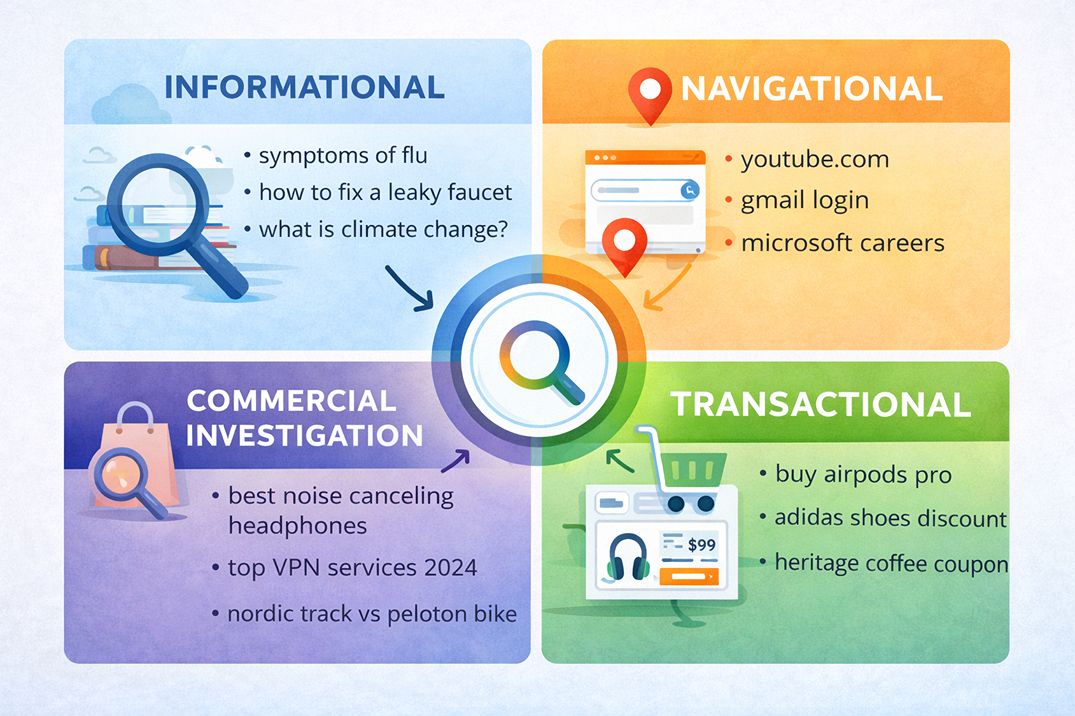
Google classifies the purpose behind a search into four broad categories. Understanding which one applies to your target keyword is the first decision you need to make before writing or optimizing any page.
Informational intent
The searcher wants to learn something. They are not ready to buy and are not looking for a specific website. They have a question and want an answer.
Example queries: "how does local SEO work," "what is a canonical tag," "why is my website not showing on Google."
Informational intent is the largest single category, accounting for approximately 52% of all Google searches. It is also the intent type most frequently triggered by AI Overviews. Pages targeting informational queries need to answer the question directly, clearly, and with enough depth to satisfy the reader without sending them back to Google to continue researching.
The right format for informational intent is usually a guide, an explainer, or a how-to article. Promotional language does not belong here. A reader who searched "how does local SEO work" is learning, not shopping. Hitting them with a pitch before they understand the topic damages trust and increases bounce rate.
Navigational intent
The searcher already knows where they want to go. They are using Google as a shortcut to reach a specific website or page rather than typing the full URL.
Example queries: "Google Search Console login," "Ahrefs keyword tool," "Search Engine Hub contact."
Navigational queries are typically brand or product specific. For most content strategies, navigational intent is not a primary focus unless you are optimizing your own branded terms. The key point is that targeting navigational queries for other brands rarely produces traffic or value because the searcher has already decided where they are going.
Commercial investigation intent
The searcher is comparing options. They know they want something but have not decided yet. They are gathering information to make a decision.
Example queries: "best SEO tools for small business," "SEO freelancer vs SEO agency," "Semrush vs Ahrefs," "local SEO services Philippines."
Commercial investigation intent is one of the highest-value categories for service businesses. The person is close to a buying decision and is actively evaluating their options. Content targeting these queries should help them compare, provide honest assessments, and make a clear case for why one option fits their needs.
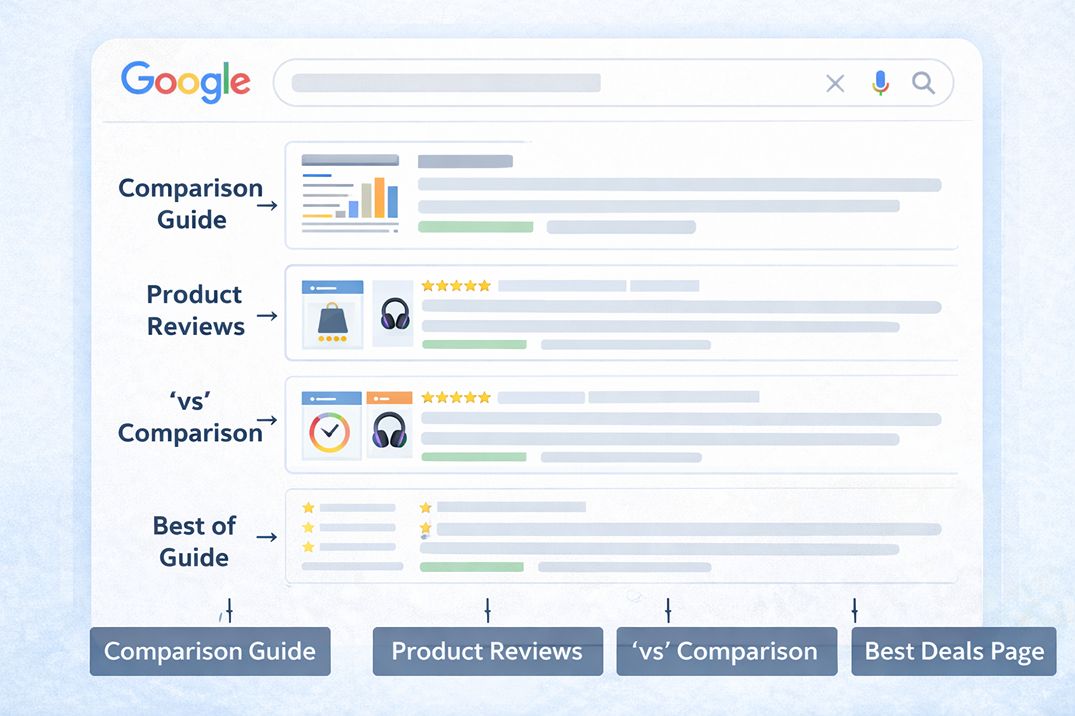
The right format here is comparison guides, review articles, or case-study-backed service pages. Thin promotional pages rarely rank for commercial investigation queries because Google can see from engagement data that users are not finding what they need on them.
Transactional intent
The searcher is ready to act. They want to buy, sign up, download, or contact someone. The decision has been made and they need the path to be clear and friction-free.
Example queries: "hire SEO freelancer Cebu," "buy SEO audit," "contact local SEO specialist Philippines."
Transactional intent pages need to be built differently from informational or commercial pages. They need trust signals such as reviews and credentials, clear service or pricing information, and a direct call to action. Long educational introductions slow transactional pages down and cost conversions. The visitor already knows what they want. Your job is to make it easy to get it.
How Google Detects Intent
Google does not simply look at the words in a query. It looks at the pattern of behavior across millions of searches for that query to understand what searchers collectively want.
When someone searches a keyword and then clicks on a result, stays on the page, and does not return to Google, that signals the page satisfied the intent. When someone clicks, immediately returns to Google, and clicks another result instead, that is a signal called pogo-sticking. It tells Google that the first page did not match what the searcher was looking for.
Over time, Google builds a statistical model of what a good result looks like for each query based on this behavioral data. This is why the top results for a given keyword share so many structural similarities. They have all passed the intent test consistently enough to earn their position.
In 2026, Google's AI systems interpret intent with significantly more precision than a few years ago. The search engine now evaluates context, decision stage, and expected outcome, not just broad intent category labels. A query like "SEO for a new bakery in Cebu" carries implicit local, informational, and commercial signals simultaneously. Pages that address all of those dimensions outperform pages that match only one.
How to Identify the Intent Behind Any Keyword
The most reliable method requires no tool. Search your keyword in an incognito browser window and read the top five results carefully.
Look for three things in the results:
- What type of page is ranking? A blog post, a product page, a comparison guide, a tool, a video, a local listing?
- What format are most results using? How-to steps, a list, a definition, a case study, a table?
- What angle are they taking? Beginner-friendly, expert-level, for a specific industry, updated for a current year?
If eight out of ten results are how-to guides, Google is rewarding informational intent for that keyword. If most results are comparison pages with pricing tables, it is commercial investigation intent. Your page needs to follow the same pattern, not because Google penalizes originality, but because that pattern reflects what searchers at that stage actually find useful.
The "People Also Ask" section in search results is a direct window into related intent. Every question listed there represents something searchers want answered in connection with the main query. Covering those questions in your content broadens its relevance to the same intent without creating separate pages.
What Intent Mismatch Looks Like in Practice
Intent mismatch is when your page does not deliver what the searcher expected based on their query. It is one of the most common and most underdiagnosed causes of ranking failure.
Here are three real patterns that cause it:
Selling when the searcher is still learning
A plumbing business writes a page targeting "how to fix a leaky faucet." The page has a brief introduction, then pivots immediately into promoting their services. The searcher wanted instructions. They hit a sales pitch. They leave within seconds.
Google reads this pattern across thousands of visits. The page gets suppressed in favor of results that actually answer the question.
The fix is not to stop having a service page. It is to keep the informational page genuinely informational, and then use a contextual internal link to guide the reader toward the service page once they have found the answer they were looking for. That internal link from an informational page to a transactional one is more effective than trying to serve both intents on a single page.
Using a guide format for a query that wants a product page
A business targets "buy SEO audit" with a long educational article about what SEO audits involve. The searcher typed "buy" in the query. They are ready to purchase. The article sends them back to Google to find someone who will just let them book an audit directly.
Transactional queries need transactional pages: clear pricing or starting price, what is included, who the service is for, and a direct call to action. Educational content belongs on a separate page linked from this one, not embedded within it.
Targeting a keyword whose intent has shifted
This is called search intent drift, and it is responsible for a significant portion of the gradual ranking declines that teams blame on algorithm updates or backlink changes.
A keyword that was primarily informational in 2022 may now trigger commercial investigation results because searcher behavior has evolved. The topic has matured. More people searching it now are comparing options rather than learning the basics. A page built for the old intent does not match what Google now sees as the dominant expectation for that query.
The signal to check for intent drift is simple: search your keyword in incognito mode and compare what is ranking now against what your page does. If the top results look fundamentally different from your page in format, depth, or angle, intent drift has likely occurred.
Intent and Format: Why Structure Is Not Decorative
Once you know the intent type, the format of your page is not a design choice. It is a signal to both the reader and to Google about what kind of page this is.
Informational intent pages that lead with the answer, use clear H2 and H3 subheadings to organize subtopics, and include examples perform better than informational pages that bury the answer in a long introduction. This is not just a usability improvement. It is an intent alignment signal. Google's AI systems and AI Overviews extract content at the section level. Pages structured to answer questions directly are more likely to be cited.
Commercial investigation pages that include comparison tables, specific pricing ranges, and honest assessments of trade-offs perform better than commercial pages built around vague promotional language. The searcher is in evaluation mode. Giving them the information they need to evaluate is what satisfies their intent.
Transactional pages that minimize friction, include social proof close to the call to action, and make the next step unambiguous convert better and earn stronger behavioral signals than transactional pages padded with content that slows the path to action.
If you want to see how your current pages are performing against intent, checking which pages have high impressions but low click-through rates in Google Search Console is a strong starting signal. High impressions mean the page is being shown. Low clicks often mean the title and description are promising a different intent than the page delivers.
The detailed process for improving those signals at the page level is covered in the on-page SEO service at Search Engine Hub, which includes reviewing keyword-to-intent alignment across every page we optimize.
Intent Alignment Across a Site, Not Just a Page
Search intent does not just apply to individual pages. It shapes how an entire site should be structured.
The most effective approach is a topic cluster model: one authoritative page targeting a commercial or transactional intent, supported by a network of informational pages that answer every related question a potential customer might have during their research phase.
This works because the informational pages capture searchers earlier in their journey, build topical authority for the main topic, and create natural internal link paths toward the commercial or transactional page. A potential client who finds your informational content helpful is far more likely to trust you with their business than one who encounters only promotional content.
The keyword choices that feed into this structure are not arbitrary. Selecting the right keywords at each intent stage is what makes the system work. This connects directly to the article on long-tail keywords for local businesses, which explains how to identify the specific queries your local audience is using at each stage of their decision process.
For businesses that also depend on local search visibility, intent alignment has an additional dimension. Someone searching "SEO specialist near me" has very different intent from someone searching "what does an SEO specialist do." How your local pages are structured relative to those two intent types affects both your organic rankings and your placement in the Google Local Pack, where intent signals from your Google Business Profile content also play a role.
How to Audit Your Existing Pages for Intent Alignment
You do not need a paid tool to run a basic intent audit on your own site. Here is the process:
- Open Google Search Console and go to the Performance report. Filter by page and look at which queries each page is appearing for.
- For your most important pages, check the average position and compare it with click-through rate. A page at position 4 with a 1% CTR often signals a title or meta description that is misrepresenting what the page delivers.
- For pages ranking but not converting, check your analytics for average session duration and bounce rate. Short sessions with high bounce on pages you want to convert signal an intent mismatch.
- For each page with a problem, search its primary keyword in incognito mode and compare what is ranking against what your page does. Note the format, depth, and angle differences.
- Update the page to align with the dominant format and angle in the top results. This is often more effective than adding more content or building more links.
Intent audits are most valuable when done before any new content is created and when reviewing pages that have been declining in ranking over the previous six months without an obvious technical explanation.
Frequently Asked Questions
What is search intent in SEO?
Search intent is the underlying reason behind a search query. It is the goal the person is trying to accomplish when they type something into Google. There are four main types: informational (learning something), navigational (finding a specific site), commercial (researching before buying), and transactional (ready to take an action or purchase). Google uses intent to decide which pages best answer a given query.
Why does search intent matter more than keywords?
Keywords tell you what someone searched. Intent tells you why. Google's ranking systems now evaluate whether your page satisfies the underlying goal behind a query, not just whether it contains the right words. A page with the keyword present but the wrong format, depth, or angle will consistently underperform a page that fully satisfies what the searcher was actually trying to accomplish.
How do I find the search intent for a keyword?
The most reliable method is to search your keyword in an incognito browser window and read the top five results. Look at what type of page is ranking, what format is being used, and what angle the content takes. If eight out of ten results are how-to guides, Google is rewarding informational intent. Your page should follow the same pattern.
What is an intent mismatch?
An intent mismatch occurs when your page does not deliver what the searcher expected based on their query. A common example is targeting the keyword "how to fix a leaky faucet" with a page that is a sales pitch for plumbing services. The searcher wanted instructions. Google reads high bounce rates and short session times as signals that the page failed, and rewards competitors whose content matches what the person was actually looking for.
What is search intent drift?
Search intent drift is when the dominant intent behind a keyword shifts over time while your content stays the same. A page that ranked well in 2022 may have lost position not because of a technical problem or backlink drop, but because what searchers now expect for that query has changed. This is a common reason older content gradually loses rankings without any obvious cause.
Can one page target multiple search intents?
Rarely, and usually poorly. A page that tries to serve both informational and transactional intent on the same URL tends to do neither well. The standard approach is one primary intent per page, with internal links connecting pages that serve different intents. A blog post answering an informational query links to a service page for the visitor ready to hire.
How does search intent affect on-page SEO?
Intent determines nearly every on-page decision: the page format, heading structure, content depth, tone, and call to action. An informational page needs clear explanations and educational language. A transactional page needs trust signals, clear scope of service, and a strong call to action. Getting these wrong, even with technically correct SEO elements, produces a page that ranks poorly and converts nobody.
Want your pages optimized for the right intent from the start?
On-page SEO at Search Engine Hub starts with intent analysis before touching a single heading or meta tag. Every page is built to match what Google is already rewarding for that query.
Learn MoreWritten by
Illan Lebumfacil
SEO Freelancer at Search Engine Hub, based in Talisay, Cebu. Helping businesses in the Philippines and internationally improve their search visibility through precise, data-driven strategies.
About me →