Search landscape
Separate broad Sydney demand from suburb, regional, service, product, and informational searches with different result types.
Technical, local, content, on-page, and outreach support for businesses targeting Sydney and Greater Sydney. Strategy follows the real customer footprint, competitive search results, and business model instead of generating generic suburb pages.
Sydney is not one uniform search market. The useful scope depends on whether customers visit a location, the business travels to them, several branches operate independently, or the website serves a wider non-local audience.
Separate broad Sydney demand from suburb, regional, service, product, and informational searches with different result types.
Review eligible Google Business Profiles, real locations, service areas, reviews, citations, and pages that support nearby customers.
Address crawling, indexing, rendering, performance, structured data, duplication, and architecture before expanding the site.
Map services, locations, categories, and supporting topics without making users or search engines navigate repetitive pages.
Create or improve pages with clear local and commercial value, strong internal links, and a defined role in the customer journey.
Assess existing authority and pursue relevant editorial opportunities with documented prospecting rather than guaranteed placements.
Targeting is selected from the actual customer footprint, search demand, physical locations, and ability to provide useful regional information.
These are planning examples, not a claim that every campaign should create a page or Google profile for every region.
The website and local search plan should match how the business operates. This avoids thin suburb pages, ineligible map listings, and content that competes with itself.
Build around the real location, priority services, nearby relevance, reviews, and a complete Google Business Profile where eligible.
Define the real travel boundary and use regional or service pages only when they add distinct information for prospective customers.
Give genuine branches distinct location information, eligible profiles, ownership, local proof, and a structure that prevents duplication.
Prioritise organic service, category, product, or editorial searches when proximity and map visibility are not the main acquisition path.
This anonymised Google Search Console account shows organic clicks and impressions from Australia over a 16-month period. It supports experience working with Australian search performance, but it is not a forecast for a Sydney website.
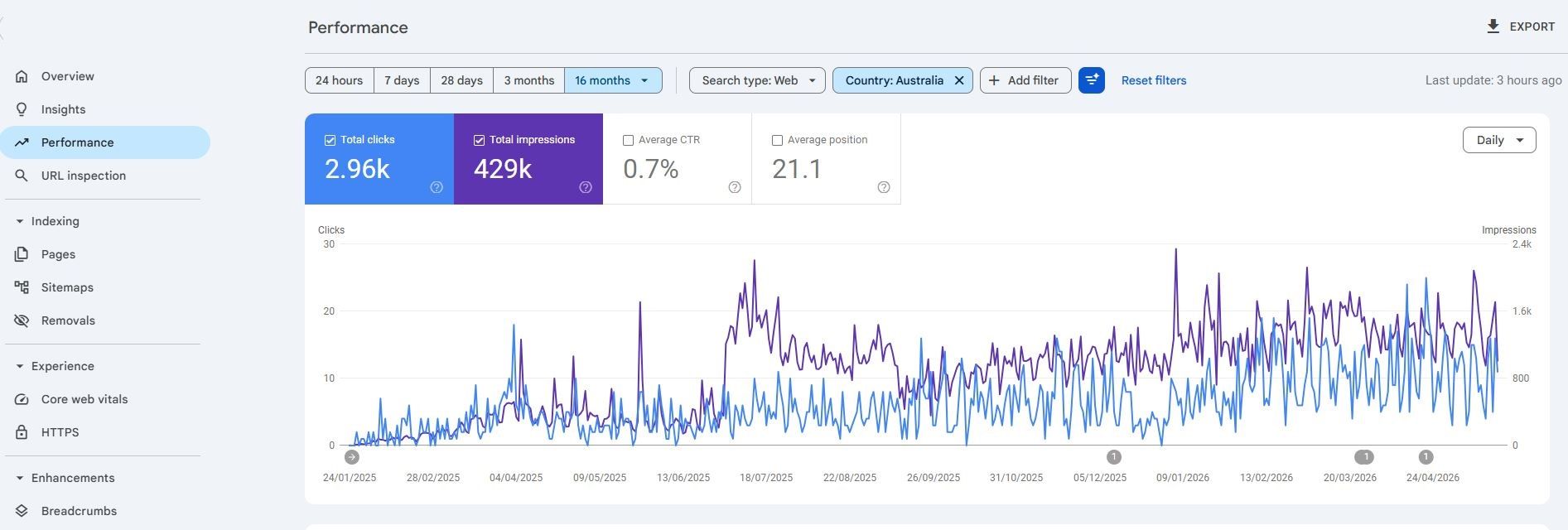
The plan begins with business reality and search evidence, then prioritises the smallest useful set of technical, content, local, and authority work.
Document real locations, service boundaries, customer travel patterns, priority services, and where enquiries can be fulfilled.
Compare broad Sydney, regional, suburb, service, product, and informational demand with the results already visible.
Choose the pages, profiles, technical work, content, tracking, and implementation ownership needed for the agreed opportunity.
Work is prioritised by impact and effort, then reviewed against Search Console, analytics, rankings, enquiries, and completed implementation.
A Sydney quote begins with the number of genuine locations, the query groups worth pursuing, and the gap between the site and the pages already competing. That prevents a single-city business from paying for an unnecessary metro-wide build.
Technical remediation, new content, local profile work, and outreach are costed according to who will implement them. The proposal shows the AUD fee and division of responsibility before work begins.
Read the Full Pricing GuideHow collaboration, access, measurement, and expectations work once the market direction is clear.
Routine updates can move through email or shared documents, with calls scheduled during agreed AEST or AEDT overlap.
The communication cadence is confirmed in the proposal so decisions do not depend on constant meetings.
Organic visibility can cover a wide market when the website has relevant pages and authority.
Local Pack visibility is more affected by proximity and the business location, so no provider can honestly guarantee map rankings across every Sydney suburb.
Yes. Tasks can be assigned to the person best placed to complete them.
Recommendations include the finding, priority, purpose, and implementation notes so an internal developer, writer, or marketing team can act on them.
Measurement is agreed around the campaign goal and may include qualified organic enquiries, Search Console clicks, priority query groups, landing-page engagement, local actions, and completed implementation.
Broad traffic alone is not treated as success.
Implementation can begin quickly, but search systems and customers need time to respond to the changes.
The useful review window depends on the query group, competitive gap, crawl frequency, release pace, and whether authority work is required.
Access depends on scope. A typical campaign may require Google Search Console, analytics, the content management system, Google Business Profile, and existing reporting or keyword documents.
Access is requested only when it is needed for the agreed work.
Share the website, locations, services, and customer footprint. I will recommend an audit, local SEO scope, or broader campaign without promising a specific ranking.